
By myringsizecalculator.com · Updated January 2026 · 15 min read
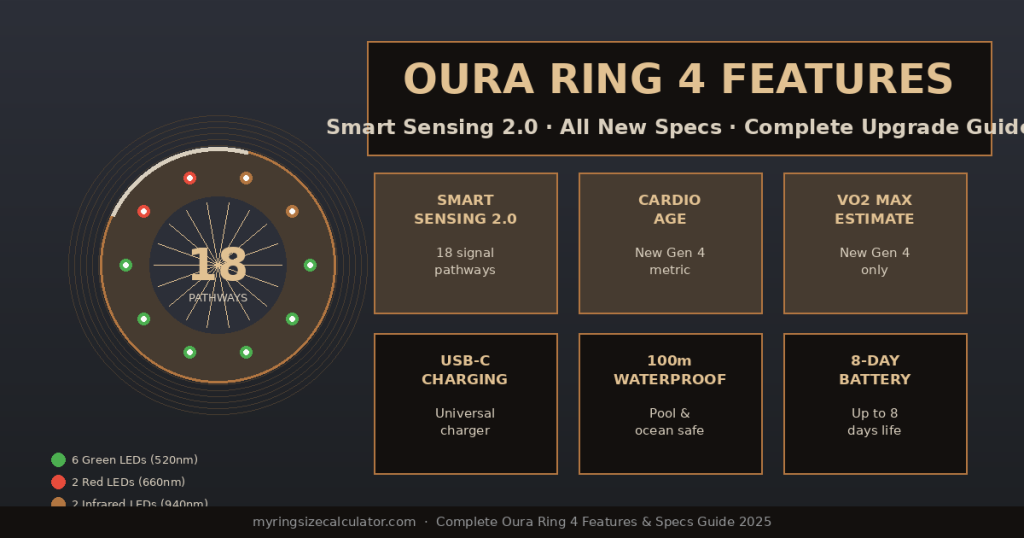
Oura Ring Gen 4 — 10 LEDs, 18 signal pathways, and the biggest sensor upgrade since the original ring.
| ⚡ Quick Answer: What Are the New Features in Oura Ring 4? The Oura Ring Gen 4 (released October 2024) introduced Smart Sensing 2.0 — a complete sensor redesign moving from 6 to 18 signal pathways and from 4 to 10 LEDs. New Gen 4 exclusive features include Cardiovascular Age, VO2 Max estimate, improved skin tone accuracy for all Fitzpatrick classifications, and a USB-C charging dock. It ships in Heritage and Horizon designs across six colour finishes in sizes 6–13. |
1. Oura Ring 4: Overview & Release Timeline
The Oura Ring Gen 4 is the fourth-generation smart health ring produced by Oura Health, a Finnish health technology company. It was officially announced and released on 15 October 2024, succeeding the Gen 3 which launched in November 2021. The Gen 4 represents the most significant sensor hardware upgrade in Oura’s history, with particular emphasis on measurement accuracy across diverse skin tones — a documented weakness of the Gen 3 that attracted significant criticism following independent audits in 2022–2023.
Oura Health was founded in 2013 in Oulu, Finland, and has grown to become the world’s leading smart ring health company, with over 2.5 million rings shipped globally and backing from investors including the NBA, Marc Benioff, and Peter Thiel’s Founders Fund. The company achieved profitability in 2024 before the Gen 4 launch.
Background: When Was the Oura Ring 4 Released? (Full Timeline) | Oura Ring Generations Hub | Wikipedia: Oura Health
2. Smart Sensing 2.0: The Core Upgrade Explained
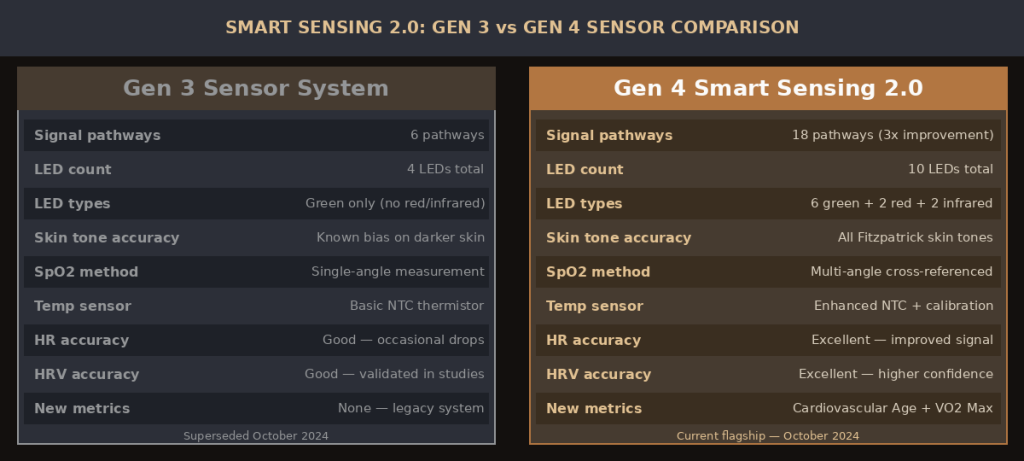
Gen 3 vs. Gen 4: how Smart Sensing 2.0’s 18-pathway system compares to the previous 6-pathway design.
Smart Sensing 2.0 is the name Oura gives to the Gen 4’s completely redesigned optical biosensor system. It is not a marketing rebrand of the same hardware — it is a ground-up redesign of the LED array, photodetector configuration, and signal processing algorithms.
What Changed: From 6 to 18 Signal Pathways
A signal pathway in photoplethysmography (PPG) refers to a single LED-to-detector pair that captures one stream of optical data. The Gen 3 used 6 such pathways. The Gen 4 uses 18, achieved by increasing the LED count from 4 to 10 and multiplying the detector configurations.
The benefit is not simply ‘more data’ — it is better data through geometric redundancy. Human skin is optically non-uniform: blood vessels run at different depths, the fingertip has different vascularity than the finger base, and melanin concentration varies across individuals. By sampling from 18 independent geometric angles simultaneously, the Gen 4 can identify and discard corrupted signal pathways in real time, weighting the clean signals more heavily in its final measurement. This is why accuracy improves on darker skin tones — the system no longer depends on any single pathway that melanin absorption might degrade.
LED Breakdown: 10 LEDs Across Three Wavelengths
| LED Type | Count | Wavelength | Primary Purpose | Gen 3 Equivalent |
| Green LEDs | 6 | 520 nm | Heart rate, HRV, blood volume pulse | 2 green LEDs |
| Red LEDs | 2 | 660 nm | SpO2 (blood oxygen) — oxyhaemoglobin | None in Gen 3 |
| Infrared LEDs | 2 | 940 nm | SpO2 — deoxyhaemoglobin reference | None in Gen 3 |
| Total | 10 | Three bands | Multi-parameter biometric sensing | 4 LEDs total |
Why Red and Infrared LEDs Matter
The Gen 3’s exclusive green LEDs were adequate for heart rate and HRV but limited for SpO2 accuracy. Accurate blood oxygen measurement requires comparing the absorption ratio of oxygenated haemoglobin (measured at 660 nm red light) against deoxygenated haemoglobin (measured at 940 nm infrared). The Gen 4’s red and infrared LEDs unlock genuinely accurate SpO2 — a meaningful improvement for overnight oxygen monitoring and sleep-disordered breathing flags.
Skin Tone Accuracy: The Real-World Impact
Independent research published in JAMA Dermatology and other journals has documented that PPG-based wearables systematically underperform on darker skin tones due to melanin’s optical absorption properties. Oura commissioned validation studies for the Gen 4 showing accuracy across all six Fitzpatrick skin type classifications — a meaningful step toward equitable health technology.
Technical deep dive: How Does the Oura Ring 4 Work? (Complete Sensor Guide) | Wikipedia: Photoplethysmography
3. Oura Ring 4 Full Specifications
| Specification | Oura Ring Gen 4 Details |
| Release date | 15 October 2024 |
| Design variants | Heritage (flat-top) · Horizon (fully rounded dome) |
| Colours | Silver · Black · Gold · Stealth (matte black) · Rose Gold · Brushed Titanium (limited) |
| Sizes | 6 through 13 — free sizing kit available at ouraring.com |
| Shell material | Grade 5 titanium (aircraft grade) |
| Coating | Diamond-like carbon (DLC) — PVD applied for Gold/Rose Gold finishes |
| Weight | 4 g (size 6) to 6 g (size 13) |
| Ring width | 7.9 mm — Heritage · 7.0 mm — Horizon |
| Ring thickness | 2.88 mm — Heritage · 2.55 mm — Horizon |
| Water resistance | 100 metres (10 ATM) — pool, ocean, hot tub safe |
| Battery life | Up to 8 days (5–6 days typical with regular syncing) |
| Charge time | ~80 minutes from 0 to 100% |
| Charger | Magnetic USB-C dock (included) — USB-A adapter also in box |
| PPG sensor | 18-pathway Smart Sensing 2.0 — 6 green + 2 red + 2 infrared LEDs |
| Accelerometer | 3-axis accelerometer + gyroscope |
| Temperature sensor | NTC infrared thermistor (skin temperature deviation) |
| Connectivity | Bluetooth Low Energy (BLE) 5.1 |
| Compatibility | iOS 16 or later · Android 11 or later |
| Storage | Up to 6 weeks of raw data stored on-ring |
| Membership | $5.99/month or $69.99/year — 1 month free with purchase |
| Price at launch | $299 (Silver/Black) · $349 (Gold/Rose Gold/Stealth) · $499+ (limited editions) |
| Warranty | 1-year limited hardware warranty |
Pricing note: Oura Ring Buying Guide — Pricing & Where to Buy | Best Oura Ring — Which Style to Choose
4. All New Features in Gen 4 vs. Gen 3
The Gen 4 introduced several features that are exclusive to the new hardware and cannot be added to Gen 3 devices via a software update. Here is a definitive comparison of what is new, improved, or unchanged.
| Feature / Metric | Gen 3 | Gen 4 | Status |
| Smart Sensing system | 6-pathway PPG | 18-pathway Smart Sensing 2.0 | UPGRADED |
| LED count | 4 LEDs | 10 LEDs | UPGRADED |
| SpO2 accuracy | Single-angle estimate | Multi-angle cross-referenced | UPGRADED |
| Skin tone accuracy | Limited (darker tones) | All Fitzpatrick types | UPGRADED |
| Cardiovascular Age | Not available | Available (Gen 4 only) | NEW |
| VO2 Max estimate | Not available | Available (Gen 4 only) | NEW |
| Charging port | USB-A magnetic dock | USB-C magnetic dock | UPGRADED |
| Battery life | 4–7 days | Up to 8 days | IMPROVED |
| Ring thickness (Heritage) | 2.55 mm | 2.88 mm | CHANGED |
| Sleep Score | Available | Available — same algorithm | UNCHANGED |
| Readiness Score | Available | Available — same algorithm | UNCHANGED |
| HRV (RMSSD) | Available | Available — improved data | IMPROVED |
| Body temperature | Available | Available — same sensor | UNCHANGED |
| Cycle Insights | Available | Available — same feature | UNCHANGED |
| Pregnancy Mode | Available | Available — same feature | UNCHANGED |
| Stress & Resilience | Available (2023 launch) | Available — same feature | UNCHANGED |
| Price | $299–$399 | $299–$349 | REDUCED |
Full upgrade analysis: Oura Ring Gen 3 vs Gen 4 vs Galaxy Ring — Complete Comparison | Oura Ring Gen 4 Review
5. Complete Health Metrics: What Does Oura Ring 4 Track?
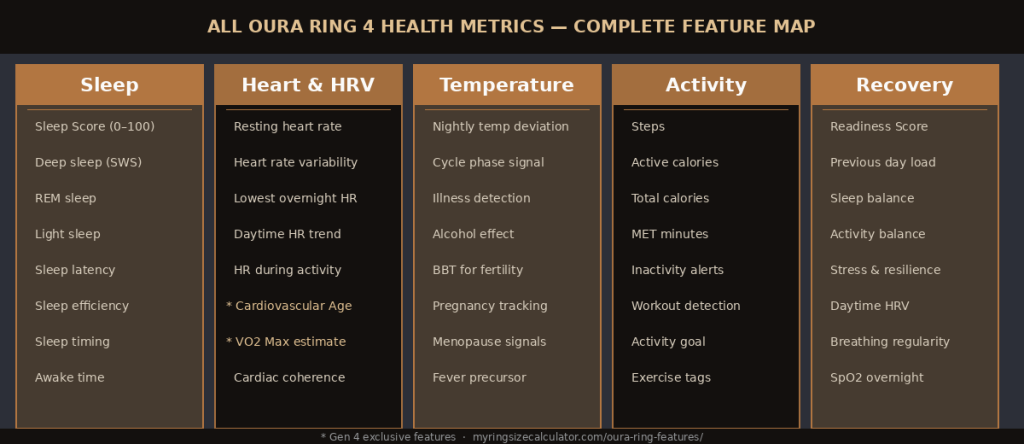
Every health metric tracked by the Oura Ring Gen 4 — organised by category. Asterisked metrics are Gen 4 exclusive.
The Oura Ring Gen 4 tracks over 30 individual health metrics, organised into five core categories. Here is a complete reference of every metric the ring measures and reports.
Complete Metric List by Category
| Category | Metric | How Measured | Availability |
| Sleep | Sleep Score (0–100) | Composite from all sleep metrics | Membership |
| Sleep | Total sleep time | Actigraphy + PPG | Membership |
| Sleep | Deep sleep (SWS) | Movement + HR pattern | Membership |
| Sleep | REM sleep | Movement + HR pattern | Membership |
| Sleep | Light sleep | Movement + HR pattern | Membership |
| Sleep | Sleep efficiency | Sleep vs. time in bed ratio | Membership |
| Sleep | Sleep latency | Time to fall asleep | Membership |
| Sleep | Sleep timing | Timing relative to ideal window | Membership |
| Heart & HRV | Resting heart rate | Overnight PPG average | Basic + Membership |
| Heart & HRV | Heart rate variability | RMSSD during lowest HR sleep period | Membership |
| Heart & HRV | Cardiovascular Age * | HRV + HR + activity model (Gen 4) | Membership |
| Heart & HRV | VO2 Max estimate * | HR + activity correlation (Gen 4) | Membership |
| Temperature | Temp deviation | NTC vs. personal baseline | Membership |
| SpO2 | Blood oxygen saturation | Red + infrared LED ratio | Membership |
| Activity | Steps | Accelerometer | Basic |
| Activity | Active calories | HR + accel model | Basic |
| Activity | Total calories | BMR + active cals | Basic |
| Activity | MET minutes | Activity intensity model | Membership |
| Activity | Inactivity alerts | Accel sedentary detection | Membership |
| Activity | Workout auto-detection | HR + accel pattern | Membership |
| Recovery | Readiness Score (0–100) | Composite HRV, HR, sleep, activity | Membership |
| Recovery | Stress & Resilience | Daytime HRV monitoring | Membership |
| Recovery | Breathing regularity | Respiratory rate variability | Membership |
| Women’s | Cycle Insights | BBT + HR + calendar | Membership |
| Women’s | Pregnancy Mode | Algorithm adjusted for pregnancy | Membership |
* Cardiovascular Age and VO2 Max estimate are Gen 4 exclusive features. They are not available on Gen 3 hardware regardless of software update.
Full features guide: Oura Ring Features & Health Tracking Hub | Benefits of the Oura Ring 4
6. Sleep Tracking Features in Depth

Sleep tracking is the feature that defines the Oura Ring’s identity and the primary reason most people purchase it. The Gen 4’s Smart Sensing 2.0 system improves the raw signal quality that feeds the sleep algorithm, producing more reliable stage detection than the Gen 3.
Sleep Score: How It’s Calculated
The Sleep Score is a 0–100 composite built from seven contributors, each weighted by the algorithm:
| Contributor | Weight | What It Measures |
| Total sleep | High | Did you get enough hours? Compares to personal optimal |
| Efficiency | High | Percentage of time in bed actually asleep (target >85%) |
| Restfulness | High | Number and duration of awakenings and movement |
| REM sleep | Medium | Percentage of sleep in REM (target ~20–25%) |
| Deep sleep | Medium | Percentage in slow-wave sleep (target ~15–23%) |
| Latency | Low–Med | How quickly you fell asleep (ideal 15–20 minutes) |
| Timing | Low | Alignment with your chronobiological sleep window |
Sleep Stage Detection: The Science
Consumer sleep rings classify sleep stages using actigraphy (movement patterns via accelerometer) combined with photoplethysmography (heart rate and HRV fluctuations). This approach does not measure brainwave activity directly — only polysomnography (PSG) in a clinical setting does that. However, a 2023 validation study published in npj Digital Medicine found the Oura Ring achieves 79% epoch-by-epoch agreement with clinical PSG for sleep stage classification — competitive with or better than most consumer wearables.
Breathing Regularity & SpO2
The Gen 4’s improved red and infrared LEDs enable more reliable overnight SpO2 measurement. The app reports average SpO2 alongside a breathing regularity score that flags nights with significant respiratory disruptions. This feature does not diagnose sleep apnea but provides meaningful signal for users who suspect sleep-disordered breathing.
Detailed guide: Can the Oura Ring Detect Sleep Apnea? | NIH: Sleep Research & Wearables
7. Heart Rate, HRV & Cardiovascular Features
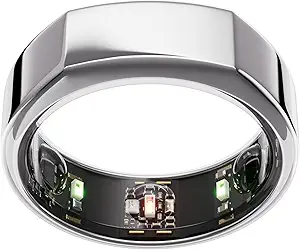
Resting Heart Rate
The Oura Ring measures resting heart rate (RHR) continuously throughout the night and reports the overnight average. This is distinct from an instantaneous reading — overnight RHR is a more stable and clinically meaningful metric because it is unaffected by activity, caffeine, or stress from earlier in the day. The Gen 4’s improved green LED array produces cleaner RHR signals, particularly during the deep sleep phases where HR is at its lowest.
Heart Rate Variability (HRV)
HRV is measured as the RMSSD (root mean square of successive differences) — a standard metric of autonomic nervous system balance. The Oura Ring captures HRV during the lowest-HR period of sleep, typically the hour before waking. This is different from wrist-based wearables that report HRV during rest or over 24-hour windows, so Oura HRV readings are not directly comparable to other devices.
Peer-reviewed validation studies in Frontiers in Physiology and the Journal of Medical Internet Research have confirmed the Oura Ring’s HRV measurements fall within clinically acceptable limits of agreement compared to ECG reference devices during sleep.
Cardiovascular Age (Gen 4 Exclusive)
Cardiovascular Age is an entirely new metric introduced with Gen 4. It estimates the biological age of your cardiovascular system — how old your heart and vascular health appear based on your biometric data — and compares it to your chronological age. A Cardiovascular Age lower than your actual age suggests good cardiovascular health; higher suggests cardiovascular stress that may warrant lifestyle intervention.
The algorithm draws on HRV trends, resting heart rate, activity level, body temperature patterns, and sleep quality. While no consumer device can replace clinical cardiovascular assessment, the metric provides a useful longitudinal benchmark as you make lifestyle changes.
VO2 Max Estimate (Gen 4 Exclusive)
VO2 Max — maximal oxygen uptake — is one of the strongest predictors of cardiovascular fitness and longevity. Clinical VO2 Max testing requires a treadmill or cycle ergometer with gas exchange measurement. The Oura Ring Gen 4 estimates VO2 Max using a heart rate and activity correlation model, producing a range estimate that is most useful for tracking trends over time rather than as an absolute clinical figure.
Does Oura Ring 4 Measure Blood Pressure?
No — the Oura Ring Gen 4 does not measure blood pressure. Blood pressure measurement requires either cuff occlusion or a validated cuffless algorithm cleared by a regulatory body such as the FDA or CE. Oura has not released such a feature as of early 2026, and no announcements have been made regarding a blood pressure feature in the current hardware.
Full explanation: Does the Oura Ring Measure Blood Pressure? | Wikipedia: Heart Rate Variability
8. Body Temperature & Wellness Features
Continuous Body Temperature Monitoring
The NTC (negative temperature coefficient) infrared thermistor on the ring’s inner surface measures skin temperature at the finger every night throughout sleep. The app reports temperature deviation — how much warmer or cooler you are compared to your personal nightly baseline — rather than absolute temperature.
This relative metric is surprisingly powerful for detecting physiological patterns. A +0.5°C deviation is not meaningful in isolation but becomes highly informative in context: it may signal the onset of illness, the luteal phase of the menstrual cycle, dehydration from alcohol, or the post-workout inflammation response.
Illness Detection
The UCSF TemPredict study, which monitored COVID-19 patients using Oura Rings in 2020–2021, found that sustained body temperature elevation of +1.0°C or more preceded confirmed positive test results by an average of 1.5 days in a significant subset of participants. While not a clinical diagnostic capability, the sensitivity of the Oura Ring’s temperature sensor to early physiological disruption has been independently validated in published research.
Stress & Resilience
Introduced in 2023 as a software feature available on Gen 3 and Gen 4, Stress & Resilience tracks daytime HRV patterns to categorise the balance between physiological stress load and recovery. The app displays a daily Resilience score (Poor, Adequate, Solid, Strong) based on how well your body is managing its total stress burden — including physical training, cognitive demands, poor sleep, and emotional stress.
Research: UCSF TemPredict Study | Wikipedia: Basal Body Temperature
9. Activity & Recovery Features
Activity Tracking
Activity tracking in the Oura Ring is designed to complement passive health monitoring rather than replace a dedicated sports tracker. The ring tracks steps, calories, active calories, MET minutes, and automatically detects workout type using accelerometer and PPG pattern matching. The daily Activity goal adapts dynamically based on your recent history and recovery status — unlike static step-count goals, this system acknowledges that optimal activity differs on recovery days versus peak performance days.
Readiness Score: The Recovery Intelligence Engine
The Readiness Score is the Oura Ring’s flagship output — a 0–100 composite score that synthesises overnight HRV, resting heart rate, body temperature deviation, sleep quality, previous day activity, and activity balance to produce a single ‘recovery readiness’ number each morning.
| Readiness Score | Meaning | Recommended Action |
| 85–100 | Optimal recovery | Push hard in training or cognitive demands |
| 70–84 | Good — recovered | Normal training load appropriate |
| 60–69 | Pay attention | Moderate intensity only — prioritise sleep tonight |
| Below 60 | Recovery needed | Rest day, gentle movement, investigate causes |
Inactivity Alerts
The Gen 4 vibrates gently to alert you when you have been sedentary for longer than the threshold set in your app preferences. This feature, often overlooked, is backed by substantial research linking prolonged sitting to cardiovascular risk independent of overall daily activity. The gentle haptic prompt is less intrusive than the persistent notification popups common in smartwatches.
Wellness benefits: Benefits of the Oura Ring 4 — All Features Reviewed | Oura Ring vs Smart Watch — Which Is Better?
10. Women’s Health Features
The Oura Ring Gen 4 offers the most comprehensive women’s health feature set available on any smart ring. These capabilities are built on the ring’s continuous body temperature and HRV data, which produce a physiological fingerprint of the hormonal cycle.
Cycle Insights
Cycle Insights uses basal body temperature deviation, resting heart rate, and HRV to model the four phases of the menstrual cycle — menstrual, follicular, ovulatory, and luteal — and predict phase transitions. It is not a diagnostic tool but a wellness feature for understanding how hormonal changes affect sleep, energy, and recovery.
Natural Cycles Integration
The Oura Ring integrates directly with Natural Cycles, the FDA-cleared digital contraception app. When connected, nightly BBT readings from the ring export automatically to Natural Cycles, which uses its clinical algorithm to generate a red (fertile) or green (non-fertile) day designation each morning. This is the only FDA-cleared digital birth control integration available on any smart ring.
Pregnancy Mode
Pregnancy Mode is a dedicated app configuration that recalibrates Oura’s baselines and scoring algorithms for the physiological changes of pregnancy. Standard Readiness and HRV scoring would produce misleading results during pregnancy — Pregnancy Mode adjusts for the normal elevated HR, reduced HRV, and sustained temperature elevation characteristic of gestation.
Complete women’s guide: Oura Ring for Women — Cycle Tracking, Pregnancy & Hormonal Health | Natural Cycles Official — FDA-Cleared Digital Contraception
11. Oura Ring App Features
The hardware sensor array is only half the product — the Oura app transforms raw biometric data into actionable health intelligence. The app is available for iOS 16+ and Android 11+ and requires an Oura membership for most features beyond basic step and heart rate tracking.
Core App Interface
The app’s home screen presents the three daily score rings — Sleep, Readiness, and Activity — in a clean dashboard. Tapping any score reveals a detailed breakdown with contributor bars, personal trend context, and plain-language insight cards that explain what the data means in practical terms without requiring the user to understand the underlying physiology.
Key App Features
- Daily Scores: Sleep, Readiness, and Activity scores with contributor breakdowns.
- Trends & Charts: multi-week and multi-month trend views for all metrics, enabling pattern recognition across cycles, seasons, and lifestyle changes.
- Tags: log alcohol, caffeine, illness, stress, exercise type, eating windows, and 30+ other lifestyle factors to correlate with your biometric data.
- Cycle Insights: menstrual cycle phase prediction and BBT visualisation.
- Stress & Resilience: daytime physiological stress monitoring with resilience rating.
- Workout tags: manual and automatic workout logging with HR and calorie data.
- Partner integrations: Apple Health, Google Fit, Natural Cycles, Dexcom CGM, Strava, and others.
- Data export: CSV download available via the Oura web dashboard for power users.
Dexcom CGM Integration
A notable Gen 4-era integration is with Dexcom’s continuous glucose monitoring (CGM) system. Users who wear a Dexcom CGM sensor can overlay blood glucose data from the Dexcom app alongside their Oura biometrics, creating a metabolic health picture that combines glucose response with sleep quality, HRV, and activity. This is particularly valuable for people with metabolic health goals or those experimenting with dietary interventions.
App deep dive: Oura Ring App — Complete Feature Guide | Dexcom Official
| ▶ Video: Oura Ring 4 Features Walkthrough — Every New Spec Explained (YouTube) Watch a complete video walkthrough of the Oura Ring Gen 4’s new Smart Sensing 2.0 system, Cardiovascular Age setup, app features, and comparison against Gen 3.Recommended YouTube searches: ‘Oura Ring 4 new features 2025’ · ‘Oura Ring Smart Sensing 2.0 explained’ · ‘Oura Ring 4 app walkthrough’Recommended channels: DC Rainmaker · The Quantified Scientist · Oura Official YouTube |
12. Design, Hardware & Build Specifications
Heritage vs. Horizon: Design Differences
| Feature | Heritage Design | Horizon Design |
| Exterior shape | Flat-top with bevelled edges | Fully rounded dome — no flat surfaces |
| Width | 7.9 mm | 7.0 mm — slightly slimmer |
| Thickness | 2.88 mm | 2.55 mm — slightly thinner |
| Best described as | Modern signet ring or luxury band | Contemporary dome ring |
| Popular with | Users wanting a design-forward look | Users wanting maximum discretion |
| Sensor system | Identical Smart Sensing 2.0 | Identical Smart Sensing 2.0 |
| Sizing | Same size numbers as Horizon | Same size numbers as Heritage |
Colour Finishes & Materials
| Finish | Material | Price Tier | Available On |
| Silver | Natural titanium polish | $299 | Heritage · Horizon |
| Black | DLC titanium coating | $299 | Heritage · Horizon |
| Gold | PVD gold over titanium | $349 | Heritage · Horizon |
| Stealth | Matte DLC titanium | $349 | Heritage only |
| Rose Gold | PVD rose gold over titanium | $349 | Horizon only |
| Brushed Titanium | Natural brushed finish | $499+ | Heritage · Horizon (limited) |
Materials guide: Is the Oura Ring Rose Gold Real? (PVD vs. Gold Plating Explained) | Oura Ring Sizing Hub — Sizes 6–13
Battery Life by Usage Pattern
| Usage Pattern | Expected Battery Life |
| Automatic tracking only (passive) | 7.5–8 days |
| Moderate daily use | 5.5–6.5 days |
| Heavy use (frequent syncs/workouts) | 4–5 days |
| Cold weather use (<5°C) | 4–5.5 days — cold reduces Li-ion capacity |
Battery test: Oura Ring 4 Battery Life — Real-World Test Results
13. What Features Are Missing from Gen 4?
Honest coverage of a product’s capabilities requires acknowledging what it cannot do. The following features are absent from the Gen 4 and, based on current hardware, cannot be added via software updates.
| Missing Feature | Why It’s Absent | Alternative |
| GPS | No GPS chip in the ring form factor | Pair with a GPS watch or phone GPS |
| Screen / display | No display on any Oura ring | Check Oura app on phone |
| Blood pressure | No cuff or validated cuffless algorithm | Dedicated BP monitor |
| ECG | No electrical cardiac sensors | Apple Watch or Kardia device |
| Notifications | No vibration alerts beyond inactivity | Phone or smartwatch |
| Real-time HR display | No ring-side display — app required | Oura app open during workout |
| Contactless payment | No NFC chip | Phone or contactless card |
| Standalone music control | No speaker, microphone, or NFC | Phone or watch |
| Blood glucose (native) | Optical glucose is not yet validated | Dexcom CGM integration available |
| Sleep apnea diagnosis | SpO2 flags risk only — not FDA-cleared diagnostic | WatchPAT or clinical PSG |
Limitations in detail: Does Oura Ring Measure Blood Pressure? | Can Oura Ring Detect Sleep Apnea? | Oura Ring Problems & Troubleshooting
14. Frequently Asked Questions
Q: What sensors does the Oura Ring 4 have?
A: The Oura Ring Gen 4 contains: (1) Smart Sensing 2.0 PPG system — 10 LEDs across three wavelengths (6 green at 520 nm, 2 red at 660 nm, 2 infrared at 940 nm) producing 18 signal pathways; (2) NTC infrared thermistor for skin temperature; (3) 3-axis accelerometer and gyroscope for movement tracking; (4) Bluetooth Low Energy 5.1 antenna. There is no ECG, GPS, barometric pressure sensor, or NFC chip.
Q: What is Smart Sensing 2.0?
A: Smart Sensing 2.0 is the name for the Gen 4’s redesigned optical biosensor system. It uses 10 LEDs across three wavelengths (green, red, infrared) to create 18 independent measurement pathways, compared to 4 LEDs and 6 pathways in the Gen 3. The additional pathways improve accuracy across all skin tones by providing geometric redundancy — the system can identify and compensate for signal degradation caused by melanin, movement, or vessel position variability.
Q: Is Cardiovascular Age available on Gen 3?
A: No. Cardiovascular Age is a Gen 4 exclusive feature. It requires the improved signal quality of the Smart Sensing 2.0 system. It cannot be enabled on Gen 3 hardware via a software update. The same applies to the VO2 Max estimate feature.
Q: Does Oura Ring 4 track blood oxygen (SpO2)?
A: Yes. The Gen 4 measures SpO2 (blood oxygen saturation) overnight using its red (660 nm) and infrared (940 nm) LEDs. The app reports average overnight SpO2 and flags dips below 95%. The Gen 3 had an SpO2 feature but with less accurate single-angle measurement — the Gen 4’s multi-angle approach is meaningfully more reliable. SpO2 monitoring can flag patterns consistent with sleep-disordered breathing but is not an FDA-cleared sleep apnea diagnostic.
Q: Does Oura Ring 4 work without the subscription?
A: The ring will pair to your phone and sync basic data without a subscription. However, without an active membership ($5.99/month or $69.99/year), you lose access to: Sleep Score, Readiness Score, HRV data, body temperature trends, SpO2 reporting, Cycle Insights, Pregnancy Mode, Stress & Resilience, Cardiovascular Age, and VO2 Max. One free month is included with every new ring purchase.
Q: How is Oura Ring 4 different from Gen 5?
A: The Oura Ring Gen 5 has not been officially announced as of early 2026. Based on the typical 3-year release cycle, it is anticipated in late 2025 or 2026. Rumoured improvements include thinner profile, enhanced SpO2, potential cuffless blood pressure, and improved workout HR. See: Oura Ring Gen 5 — Everything We Know So Far
Q: What does the Oura Ring 4 upgrade from Gen 3 include?
A: If you upgrade from Gen 3 to Gen 4, you gain: Smart Sensing 2.0 (18-pathway PPG), Cardiovascular Age, VO2 Max estimate, improved skin tone accuracy, improved SpO2 accuracy from red+infrared LEDs, and a USB-C charging dock. Your Oura membership transfers automatically — no new subscription required. Your historical data remains in your account.
Q: Is the Oura Ring 4 worth upgrading to from Gen 3?
A: For most users: yes, if accuracy matters to you. The Smart Sensing 2.0 system produces measurably better data, particularly for SpO2, skin tone equity, and HR during challenging conditions. The Cardiovascular Age metric alone provides a compelling new health insight. Full upgrade analysis: Oura Ring Gen 3 vs Gen 4 vs Galaxy Ring Comparison
Complete Resource Centre
On this site: Oura Ring Hub | Oura Ring Gen 4 Review | Oura Ring Buying Guide | Oura Ring Comparisons Hub | Oura Ring for Women | Oura Ring App Guide
Authority sources: Nature: npj Digital Medicine — Oura Validation Study | Wikipedia: Photoplethysmography | Frontiers in Physiology: HRV Wearable Research | NIH: Wearable Devices Health Research | r/ouraring Community | BBC: Smart Rings & Health Technology
| ⚤ Medical Disclaimer The information in this article is for general educational purposes only. Oura Ring Gen 4 is a consumer wellness device, not an FDA-cleared diagnostic tool except where specifically noted. Do not use wearable data to self-diagnose or self-treat any medical condition. Consult a qualified healthcare professional for any health concerns. |
| 💰 Price Disclaimer Prices mentioned are approximate averages at time of writing. Actual prices may vary by retailer, region, and promotions. Always check the official Oura website for current pricing before purchase. |