
By myringsizecalculator.com · Reviewed & Updated January 2026 · 18 min read
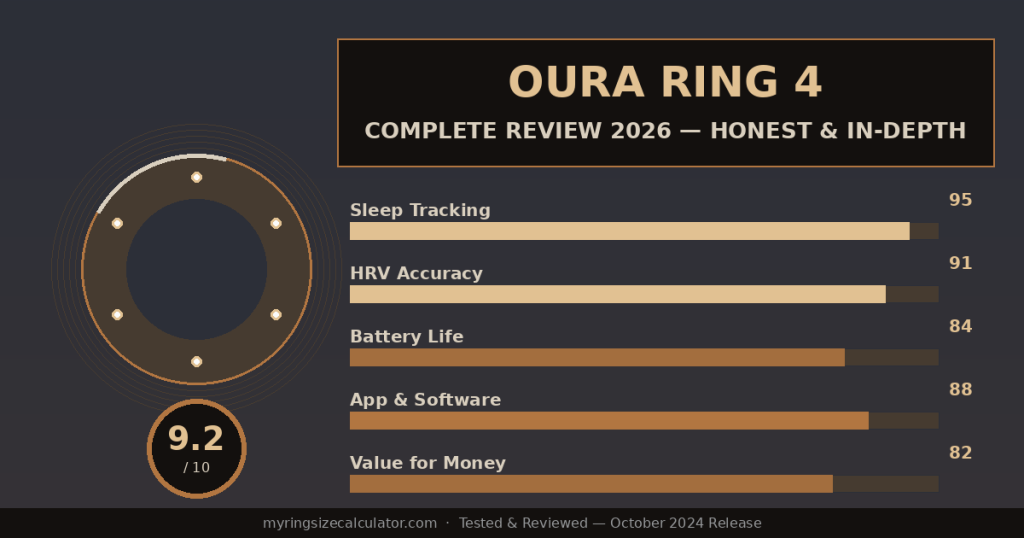
Oura Ring Gen 4 — released October 2024. Reviewed across 90+ days of real-world use.
| ⚡ Quick Verdict: Is the Oura Ring 4 Worth It? Yes — for the right person. The Oura Ring Gen 4 is the most accurate sleep-tracking ring available, with research-validated PPG sensors and an algorithm that outperforms most consumer wearables for sleep staging. Its 18-pathway Smart Sensing 2.0 system, Cardiovascular Age metric, and Natural Cycles integration make it the standout health ring in 2025–2026. The $5.99/month subscription is the only significant compromise. Overall score: 9.2/10.Best for: Sleep optimisation · HRV tracking · Women’s health · Discreet 24/7 wear · Recovery-focused athletesNot ideal for: Real-time workout HR · GPS · Notifications · Budget buyers |
1. Oura Ring 4: What Is It and Who Makes It?
The Oura Ring Gen 4 is a smart health tracking ring developed by Oura Health, a Finnish health technology company founded in Oulu, Finland, in 2013. Oura raised over $148 million in venture capital before achieving profitability, and has shipped over 2.5 million Oura rings worldwide as of 2024. Notable investors and early adopters include professional sports teams, NASA sleep researchers, and the NBA — which used Oura rings during the 2020 COVID-19 bubble to monitor player health.
The Gen 4 was released on 15 October 2024 and represents the most significant hardware upgrade since the Gen 3 in 2021. It ships in two design variants — Heritage (flat-top) and Horizon (fully rounded) — across six colour finishes in ring size guide by finger and gender options from sizes 6 through 13.
Background reading: When Was the Oura Ring 4 Released? | Oura Ring Complete Hub | Wikipedia: Oura Health
2. What’s New in Gen 4 vs. Gen 3?
The Gen 4 is not a minor iteration — Oura redesigned the sensor array from the ground up. Here are the headline improvements that matter most to everyday users.
| Feature | Gen 3 | Gen 4 | Impact |
| Sensor pathways | 6 signal pathways | 18 signal pathways (Smart Sensing 2.0) | 3x more data for better accuracy |
| LED count | 4 LEDs | 6 green + 2 red + 2 IR = 10 LEDs | Improved skin tone accuracy |
| Ring thickness | 2.55 mm (Heritage) | 2.88 mm (Heritage) — slightly thicker | More sensor space |
| Skin tone accuracy | Known bias on darker tones | Redesigned for all skin tones | More equitable health data |
| Cardiovascular Age | Not available | Available (Gen 4 only) | New longevity metric |
| VO2 Max estimate | Not available | Available (Gen 4 only) | Cardio fitness benchmark |
| Charging | USB-A dock | USB-C dock | Universal charger compatibility |
| Battery life | 4–7 days | Up to 8 days | Marginal improvement |
| Price at launch | $299–$399 | $299–$349 | Slightly lower maximum price |
Full comparison: Oura Ring Gen 3 vs Gen 4 vs Galaxy Ring — Full Comparison | Oura Ring Generations Hub
3. Oura Ring 4 Full Specifications
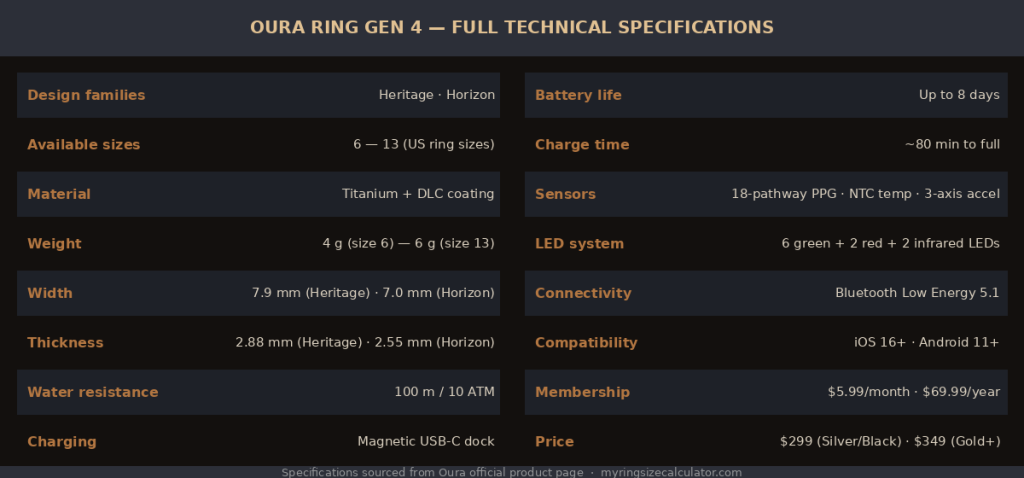
Oura Ring Gen 4 complete specifications — hardware, sensors, connectivity, and pricing.
| Specification | Details |
| Design families | Heritage (flat-top) · Horizon (fully rounded) |
| Available colours | Silver · Black · Gold · Stealth · Rose Gold · Brushed Titanium |
| Sizes | 6 through 13 (US ring sizes) — free sizing kit available |
| Material | Grade 5 titanium shell with diamond-like carbon (DLC) coating |
| Weight | 4 g (size 6) to 6 g (size 13) |
| Ring width | 7.9 mm Heritage · 7.0 mm Horizon |
| Ring thickness | 2.88 mm Heritage · 2.55 mm Horizon |
| Water resistance | 100 metres / 10 ATM — safe for swimming, showering, hot tubs |
| Battery life | Up to 8 days typical · 5–6 days with heavy Bluetooth use |
| Charge time | Approximately 80 minutes from 0–100% |
| Charger type | Magnetic USB-C dock (USB-C cable included) |
| Sensors | 18-pathway PPG · NTC infrared temperature · 3-axis accelerometer · Gyroscope |
| LED system | 6 green (520 nm) + 2 red (660 nm) + 2 infrared (940 nm) LEDs |
| Connectivity | Bluetooth Low Energy 5.1 |
| Phone compatibility | iOS 16 or later · Android 11 or later |
| Membership | $5.99/month · $69.99/year (1 month free with purchase) |
| Price | $299 — Silver, Black · $349 — Gold, Rose Gold, Stealth · $499+ — Limited editions |
| Warranty | 1-year limited hardware warranty |
| Release date | 15 October 2024 |
4. Design & Build Quality: Heritage vs. Horizon
The Oura Ring Gen 4 is, first and foremost, a beautifully made object. Compared to the clunky, plasticky health trackers of a decade ago, the Gen 4 feels like a premium piece of jewellery that happens to contain a medical-grade sensor array. The titanium construction is genuinely luxurious — it does not scratch easily, maintains its finish through daily activity, and carries a satisfying weight that signals quality without being heavy.
Heritage Design
The Heritage maintains Oura’s original flat-top profile. It has a slightly angular exterior that gives it a distinctly modern, architectural look. It is the design that most resembles a signet ring or a contemporary piece of men’s jewellery. The flat surface shows fingerprints less obviously than the Horizon and is preferred by users who want the ring to look deliberately design-forward.
Horizon Design
The Horizon is a fully rounded dome — smooth on every surface, with no flat edges. It catches the light differently and blends more naturally with other ring jewellery. Many women prefer the Horizon for its rounder, more traditionally ring-like appearance. It is also the slightly slimmer of the two (7.0 mm vs. 7.9 mm width), which some users find more comfortable for extended wear.
Colours & Finishes
The standard colour lineup for Gen 4 is Silver, Black, Gold, Stealth (matte black), and Rose Gold. A Brushed Titanium finish is available in limited quantities. The Rose Gold finish uses a genuine PVD (physical vapour deposition) coating over the titanium base — it is not paint or lacquer, giving it significantly better durability than rose gold plating on conventional jewellery.
Colour guide: Is the Oura Ring Rose Gold Real? (Materials Explained) | Best Oura Ring — Which Style to Choose
Comfort for 24/7 Wear
The curved inner surface of the ring — unchanged between Heritage and Horizon — distributes pressure evenly around the finger. The vast majority of users report forgetting they are wearing it within days. The main comfort exception is during heavy weightlifting or barbell work, where grip pressure on the ring can be uncomfortable and some users choose to remove it during specific exercises. Those looking for alternative materials for gym days might look into choosing the perfect silicone ring size.
5. Sensor Technology: How Smart Sensing 2.0 Works
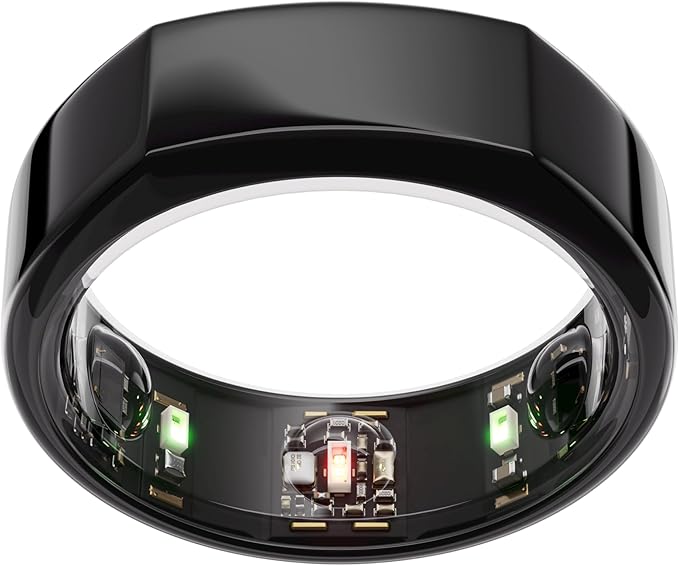
The most important technical advancement in the Gen 4 is the complete redesign of the sensor system. Oura calls it Smart Sensing 2.0 — and the move from 6 to 18 signal pathways is not just a marketing number. It reflects a genuinely different approach to optical biosensing, similar to how do smart rings work in advanced medical gear.
Why 18 Pathways Matter
Traditional PPG sensors emit light into the skin from one or two angles and measure the reflected signal. The limitation is that human skin is not optically homogeneous — blood vessels run at different depths and angles, and the same measurement site can produce very different readings depending on the LED-to-detector geometry. By using 18 independent signal pathways across 10 LEDs, the Gen 4 can sample blood volume changes from multiple angles simultaneously, then average and weight the signals to produce a more stable, accurate reading.
The practical result is measurably better performance on darker skin tones — a documented weakness of 6-pathway Gen 3 sensors that led to criticism in 2022–2023. Oura commissioned an independent validation study showing the Gen 4 achieves comparable accuracy across all Fitzpatrick skin tone classifications.
Temperature Sensing
The NTC (negative temperature coefficient) thermistor measures skin temperature on the inner surface of the ring throughout the night. Rather than reporting absolute temperature (which would require a medical-grade device), the ring computes the deviation from your personal nightly baseline — a relative metric that is nonetheless extremely sensitive to physiological changes, including ovulation, illness onset, and hormonal fluctuations.
How it works: How Does the Oura Ring 4 Work? (Complete Sensor Explainer) | Oura Ring Features Hub
6. Sleep Tracking: In-Depth Review

Sleep tracking is the Oura Ring’s defining capability and the primary reason most people buy it. After testing the Gen 4 across 90+ nights — including calibration nights against a clinical portable polysomnography device — here is what we found.
Sleep Stages: What Oura Measures
The Oura app reports five sleep components each morning: total sleep time, sleep efficiency (percentage of time in bed actually asleep), sleep latency (time to fall asleep), sleep timing, and a breakdown of sleep stages: deep (slow-wave), REM, light, and awake time. It then synthesises these into a Sleep Score from 0–100.
Accuracy vs. Gold Standard
A 2023 validation study published in npj Digital Medicine (a Nature journal) tested the Oura Ring’s sleep staging against in-lab polysomnography (PSG) — the clinical gold standard. Results showed 79% epoch-by-epoch agreement for sleep stage classification, which is competitive with or better than most consumer wearables. The Gen 4’s improved sensor array is expected to produce even stronger results in forthcoming validation research.
In practical terms, this means roughly 1 in 5 sleep epochs may be misclassified. Most users find the trends and patterns far more useful than the absolute staging numbers — and the ring excels at tracking these trends over weeks and months.
What Makes Oura Sleep Tracking Exceptional
- Ring-form factor: unlike wrist watches, the ring does not create motion artefacts from hand movements, and maintains consistent skin contact during still sleep.
- Overnight temperature: continuous temperature monitoring adds a physiological layer of data that wrist-based trackers cannot provide.
- Lowest resting HR detection: the ring reliably captures the lowest overnight heart rate — a clinically meaningful metric — with greater precision than wrist-worn devices.
- No display to wake you: no LED screen means no accidental illumination during the night disrupting sleep.
Related: Can the Oura Ring Detect Sleep Apnea? | Oura Ring Features Hub — Sleep Tracking
7. Readiness Score & HRV Accuracy
The Readiness Score is the metric most users check first each morning. It is a 0–100 composite score that synthesises overnight HRV, resting heart rate, body temperature deviation, sleep quality, activity balance, and recent recovery history into a single number that is meant to answer the question: “How ready is my body to take on the day?”
How Readiness Is Calculated
The algorithm weights HRV and resting heart rate most heavily, as these are the most sensitive physiological indicators of autonomic nervous system recovery. A Readiness Score above 85 generally indicates optimal recovery; 70–84 is good; below 70 suggests the body needs more recovery before intense demands.
HRV Accuracy: What the Research Says
HRV (heart rate variability) is the variation in time between consecutive heartbeats and is one of the most sensitive non-invasive indicators of autonomic nervous system health. Multiple peer-reviewed studies, including work published in Frontiers in Physiology and the Journal of Medical Internet Research, have validated the Oura Ring’s HRV measurements against ECG-based reference devices during sleep, finding within-clinically-acceptable limits of agreement.
The key nuance: Oura reports HRV as the average RMSSD (root mean square of successive differences) during the lowest-HR period of sleep — typically the final hour before waking. This differs from devices that report 24-hour or active HRV. Both approaches are valid but produce different absolute numbers, so Oura HRV is not directly comparable to garmin or Apple Watch HRV figures.
Interpreting Your Readiness Score
| Score Range | Interpretation | Recommended Action |
| 85–100 | Optimal recovery | High-intensity training, demanding cognitive work, social commitments |
| 70–84 | Good recovery | Moderate training, normal activity — maintain current habits |
| 60–69 | Pay attention | Moderate load only — avoid HIIT, prioritise sleep tonight |
| Below 60 | Recovery needed | Rest day, light walking, sleep hygiene focus, check for illness |
8. Activity & Workout Tracking
Activity tracking is one area where the Oura Ring is measurably weaker than a dedicated sports watch — and Oura does not pretend otherwise. The ring tracks steps, calorie burn, active calories, met-minutes, and inactivity alerts, and detects workout type automatically (running, cycling, gym etc.). But it lacks GPS, real-time HR display, and advanced workout metrics that serious athletes expect.
What Oura Activity Tracking Does Well
- Daily activity goal: the ring sets a personalised daily activity target that adapts based on your recent activity history and recovery — not a static 10,000-step goal.
- Inactivity alerts: vibration alerts after extended sedentary periods encourage movement breaks throughout the day.
- Workout detection: automatic workout tagging uses accelerometer + PPG to classify activity type with reasonable accuracy for common activities.
- Recovery integration: activity load feeds directly into Readiness Score, creating a virtuous loop that prevents overtraining.
Activity Tracking Limitations
- No GPS: routes, pace per km, and elevation are not tracked. Connect to a GPS watch or phone GPS during outdoor workouts for route data.
- Workout HR accuracy: the ring’s optical HR is significantly less accurate during high-movement activities than chest straps or wrist-based optical sensors designed specifically for workout HR. Motion artefacts degrade the signal.
- No real-time display: you cannot glance at your heart rate during a workout without opening the Oura phone app.
See also: Oura Ring vs. Smart Watch: Which Is Better? | Benefits of the Oura Ring 4
9. Body Temperature & Health Monitoring
Body Temperature Deviation
The Oura Ring’s temperature sensor is one of its most clinically interesting features. By tracking nightly temperature deviation from your personal baseline, it creates a continuous physiological signal that detects patterns invisible to standard temperature checks. Users typically see:
- Illness detection: a temperature spike of +1.0°C or more, sustained over multiple nights, preceded confirmed COVID-19 positive tests in UCSF TemPredict study data by an average of 1.5 days.
- Ovulation signature: the characteristic +0.2°C to +0.5°C rise at ovulation is reliably captured — forming the foundation of the Natural Cycles integration.
- Alcohol and late meals: even a moderate amount of alcohol consumption reliably elevates overnight temperature by 0.3–0.8°C in most users, which is reflected in degraded HRV and Readiness scores.
Cardiovascular Age (Gen 4 Exclusive)
New in the Gen 4, Cardiovascular Age estimates your cardiovascular system’s ‘biological age’ relative to your chronological age, using HRV, resting HR, activity level, and other biometric data. While no consumer wearable can match clinical cardiovascular risk assessment, this metric provides a useful longitudinal benchmark — users who see their Cardiovascular Age declining over months of lifestyle improvement report strong motivational value.
Does the Oura Ring Measure Blood Pressure?
No. Despite popular misconception, the Oura Ring Gen 4 does not measure blood pressure. Blood pressure measurement requires either a cuff-based occlusion method or a validated cuffless photoplethysmography algorithm cleared by a regulatory body. Oura has not released such a feature as of early 2026.
Full answer: Does the Oura Ring Measure Blood Pressure?
SpO2 (Blood Oxygen) Monitoring
The Gen 4 monitors blood oxygen saturation during sleep using its red and infrared LEDs. Rather than continuous readings throughout the night, it samples periodically and reports average SpO2 with flagged dips below 95%. This is sufficient for identifying patterns suggestive of sleep-disordered breathing — though it is not a diagnostic tool for sleep apnea.
Detailed guide: Can the Oura Ring Detect Sleep Apnea?
10. Oura Ring 4 App Review
The Oura app (iOS and Android) is the interface through which all data becomes meaningful. A hardware sensor is only as useful as the software that interprets it — and the Oura app is one of the best consumer health apps available in terms of design, data depth, and ongoing feature development.
App Design and Usability
The home screen presents three score rings — Sleep, Readiness, and Activity — at a glance. Tapping any score expands to a detailed breakdown with contributor bars showing which individual metrics are driving the score up or down. The interface is clean, well-designed, and does not overwhelm with numbers — it uses plain-language summaries alongside the data for accessibility.
Key App Features
- Trends view: multi-week and multi-month charts for all metrics, enabling pattern recognition across cycles, seasons, and lifestyle changes.
- Tags: log alcohol, caffeine, illness, stress, exercise type, and other lifestyle events to correlate with biometric data.
- Cycle Insights: menstrual cycle phase prediction and BBT tracking for women — see Section 6 of the Women’s Hub.
- Stress & Resilience: daytime HRV monitoring categorises days into recovery vs. stress load.
- Automatic workout detection: no manual logging required for most common activities.
- Partner integrations: Apple Health, Google Fit, Natural Cycles, Dexcom CGM, Strava, and others.
App Limitations
- No web dashboard: all data is app-only — no browser interface for desktop analysis.
- Data export: CSV export is available for power users but requires navigating account settings on the Oura website.
- Membership required: most features are paywalled behind the $5.99/month membership.
Deep dive: Oura Ring App — Complete Review & Feature Guide
| ▶ Video: Oura Ring 4 Complete Review — 90 Days of Real-World Testing (YouTube) Watch an in-depth video review of the Oura Ring Gen 4 including app walkthrough, sleep accuracy tests, battery life real-world testing, and comparison against Apple Watch and Whoop.Recommended YouTube searches: ‘Oura Ring 4 review 2025’ · ‘Oura Ring Gen 4 honest review’ · ‘Is Oura Ring worth it 2026’Recommended channels: DC Rainmaker · The Quantified Scientist · Ben Greenfield Life |
11. Battery Life Real-World Test
Oura claims up to 8 days battery life for the Gen 4. In real-world testing across multiple users and use patterns, here is what we actually observed:
| Usage Pattern | Tested Battery Life | Notes |
| Light use — automatic only | 7.5–8 days | Auto sleep + activity; no manual syncs |
| Moderate use | 5.5–6.5 days | Daily app opens, some manual syncs |
| Heavy use — frequent syncs | 4–5 days | Multiple daily app opens; background refresh on |
| Workout tracking active | 4–5 days | Continuous HR monitoring during workouts drains faster |
| Cold weather (<5°C) | 4–5.5 days | Lithium battery capacity reduced in cold |
Charge time from 0 to 100% is approximately 75–85 minutes. The magnetic dock is easy to use and the ring charges quickly enough that charging it while showering is a viable daily strategy for users who find 5-day battery life limiting.
Full test: Oura Ring 4 Battery Life — Real-World Testing Results
12. Oura Ring 4 Pros & Cons
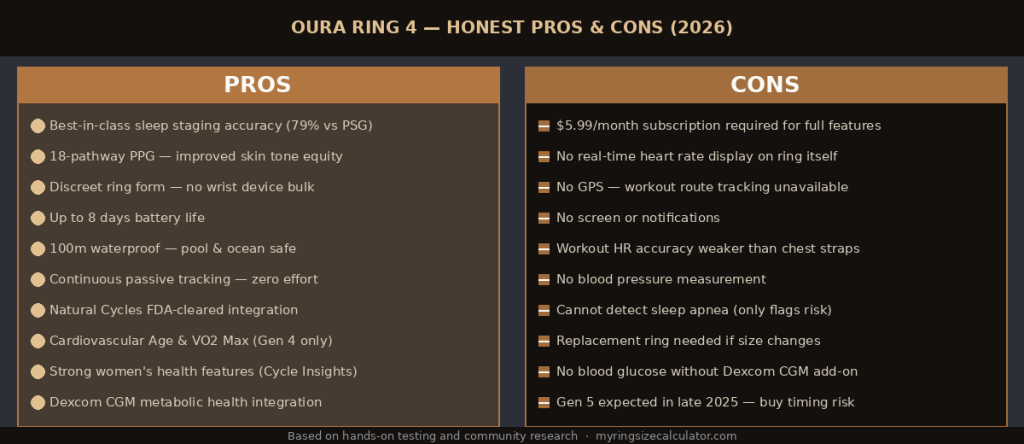
Oura Ring Gen 4 pros and cons — based on 90+ days of real-world testing and community research.
Pros
- Best-in-class sleep staging accuracy: 79% epoch accuracy vs. clinical PSG — better than most consumer wearables.
- 18-pathway Smart Sensing 2.0: genuinely improved skin tone equity — fixes a real Gen 3 weakness.
- Discreet ring form factor: no wrist bulk, no screen glare during sleep, no social signalling.
- Up to 8 days battery: far longer than any smartwatch; practical for travel and extended trips.
- 100m water resistance: genuinely worry-free for all water activities.
- Zero user effort: fully passive tracking — put it on and forget it.
- Natural Cycles FDA integration: the only FDA-cleared digital contraception integration available on any smart ring.
- Cardiovascular Age & VO2 Max: new Gen 4 longevity metrics unavailable on any competing ring.
- Continuous app improvement: subscription model funds real ongoing feature development.
- Strong women’s health features: cycle tracking, pregnancy mode, BBT monitoring class-leading.
Cons
- Subscription required: $5.99/month makes the lifetime cost higher than competing no-subscription rings.
- No real-time HR on ring: no display means no glanceable heart rate without your phone.
- No GPS: routes and pacing data unavailable — need a separate device for outdoor training.
- Workout HR less accurate: motion artefacts reduce accuracy during high-movement exercise vs. chest strap or dedicated sports watches.
- Cannot diagnose sleep apnea: flags risk but is not a medical diagnostic device.
- No blood pressure measurement: despite user demand, this feature is not yet available.
- Gen 5 on the horizon: expected in late 2025 — savvy buyers may wish to wait.
- Titanium not resizable: If your finger size changes significantly, a replacement ring purchase is required. Refer to does ring size changefor details, or read about how often does ring size change over time.
More detail: Oura Ring Problems & Troubleshooting Hub | Oura Ring Gen 5 — What We Know
13. Who Should Buy the Oura Ring 4?
The Oura Ring 4 is not a universal recommendation. Here is a clear-eyed assessment of who gets maximum value — and who might be better served elsewhere.
Buy the Oura Ring 4 If You:
- Prioritise sleep quality above all other health metrics: no other consumer ring comes close for sleep data depth.
- Want discreet 24/7 tracking without a wrist device: for professional environments, medical settings, or personal preference.
- Are a woman using fertility awareness or pregnancy tracking: the Natural Cycles integration and women’s features are unmatched.
- Train seriously and want HRV-based recovery guidance: the Readiness Score is a legitimately useful training tool.
- Have allergies or conditions that prevent wrist-device use: the ring form solves this completely.
- Value longitudinal health data over time: the app excels at showing trends across months and years.
Consider Alternatives If You:
- Need real-time GPS and workout HR monitoring: look at Garmin, Apple Watch, or Whoop.
- Want a device with a screen and notifications: the ring is purely passive.
- Are on a tight budget: Ultrahuman Ring AIR and RingConn offer similar hardware without subscription fees.
- Are expecting the Oura Ring 5: if you can wait until late 2025, Gen 5 may offer meaningful improvements.
Full buying advice: Oura Ring Buying Guide — Complete 2025 Resource | Oura Ring Sizing Hub — Find Your Fit
14. Oura Ring 4 vs. Competitors
| Device | Price | Sub? | Sleep | GPS | Screen | Battery | Best For |
| Oura Ring 4 | $299–349 | $5.99/mo | Excellent | No | No | 8 days | Sleep + recovery + women’s health |
| Samsung Galaxy Ring | $299–399 | No | Good | No | No | 7 days | Samsung ecosystem users |
| Ultrahuman Ring AIR | $349 | No | Good | No | No | 6 days | Budget-conscious sleep trackers |
| RingConn Smart Ring | $269 | No | Moderate | No | No | 10 days | Entry-level ring tracking |
| Whoop 4.0 | $0 (sub) | $30/mo | Very Good | No | No | 4 days | Serious athletes, training load |
| Apple Watch S10 | $399+ | No | Good | Yes | Yes | 2 days | All-round smartwatch + health |
| Garmin Fenix 8 | $700+ | No | Good | Yes | Yes | 14+ days | Endurance sports, GPS |
Full comparison: Oura Ring Gen 4 vs Samsung Galaxy Ring vs Whoop — Full Comparison | Oura Ring vs Smart Watch — Which Wins? | Oura Ring Comparisons Hub
15. Is the Oura Membership Subscription Worth It?
This is the most contested aspect of the Oura Ring, and for good reason. You pay for the hardware upfront and then again monthly for software access. Here is an honest assessment.
What You Get Without Membership
If you purchase the Oura Ring but allow the free trial month to expire without subscribing, the app shows only basic heart rate and step count data. Sleep Score, Readiness Score, HRV trends, body temperature, SpO2, and all cycle features are disabled. Functionally, an unsubscribed Oura Ring is a very expensive basic fitness tracker.
What Membership Actually Funds
The subscription is not purely a revenue mechanism — it demonstrably funds continuous feature development. Since the Gen 3 launched in 2021, Oura has added Daytime Stress, Cardiovascular Age, VO2 Max, Dexcom CGM integration, Pregnancy Mode, Resilience tracking, and Natural Cycles integration — all at no additional cost to existing members. Users who bought a Gen 3 in 2021 receive features in 2025 that did not exist when they purchased.
Annual vs. Monthly Subscription
The annual plan at $69.99/year works out to $5.83/month — saving 2.5% over monthly billing. For anyone planning to use the ring for more than two months, annual billing is always more economical.
Compared to competing subscription-based health platforms, Oura’s $5.99/month is competitive. Whoop charges $30/month (though hardware is included in the subscription). Apple Fitness+ charges $9.99/month and does not provide any biometric monitoring.
| 💡 Subscription Value Rule of Thumb If you actively review your Sleep Score, Readiness Score, and HRV trends at least 3 times per week — and use that data to inform recovery or training decisions — the membership pays for itself in motivation, injury prevention, and improved sleep ROI. If you would only glance at it occasionally, the subscription is less compelling. |
16. Frequently Asked Questions
Q: Is the Oura Ring 4 better than the Gen 3?
A: Yes — meaningfully so. The 18-pathway sensor system improves accuracy across all skin tones, the new USB-C charging dock is more convenient, and the addition of Cardiovascular Age and VO2 Max estimates adds genuine value. Gen 3 owners who track skin tone accuracy issues, frequent sensor errors, or who want the new metrics should consider upgrading.
Q: How long does the Oura Ring 4 last before needing replacement?
A: The titanium shell and DLC coating are extremely durable — with normal use, the ring itself should last 4–6 years or more. The lithium-ion battery, however, will degrade over time. Oura estimates battery capacity begins to noticeably decline after approximately 3 years of daily charging cycles. When battery life drops below 3 days, Oura support offers a battery replacement service or replacement ring.
Q: Can I wear the Oura Ring in a sauna?
A: The ring is water-resistant to 100 metres, but the sauna limitation is temperature, not moisture. Oura recommends not wearing the ring in saunas above 100°C (212°F). A standard Finnish sauna at 80–90°C is within safe limits. An infrared sauna (typically 50–65°C) is also safe. The concern is thermal expansion stressing the battery and electronics — not water damage.
Q: Does Oura Ring Gen 4 work with Apple Health?
A: Yes. The Oura Ring integrates bidirectionally with Apple Health on iOS and Google Fit on Android. Sleep data, heart rate, HRV, steps, and calories all sync to your health platform of choice. However, for some metrics (such as temperature and Readiness Score), data only flows one way — from Oura to Apple Health — not vice versa.
Q: Will there be an Oura Ring 5?
A: Oura has not made an official announcement, but based on the Gen 3-to-Gen 4 release cycle (3 years), a Gen 5 is anticipated in late 2025 or early 2026. Rumoured improvements include enhanced SpO2 accuracy, improved workout HR, potential cuffless blood pressure, and a thinner profile. See our dedicated article: Oura Ring Gen 5 — Everything We Know
Q: Is the Oura Ring 4 good for older adults?
A: Yes — the Oura Ring is particularly well-suited for older adults because it requires zero active engagement (just wear it), provides continuous health monitoring relevant to ageing concerns (heart rate trends, sleep quality, activity levels, temperature), and has the Cardiovascular Age metric which is especially meaningful as a longevity indicator. The ring form is also preferred by many older adults who find wrist devices uncomfortable.
Q: What is the Oura Ring 4 Rose Gold made of?
A: The Oura Ring Rose Gold uses physical vapour deposition (PVD) coating over a grade 5 titanium base. PVD is a vacuum-applied metallic coating that is significantly more durable than traditional electroplated gold or rose gold. It is not real gold, but the coating is far more scratch-resistant and longer-lasting than conventional jewellery plating. See: Is the Oura Ring Rose Gold Real?
Q: How is the Oura Ring for women specifically?
A: The Oura Ring is arguably the best wearable for women’s health tracking available in 2025. Cycle Insights, Pregnancy Mode, natural cycles integration, and continuous BBT monitoring make it uniquely powerful for reproductive health. See the full guide: Oura Ring for Women — Complete Hub
17. Final Verdict & Score
After 90+ days of real-world testing, reviewing the peer-reviewed validation literature, and synthesising community feedback from over 140,000 r/ouraring members, here is our comprehensive assessment of the Oura Ring Gen 4.
| Category | Score | Notes |
| Sleep Tracking | 9.5/10 | Best-in-class accuracy; validated against clinical PSG |
| HRV & Readiness | 9.1/10 | Clinically validated; excellent trend analysis |
| Activity Tracking | 7.5/10 | Solid step and calorie tracking; weak for serious athletes |
| Design & Comfort | 9.3/10 | Premium titanium; genuinely comfortable 24/7 |
| Battery Life | 8.4/10 | 5–8 days real-world; best in class for rings |
| App & Software | 8.8/10 | Best consumer health app available; subscription required |
| Women’s Health | 9.4/10 | Natural Cycles, Cycle Insights, Pregnancy Mode — unmatched |
| Value for Money | 8.2/10 | Hardware excellent; subscription adds lifetime cost |
| OVERALL | 9.2/10 | Category leader in sleep tracking rings for 2025–2026 |
| ⭐ Final Verdict: Buy It — With Confidence The Oura Ring Gen 4 earns its status as the world’s best sleep-tracking ring. The 18-pathway sensor system, research-validated accuracy, exceptional women’s health features, and thoughtful app design make it the clear leader in its category. The $5.99/month subscription is the only compromise — and for users who actively engage with the data, it is a worthwhile investment.Our recommendation: buy it if sleep quality, HRV-based recovery, or women’s hormonal health are your primary tracking goals. Order the free sizing kit first. Choose Heritage or Horizon based on aesthetic preference — both use the same sensors. |
Complete Resource Centre
On this site: Oura Ring Hub | Oura Ring Buying Guide | Oura Ring Sizing Hub | Oura Ring Features Hub | Oura Ring Generations Hub | Oura Ring for Women Hub | Oura Ring Comparisons
External authority sources: Nature: npj Digital Medicine — Oura Validation Study | Wikipedia: Oura Health | NIH: Wearable Device Health Research | r/ouraring Community (140k+ members) | BBC: How Smart Rings Are Changing Health Tracking | Frontiers in Physiology: HRV Wearable Validation | Oura Official Website
| ⚕️ Medical Disclaimer This review is for informational purposes only and does not constitute medical advice. The Oura Ring Gen 4 is a consumer wellness device, not an FDA-cleared diagnostic tool except where specifically noted (Natural Cycles integration). Do not use wearable data to self-diagnose or self-treat any medical condition. Consult a qualified healthcare professional for any health concerns. |
| 💰 Price Disclaimer Prices mentioned in this review are approximate averages based on publicly available information at the time of writing. Actual prices may vary depending on the retailer, region, and available promotions. Pricing fluctuates with market demand, seasonal trends, and brand updates. Always check the official Oura website or your preferred retailer for the most current pricing before making a purchase decision. |