
By myringsizecalculator.com · Updated April 2026 · 16 min read
The Oura Ring Gen 4 is one of the most advanced consumer tools available for women’s health tracking.
| ⚡ Quick Answer: Is the Oura Ring Good for Women? Yes — the Oura Ring is one of the most comprehensive women’s health trackers available in a wearable form. It tracks basal body temperature (BBT), menstrual cycle phases, ovulation prediction, sleep quality across cycle phases, heart rate variability, and includes a dedicated Pregnancy Mode. It integrates with Natural Cycles (FDA-cleared birth control app) and Dexcom CGM. For women who want deep hormonal, reproductive, and recovery data in a discreet ring form, it is the category leader in 2026. |
1. Why the Oura Ring Was Built for Women’s Health
Most wearable health technology has historically been designed around male physiology — calibrated on male baseline data, tested predominantly on men, and lacking features relevant to the female hormonal cycle. The Oura Ring takes a fundamentally different approach.
The ring’s continuous basal body temperature (BBT) monitoring, combined with heart rate variability (HRV) and resting heart rate data, creates a multi-signal hormonal fingerprint that changes predictably throughout the menstrual cycle. This is not a coincidence of design — Oura partnered with UCSF researchers, the TemPredict study, and clinicians specifically to develop cycle-tracking algorithms grounded in peer-reviewed science.
Beyond cycle tracking, the Oura Ring Gen 4’s 18-pathway Smart Sensing 2.0 system improved sensor accuracy for darker skin tones — addressing a well-documented bias in earlier PPG-based optical sensors — making it more equitable as a health tool across diverse populations of women.
Hub overview: Oura Ring Complete Guide | Oura Ring Features & Health Tracking Hub
2. Oura Ring Cycle Insights: How It Works
Cycle Insights is Oura’s dedicated menstrual cycle feature, available to all members with an Oura membership. It uses three primary biometric signals — basal body temperature deviation, resting heart rate, and heart rate variability — to model where you are in your menstrual cycle and predict phase transitions.
The Science Behind BBT Tracking
Basal body temperature is the lowest body temperature reached during rest. In the female hormonal cycle, progesterone — which surges after ovulation — causes a measurable rise in core body temperature of approximately 0.2°C to 0.5°C. This thermal shift persists throughout the luteal phase and drops back at menstruation. The Oura Ring captures this via its infrared sensor array on the ring’s inner surface, measuring temperature deviation from your personal nightly baseline rather than absolute temperature.
How Oura Captures BBT More Accurately Than Manual Methods
Traditional BBT tracking requires waking at the same time every morning to take a sublingual or oral temperature reading before getting out of bed — a method prone to user error, missed readings, and sleep disruption. The Oura Ring measures temperature passively throughout the night, sampling continuously during sleep and computing a nightly average. This eliminates user error and provides a richer dataset than a single morning reading.
| Method | Measurement Time | Readings per Night | User Effort | Oura Advantage |
| Manual BBT thermometer | Once — on waking | 1 | High — must wake at same time daily | — |
| Oral digital thermometer | Once — before rising | 1 | High — requires consistency | — |
| Oura Ring continuous | All night during sleep | Hundreds of samples | Zero — fully passive | Yes |
| Other wrist wearables | Wrist skin temp only | Continuous but less accurate | Zero | Partial |
Science: Wikipedia: Basal Body Temperature | NIH: Menstrual Cycle & Thermoregulation Research
3. The Four Cycle Phases & What Oura Tracks in Each
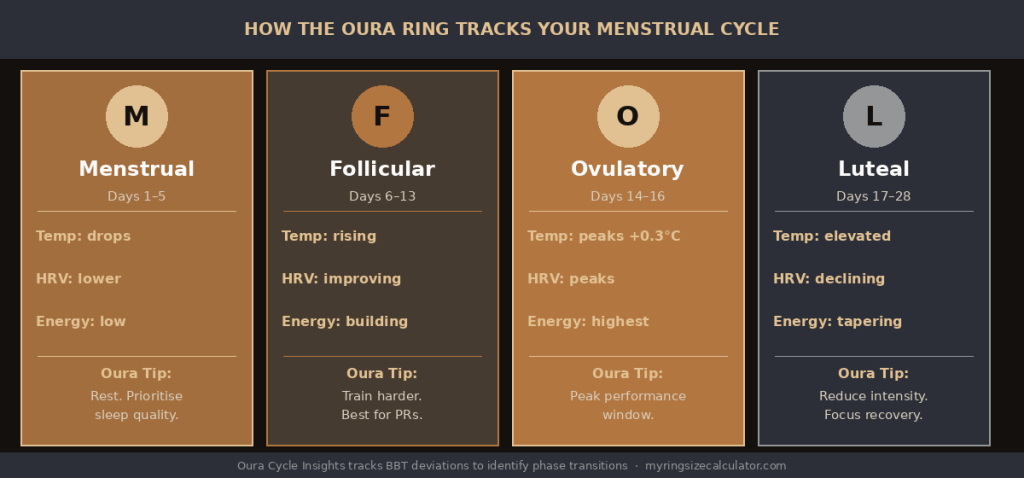
The four phases of the menstrual cycle and how Oura Ring biometrics change in each phase.
Understanding how your biometrics shift across the four cycle phases is the foundation of using the Oura Ring for women’s health. The ring does not just tell you which phase you are in — it shows you the physiological evidence behind the prediction.
Phase 1: Menstrual Phase (Days 1–5)
The menstrual phase begins on the first day of bleeding. Estrogen and progesterone are at their lowest, which typically means lower energy, reduced exercise capacity, and disrupted sleep architecture. Oura users typically see their Readiness Score dip slightly and their body temperature drop to a personal low during this phase.
- Body temperature: drops to cycle low — Oura baseline resets here
- HRV: often lower — parasympathetic activity reduced during cramping/inflammation
- Resting heart rate: may be slightly elevated due to prostaglandin-driven inflammation
- Sleep: deep sleep often disrupted; more awakenings common
- Oura insight: Readiness Score typically lower; the app flags recovery as priority
Phase 2: Follicular Phase (Days 6–13)
Rising estrogen dominates the follicular phase. This is the body’s natural ‘rebuild’ window — estrogen promotes tissue repair, improves mood and cognitive function, and enhances cardiovascular efficiency. Athletes often find this is their best training phase.
- Body temperature: gradually rising from cycle low
- HRV: improving — estrogen has a positive effect on autonomic nervous system balance
- Resting heart rate: trending down as cardiovascular efficiency improves
- Sleep: typically best quality of the cycle — deeper slow-wave sleep
- Oura insight: Readiness Score climbs; app may suggest increasing activity targets
Phase 3: Ovulatory Phase (Days 14–16)
Ovulation is triggered by a luteinising hormone (LH) surge. Body temperature rises sharply by 0.2°C–0.5°C — the most distinctive thermal signal in the entire cycle. Energy, libido, and cognitive performance peak. This is the window Natural Cycles uses to identify the fertile period.
- Body temperature: sharply elevated +0.2°C to +0.5°C above follicular baseline
- HRV: at cycle peak — autonomic recovery is optimal
- Resting heart rate: lowest point of the cycle
- Sleep: often vivid dreams; sleep structure slightly disrupted by LH surge
- Oura insight: Cycle Insights flags temperature rise; fertile window prediction activated
Phase 4: Luteal Phase (Days 17–28)
The luteal phase is governed by progesterone. Body temperature remains elevated throughout and drops sharply at the onset of menstruation. Many women experience PMS symptoms — sleep disruption, elevated resting heart rate, reduced HRV, and lower energy — in the late luteal phase. Oura captures all of these changes and can help correlate them to specific days.
- Body temperature: remains elevated 0.2°C–0.5°C above follicular baseline throughout
- HRV: declining as the phase progresses — progesterone reduces HRV
- Resting heart rate: elevated by 2–5 bpm above follicular phase average
- Sleep: quality declines in late luteal; less deep sleep, more light sleep
- Oura insight: app may reflect declining Readiness as late-cycle progesterone peaks
4. Oura Ring & Ovulation: Can It Detect Fertile Days?
This is one of the most searched questions about the Oura Ring among women — and the answer is nuanced. The Oura Ring does not directly detect ovulation or measure LH (luteinising hormone). However, it detects the thermal signature of ovulation — the rise in basal body temperature that follows the LH surge — which is the same principle used by clinical BBT charting methods recognised by reproductive medicine.
| 🔬 Oura + Natural Cycles: FDA-Cleared Fertility Awareness The Oura Ring integrates directly with Natural Cycles — the only FDA-cleared digital birth control app in the United States. Natural Cycles uses Oura’s BBT data alongside its own algorithm to identify fertile and non-fertile days. When using this integration, Natural Cycles provides a red (fertile/unprotected) or green (non-fertile) day designation each morning. This is a medically recognised fertility awareness method — not just consumer wellness tracking. |
How Accurate Is Oura for Ovulation Detection?
A 2021 study published in npj Digital Medicine found that continuous temperature monitoring via wearable sensors showed promise for retrospective ovulation detection, though prospective prediction (identifying fertile days before they occur) remains an area of active research. The combination of Oura BBT data with Natural Cycles’ algorithm achieves a typical-use efficacy of 93% and perfect-use efficacy of 98% as a contraceptive method according to Natural Cycles’ clinical trial data.
It is important to note that the Oura Ring alone does not provide a fertile window prediction — this requires the Natural Cycles integration or manual charting of Oura’s temperature data.
External: Natural Cycles — FDA-Cleared Digital Contraception | FDA: Natural Cycles De Novo Authorisation | Wikipedia: Fertility Awareness Methods
5. Oura Ring Pregnancy Mode: Complete Guide
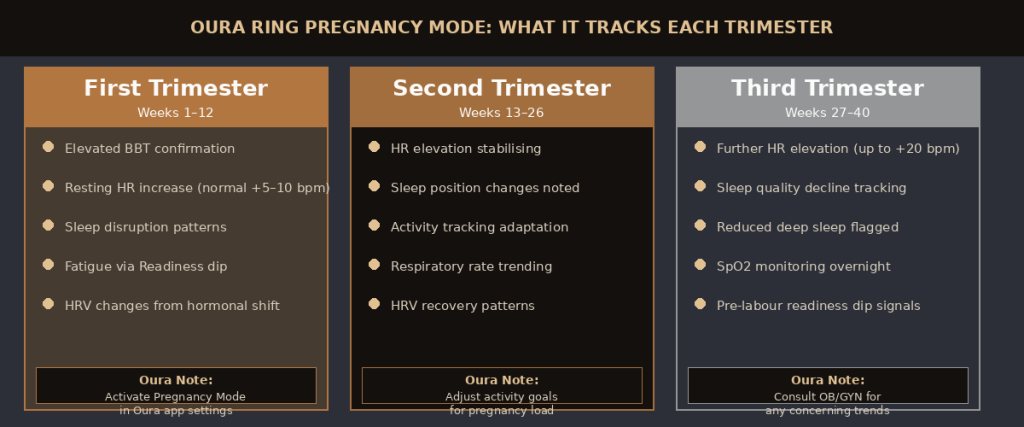
Oura Ring Pregnancy Mode adapts tracking algorithms across all three trimesters of pregnancy.
Oura’s Pregnancy Mode is a dedicated tracking configuration introduced in 2022 that adapts the ring’s algorithms, baselines, and scoring to account for the physiological changes of pregnancy. Standard Oura metrics — particularly Readiness Score and HRV trends — become misleading during pregnancy because the body’s normal stress-recovery patterns are fundamentally altered by gestation.
How to Activate Pregnancy Mode
- Open the Oura app and tap Profile (bottom-right).
- Tap Tags & Events → Pregnancy Mode.
- Enter your estimated due date or last menstrual period (LMP).
- The app will recalibrate your baselines and adjust scoring accordingly.
- Oura recommends activating Pregnancy Mode as soon as pregnancy is confirmed.
What Pregnancy Mode Changes
| Feature | Standard Mode | Pregnancy Mode |
| Resting HR baseline | Personal pre-pregnancy average | Adjusted for normal pregnancy HR increase (+10–20 bpm) |
| HRV scoring | Standard autonomic recovery model | Recalibrated — pregnancy naturally lowers HRV |
| Body temperature | Cycle-phase deviation | Sustained elevation recognised as normal (progesterone-driven) |
| Readiness Score | Standard recovery algorithm | Adjusted — not penalised for pregnancy-normal physiology |
| Activity goals | Standard daily targets | Reduced to reflect safe pregnancy exercise guidelines |
| SpO2 monitoring | Standard overnight | Maintained — important for gestational breathing monitoring |
Pregnancy Mode Across the Three Trimesters
First Trimester (Weeks 1–12)
The first trimester is when the ring most clearly signals pregnancy before symptoms are obvious. Sustained BBT elevation — remaining high rather than dropping at expected menstruation — is one of the earliest Oura indicators of possible pregnancy. Resting heart rate begins increasing as blood volume expands, and fatigue is reflected in declining Readiness scores.
Second Trimester (Weeks 13–26)
Often called the ‘easiest’ trimester physiologically, the second trimester typically brings stabilising heart rate, improving sleep quality, and a more settled biometric baseline. Oura users often report their Readiness Score recovering somewhat as first-trimester fatigue lessens. Activity tracking remains useful for monitoring exercise load against safe pregnancy guidelines from organisations such as the American College of Obstetricians and Gynecologists (ACOG).
Third Trimester (Weeks 27–40)
The third trimester brings the most significant physiological change. Resting heart rate may rise to 20 bpm above pre-pregnancy baseline. Sleep quality declines due to physical discomfort, frequent urination, and reduced deep sleep. SpO2 overnight monitoring becomes particularly relevant as respiratory mechanics are affected by the growing uterus. Some Oura users report a notable Readiness Score dip in the days preceding labour — though this is anecdotal and not a clinically validated labour predictor.
| ⚠️ Important: Oura Ring Is Not a Medical Device During Pregnancy Pregnancy Mode provides wellness tracking data — it does not replace prenatal care, clinical monitoring, or medical advice. Any concerning trends in heart rate, SpO2, or temperature during pregnancy should be discussed with your obstetrician or midwife immediately. Do not make medical decisions based on Oura data alone. |
External guidance: ACOG: Exercise During Pregnancy Guidelines | NHS: Keeping Active During Pregnancy
6. Oura Ring & PMS / PMDD: How Tracking Helps
Premenstrual syndrome (PMS) affects up to 75% of menstruating women, while the more severe premenstrual dysphoric disorder (PMDD) affects approximately 3–8%. Both conditions are characterised by physical and psychological symptoms in the luteal phase — and both leave a clear biometric signature that the Oura Ring can capture.
What Oura Shows During PMS
- Elevated resting heart rate: typically 2–5 bpm above follicular baseline in late luteal phase
- Reduced HRV: sympathetic nervous system dominance increases, reducing HRV
- Disrupted sleep: less deep sleep, more light sleep, increased awakenings
- Temperature elevation: sustained progesterone-driven warmth correlates with symptom onset
- Lower Readiness Score: the composite score reflects the physiological PMS burden
Using Oura Data to Manage PMS Proactively
Because Oura captures the biometric precursors of PMS symptoms — often 2–4 days before subjective symptoms become noticeable — it can help you anticipate your symptom window and adjust lifestyle accordingly. Women who track consistently can identify their personal PMS biometric pattern and use it to time recovery activities, reduce training intensity, prioritise sleep, and plan socially demanding events around lower-symptom phases.
This is a practical application of the emerging field of cycle syncing — aligning nutrition, exercise, social commitments, and cognitive demands to hormonal cycle phases based on data rather than guesswork.
Community discussion: r/ouraring — Women’s Health Tracking Thread | Wikipedia: Premenstrual Dysphoric Disorder
7. Oura Ring for Menopause & Perimenopause
Perimenopause — the transitional phase preceding menopause — typically begins in a woman’s mid-to-late 40s and can last 4–10 years. It is characterised by hormonal fluctuations, irregular cycles, sleep disruption, hot flushes, and significant HRV variability. The Oura Ring offers several highly relevant tracking capabilities for this life stage.
Key Menopausal Symptoms the Oura Ring Can Track
| Symptom | How Oura Tracks It | Value to User |
| Night sweats / hot flushes | Body temperature spikes during sleep — detected as sharp deviations above baseline | Quantify frequency and intensity; correlate with sleep disruption |
| Sleep disruption | Sleep staging shows reduced deep sleep, more awakenings, lighter overall sleep | Identify worst nights; correlate with other metrics |
| Heart rate changes | Resting HR and HRV changes visible in trends — irregular cycles alter the pattern | Distinguish hormonal HR shifts from fitness-driven changes |
| HRV decline | Menopause naturally lowers HRV; Oura tracks personal baseline shift | Monitor cardiovascular health; see response to HRT or lifestyle interventions |
| Mood / fatigue correlation | Readiness Score declines correlate with sleep disruption and autonomic burden | Data to discuss with GP / endocrinologist |
Oura During Hormone Replacement Therapy (HRT)
Women undergoing hormone replacement therapy often report significant changes in their Oura metrics — particularly improvements in HRV, resting heart rate, and deep sleep — as exogenous hormones stabilise the hormonal environment. Tracking these changes longitudinally in the Oura app provides objective data to support conversations with a GP or endocrinologist about HRT efficacy.
Further reading: Wikipedia: Menopause | NHS: Menopause Information & Treatment | NIH: Menopause & Cardiovascular Health
8. Sleep & HRV Across the Hormonal Cycle
Sleep quality is not constant across the menstrual cycle — it fluctuates predictably with hormonal changes, and the Oura Ring is uniquely well-suited to capture this variability because it is worn during sleep every night.
How Sleep Changes Across the Cycle
| Cycle Phase | Estrogen | Progesterone | Typical Sleep Pattern | Deep Sleep |
| Menstrual (Days 1–5) | Low | Low | Disrupted — cramping, discomfort | Reduced |
| Follicular (Days 6–13) | Rising | Low | Best quality of cycle | Optimal |
| Ovulatory (Days 14–16) | Peaks | Surging | Slightly disrupted — LH surge | Variable |
| Luteal (Days 17–28) | Moderate | High | Progressively worse toward period | Declining |
Why Your Oura Sleep Score Changes Month to Month
Many women are confused when their Sleep Score drops despite making no changes to their sleep habits. The answer is almost always hormonal. Progesterone in the luteal phase fragments sleep architecture, reducing slow-wave (deep) sleep and increasing nighttime awakenings. Oura’s Sleep Score accurately reflects this deterioration — it is not a flaw in the algorithm but a faithful record of your physiology.
Using the Oura app’s trend view across multiple cycles allows you to visualise this pattern, confirm its cyclical nature, and distinguish it from genuine sleep problems that warrant intervention.
HRV and the Hormonal Cycle
Heart rate variability follows a characteristic pattern across the cycle: HRV tends to be highest in the follicular and ovulatory phases (when estrogen is dominant) and lower in the luteal phase (when progesterone is dominant). This is because estrogen has a positive effect on autonomic nervous system balance, enhancing parasympathetic tone, while progesterone tends to suppress HRV. Women should interpret their HRV scores relative to their cycle phase, not as isolated data points.
Deep dive: Oura Ring Features Hub — Sleep & HRV Explained | Does Oura Ring Detect Sleep Apnea?
9. Natural Cycles Integration: FDA-Cleared Birth Control
The integration between the Oura Ring and Natural Cycles is the most clinically significant women’s health feature in Oura’s ecosystem. Natural Cycles is a Swedish-developed digital contraception app that received FDA De Novo authorisation in 2018 — the first digital birth control method ever cleared by the FDA.
How the Oura + Natural Cycles Integration Works
- Activate the Natural Cycles integration in your Oura app under Partners & Integrations.
- Your nightly BBT readings from the Oura Ring automatically export to Natural Cycles.
- Natural Cycles’ algorithm combines your Oura BBT data with calendar data to predict fertility.
- Each morning the app displays a red (fertile) or green (non-fertile) day.
- The integration eliminates the need for manual thermometer readings entirely.
Clinical Efficacy Data
Natural Cycles’ pivotal clinical trial — published in the European Journal of Contraception and Reproductive Health Care — demonstrated 93% typical-use efficacy and 98% perfect-use efficacy. These are comparable to condom typical-use rates and slightly below combined oral contraceptive pill rates. The Oura integration does not change these efficacy figures — the algorithm is the same whether you enter temperature manually or via Oura.
| ℹ️ Natural Cycles Is a Contraceptive Method — Not Passive Fertility Tracking Using Natural Cycles with Oura data as a birth control method requires consistent ring-wearing every night, active engagement with the app each morning, and following the red/green day designations as instructed. It is not suitable for women with highly irregular cycles, PCOS, or those who cannot commit to nightly ring use. Consult a healthcare provider before using any new contraceptive method. |
Official resource: Natural Cycles — How It Works | FDA: Natural Cycles Authorisation Press Release
| ▶ Video: Oura Ring for Women — Cycle Tracking & Natural Cycles Review (YouTube) Watch in-depth reviews of Oura’s women’s health features from creators who have tracked multiple cycles with the ring. Recommended YouTube searches: ‘Oura Ring cycle tracking review‘ · ‘Oura Ring Natural Cycles integration‘ · ‘Oura Ring pregnancy mode 2026’ |

10. Oura Ring for Female Athletes & Training
Female athletes face a unique challenge that male-calibrated training plans do not address: performance capacity, recovery speed, and injury risk all vary significantly across the menstrual cycle. The Oura Ring provides the physiological data to make cycle-synced training a practical, personalised strategy rather than a theoretical one.
Cycle-Synced Training with Oura
| Phase | Recommended Training | Why Oura Data Confirms This |
| Menstrual (Days 1–5) | Active recovery, yoga, light movement | Low HRV + low Readiness = high recovery demand |
| Follicular (Days 6–13) | High-intensity training, strength, intervals | Rising HRV + high Readiness = optimal adaptation |
| Ovulatory (Days 14–16) | Peak performance work, new PRs, competition | Highest HRV + lowest RHR = peak physiological capacity |
| Luteal (Days 17–28) | Moderate load, tempo, reduce high-intensity | Declining HRV + rising RHR = reduced recovery capacity |
Injury Risk and the Hormonal Cycle
Research published in the British Journal of Sports Medicine has found that anterior cruciate ligament (ACL) injuries in female athletes are significantly more common in the pre-ovulatory phase when estrogen peaks — estrogen affects ligament laxity. The Oura Ring cannot directly predict injury risk, but knowing your cycle phase via Cycle Insights allows you to be more intentional about warm-up protocols and movement quality during this window.
Nutrition Timing and Oura Data
Metabolic rate is slightly higher in the luteal phase due to elevated progesterone — studies suggest an increase of approximately 100–300 kcal per day above follicular baseline. Oura’s calorie estimation does not currently adjust for cycle phase, but tracking your Readiness and Activity Scores alongside food intake can help you identify patterns between calorie availability and recovery quality.
Related: Oura Ring Benefits — Full Breakdown | BBC: How Wearables Are Changing Women’s Sport
11. Accuracy: What the Research Says for Women
A critical question for any women’s health tracking device is whether it has been validated in female-specific studies — not just generalised population research. The Oura Ring has a growing body of female-specific validation evidence.
Sleep Staging Accuracy in Women
Sleep architecture differs between men and women: women typically have more slow-wave (deep) sleep and experience greater sleep disruption related to hormonal cycles. A 2023 validation study in npj Digital Medicine included female participants and found comparable accuracy between male and female subjects for sleep stage classification — an important finding that was not always the case with earlier actigraphy-based devices.
Temperature Accuracy and Ovulation Detection
A 2021 study published in Scientific Reports examined continuous temperature monitoring with wearable sensors for ovulation detection. Results indicated that wearable BBT monitoring could retrospectively identify ovulation in the majority of cycles, though prospective detection remained less reliable than retrospective confirmation. The Oura Ring uses this same principle within Cycle Insights and the Natural Cycles integration.
Limitations for Women
The Oura Ring’s cycle tracking is most reliable in women with regular cycles (24–35 days). Women with polycystic ovary syndrome (PCOS), highly irregular cycles, hormonal IUDs (which suppress natural temperature fluctuation), or anovulatory cycles may find cycle predictions less accurate. Hormonal contraceptives that suppress ovulation also suppress the BBT thermal shift, making ovulation-based tracking non-functional while on these methods.
Research: npj Digital Medicine — Oura Sleep Validation | NIH: Wearable Devices in Women’s Health Research | Wikipedia: Polycystic Ovary Syndrome
12. Frequently Asked Questions: Oura Ring for Women
Q: Can the Oura Ring replace a BBT thermometer for fertility tracking?
A: For use with Natural Cycles, yes — the integration is fully supported and eliminates manual thermometry. For manual fertility awareness charting methods (FAM), Oura’s temperature data can be exported and used, but note that Oura measures skin temperature deviation rather than oral/vaginal BBT. The Natural Cycles integration has been validated clinically; manual charting with Oura data has not been independently validated to the same standard.
Q: Does the Oura Ring work with hormonal contraceptives?
A: The ring works as a health tracker while on hormonal contraceptives, but Cycle Insights and Natural Cycles integration will not function correctly. Combined oral contraceptive pills, hormonal IUDs, and hormonal implants suppress natural cycle hormones, eliminating the BBT thermal shift that cycle tracking relies upon. Women on these contraceptives can still use all other Oura features (sleep, HRV, activity, readiness).
Q: Is the Oura Ring safe to wear during pregnancy?
A: Yes. The ring emits only Bluetooth (2.4 GHz) signals — at levels far below any established safety threshold. There is no ionising radiation. Thousands of women use Oura throughout pregnancy. As always, consult your obstetrician if you have specific concerns about any wearable device during pregnancy.
Q: What ring size should I get during pregnancy?
A: Fingers swell during pregnancy, particularly in the second and third trimesters due to increased blood volume and fluid retention. Many women find they need to size up by 1–2 sizes mid-pregnancy. Oura sells individual replacement rings, so you can size up as needed without purchasing a new ring and membership. Use Oura’s free sizing kit to find your current pregnancy size before ordering.
Q: Can the Oura Ring detect PCOS?
A: No — the Oura Ring cannot diagnose PCOS or any medical condition. PCOS diagnosis requires clinical evaluation, blood tests (LH, FSH, testosterone, AMH), and often ultrasound. However, some PCOS patterns — such as irregular cycle-phase thermal shifts or absent ovulatory temperature rises — may be visible in Oura data and could prompt a conversation with a gynaecologist.
Q: Does the Oura Ring track postpartum recovery?
A: Yes, though there is no dedicated postpartum mode. Many users deactivate Pregnancy Mode after birth and use the standard Oura app to track postpartum recovery — monitoring sleep quality (inevitably disrupted by newborn feeding), Readiness Score, HRV recovery, and the gradual return of normal cycle patterns if not breastfeeding. Breastfeeding suppresses ovulation and alters the cycle biometric pattern, so Cycle Insights may be unreliable during exclusive breastfeeding.
Q: Is the Oura Ring better than the Apple Watch for women’s health?
A: The Oura Ring is generally considered superior for cycle tracking, BBT monitoring, sleep tracking, and passive HRV — the features most relevant to women’s hormonal health. The Apple Watch offers period logging via the Health app but does not measure BBT. For women who want comprehensive hormonal health data in a discrete form, the Oura Ring is the stronger choice. For women who also want smartwatch features (GPS, notifications, ECG), the Apple Watch may be preferable. See our comparison: Oura Ring vs Competitors
Further Reading & Resources
On this site: Oura Ring Complete Guide | Oura Ring Generations Hub | Oura Ring Buying Guide | Oura Ring Problems Hub
External: Natural Cycles Official | ACOG: Women’s Health Guidelines | NHS: Menstrual Cycle Health | Wikipedia: Menstrual Cycle | r/ouraring — Women’s Health | BBC: Smart Rings & Women’s Health
| ⚕️ Medical Disclaimer The information in this article is for general educational and informational purposes only. It does not constitute medical advice and is not a substitute for professional medical consultation, diagnosis, or treatment. The Oura Ring is a consumer wellness device, not an FDA-cleared medical diagnostic device (except where specifically noted, such as the Natural Cycles integration). Women with medical conditions — including PCOS, endometriosis, fertility challenges, or pregnancy complications — should consult a qualified healthcare professional before relying on wearable data for health decisions. |
| 💰 Price Disclaimer Prices mentioned in this article are approximate averages based on publicly available information at the time of writing. Actual prices may vary depending on the retailer, region, and available promotions. Pricing fluctuates with market demand, seasonal trends, and brand updates. Always check the official Oura website or your preferred retailer for the most current pricing before making a purchase decision. |