
The Oura Ring has been through four generations of hardware since its first commercial release in 2017. Each generation has introduced meaningful advances — not superficial spec bumps, but genuine engineering leaps in sensing accuracy, design comfort, and health intelligence. Whether you are deciding which generation to buy, considering an upgrade, or simply curious about what makes each model different, this guide gives you the complete picture.
We cover every Oura Ring generation from Gen 1 through the current Oura Ring 4 — including the full technical story behind Gen 4’s Smart Sensing platform — and everything known about the forthcoming Oura Ring Gen 5. This is the only Oura Ring generations resource you need for 2026.
| ⚡ Quick Answer — Which Oura Ring Generation Is Best in 2026? The Oura Ring 4 (Gen 4), released October 2024, is the best Oura Ring ever made. It features all-titanium construction, Smart Sensing with 18 PPG signal pathways, recessed sensors for comfort, sizes US 4–15, up to 8 days of battery, and +120% SpO₂ signal quality vs Gen 3. Gen 1 and Gen 2 are discontinued and unsupported. Gen 3 is discontinued. The Gen 5 is unannounced and is not expected before 2027. Buy the Gen 4 now. |
1. Oura Ring Generation Timeline: All Models at a Glance
Oura Health was founded in 2013 in Oulu, Finland — a city synonymous with Finnish engineering excellence. After four years of clinical development and sensor research, the company released its first consumer ring in 2017. Since then, every generation has been shaped by the clinical and user data gathered from the previous one.
| Generation | Released | Key Innovation | Current Status |
| Gen 1 (2017) | 2017 | World’s first commercial smart ring; sleep, HR & temp tracking | Discontinued · no longer app-supported |
| Gen 2 (2018) | Late 2018 | Refined design, Heritage & Horizon shapes, extended battery, Readiness Score launch | Discontinued · no longer app-supported |
| Gen 3 (2021) | Late 2021 | SpO₂, continuous HR, temperature trending, menstrual cycle tracking (Cycle Insights) | Discontinued · limited refurbished stock |
| Gen 4 (2024) | October 15, 2024 | Smart Sensing (18-path PPG), all-titanium, recessed sensors, sizes 4–15, 8-day battery | Current flagship — available new now |
| Gen 5 (est. 2027+) | ~2027 (unannounced) | Not confirmed — blood pressure estimation rumored | Not announced |
Each generation has built directly on peer-reviewed research. The Oura Science & Research page documents the clinical studies that have informed product development, including published work from Harvard Medical School, Stanford University, and the University of California San Francisco (UCSF).
2. Oura Ring Gen 1 (2017): The World’s First Commercial Smart Ring
When the original Oura Ring shipped to Kickstarter backers in 2017, the concept was genuinely unprecedented: a titanium band worn on the finger — not the wrist — that continuously monitored your physiology while you slept and rested. It challenged the assumption that health wearables needed screens, notifications, and GPS radios to be useful.
The Gen 1 ring proved that the finger was a superior biometric measurement site compared to the wrist. The digital arteries running along the underside of the finger are closer to the skin surface and carry a far stronger pulse signal than the capillary network at the wrist — a fundamental physiological advantage that remains the foundation of Oura’s sensing approach through every subsequent generation.
What Gen 1 Tracked
- Sleep: Total sleep time, sleep efficiency, sleep latency, and basic sleep stage estimation using accelerometer and temperature signals
- Resting heart rate: Measured during sleep via infrared photoplethysmography (PPG)
- Body temperature: Nightly skin temperature deviation from personal baseline
- Activity: Steps, active calories, and inactivity alerts via 3D accelerometer
- Readiness Score: An early version based on sleep, HR, and temperature data
Gen 1 Limitations
The Gen 1 had no blood oxygen (SpO₂) sensor, no continuous daytime heart rate monitoring, and no menstrual cycle tracking. Its sleep staging algorithm was limited in scope compared to later generations. The ring body used a plastic interior with a titanium exterior — less refined than the all-titanium or epoxy interior designs of later models. Gen 1 is fully discontinued and no longer supported by the Oura app. It cannot be connected to a current membership.
Its historical significance is undeniable — it established the smart ring category. As a practical health device in 2026, it has no relevance. It is mentioned here for completeness.
3. Oura Ring Gen 2 (2018–2019): The Design That Built the Brand
The Gen 2, released in late 2018, was the ring that established Oura’s commercial and scientific reputation. It introduced the two iconic ring shapes — Heritage (a flat-top design with subtle angular edges) and Horizon (a smooth, uninterrupted circular band) — that defined Oura’s product design for the next six years. The Readiness Score was properly launched with Gen 2 as a core daily metric, and the ring’s accuracy began attracting serious attention from the athletic and medical research communities.
The Gen 2 was used by NBA teams during the 2020 season’s biosecure bubble in Orlando, by Olympic athletes preparing for Tokyo 2021, and by multiple research institutions studying COVID-19 early detection — most notably the TemPredict Study at UCSF, which used Gen 2 temperature data to detect illness onset an average of two days before subjective symptoms appeared.
Gen 2 Key Improvements Over Gen 1
- PPG sensors: Improved sensitivity and accuracy for heart rate and HRV during sleep
- Battery life: Extended to up to 7 days — a major practical improvement over Gen 1’s 2–3 days
- Design refinement: Slimmer, more jewellery-like profile. Heritage and Horizon shapes introduced
- Readiness Score maturation: Fully launched as the signature daily output, drawing from sleep, HR, HRV, and temperature
- Temperature sensor upgrade: More precise baseline tracking enabled early illness detection research
The Gen 2 is fully discontinued and no longer receives app updates or Oura membership support. It is unavailable for purchase. For users curious about what the Readiness Score measures and how it is calculated across all generations, see our detailed guide: Oura Ring Complete Guide.
4. Oura Ring Gen 3 (2021–2024): The Health Tracking Breakthrough
Released in late 2021, the Oura Ring Gen 3 was the most transformative leap in the product’s history at the time. It added blood oxygen (SpO₂) monitoring, continuous 24/7 heart rate tracking, enhanced skin temperature precision, and — most significantly for half the population — menstrual cycle tracking through the Cycle Insights feature. The Gen 3 transformed Oura from a premium sleep tracker into a comprehensive health monitoring platform.
Multiple peer-reviewed studies validated the Gen 3’s accuracy. A 2024 paper published in Sleep Medicine involving 96 participants and 421,045 analysed epochs confirmed 94.4% sleep sensitivity and 91.7% overall sleep/wake accuracy compared to polysomnography — the gold-standard clinical measure of sleep. The Gen 3 became the most scientifically validated consumer sleep tracker available until the Gen 4 superseded it in October 2024.
New Features Introduced in Gen 3
- Blood oxygen (SpO₂): Red and infrared LEDs added for nightly blood oxygen saturation monitoring — Oura’s first device capable of flagging potential sleep-disordered breathing patterns
- Continuous heart rate: 24/7 heart rate monitoring extended beyond sleep into waking hours for the first time
- Skin temperature precision: Enhanced NTC sensor providing body temperature deviations to approximately ±0.1°C
- Cycle Insights: Menstrual cycle phase tracking using temperature deviation patterns — Oura’s first dedicated women’s health feature
- Workout heart rate detection: Automatic activity type detection with heart rate zone monitoring during exercise
- Respiratory rate: Continuous tracking during sleep derived from PPG signal analysis
- Restorative time: Expanded activity metrics including restorative time, equivalent walking distance, and inactivity alerts
Oura Ring Gen 3 Specifications
| Specification | Oura Ring Gen 3 |
| Release date | Late 2021 |
| Body material | Titanium exterior with epoxy resin interior |
| Interior design | Raised sensor dome bumps on ring interior |
| PPG signal pathways | ~8 fixed pathways |
| LEDs | Infrared, red, and green |
| Temperature sensor | NTC (±0.1°C precision) |
| Sizes available | US 6–13 (8 sizes) |
| Battery life | 4–7 days |
| Water resistance | 100 metres |
| Colours | 4 finishes: Silver, Black, Gold, Rose Gold |
| Shapes | Heritage + Horizon |
| Weight (min) | ~4g |
| Price at launch | $299 |
| App/membership | Requires $5.99/month Oura Membership |
| Current status | Discontinued — limited refurbished availability |
Gen 3 Real-World Strengths
Despite its discontinuation, the Gen 3 remains relevant context for understanding the Gen 4 upgrade. Its sleep tracking was the most clinically validated of any consumer wearable at the time of its release. The Cycle Insights feature was used in published research on menstrual cycle physiology. The TemPredict study’s illness-detection findings — initially validated on Gen 2 — were confirmed in Gen 3 users. For many users who purchased the Gen 3 at launch, it continued to be a highly useful health monitoring device up until October 2024.
Gen 3 Known Limitations
- Raised sensor domes: The interior domes protruded significantly and caused discomfort for many users, particularly during gripping activities and handshakes. This was the most consistently cited complaint about the Gen 3 across user reviews
- Epoxy interior layer: The non-titanium interior occasionally caused mild skin sensitivity in users with high metal or material sensitivities
- Fixed 8-pathway PPG: The ring used 8 fixed LED-photodetector pathways. When the ring rotated during sleep — which is common — sensors would face away from optimal measurement sites, causing data gaps in HRV, SpO₂, and heart rate readings. This was the core engineering limitation that Smart Sensing in Gen 4 directly addresses
- Limited size range: Sizes 6–13 excluded users with smaller or larger fingers — approximately 20% of the adult population
For a full technical comparison between Gen 3 and Gen 4, see: Oura Ring Gen 3 vs Gen 4: Thickness & Design Changes.
5. Oura Ring Gen 4 (2024): Current Flagship — Full Review
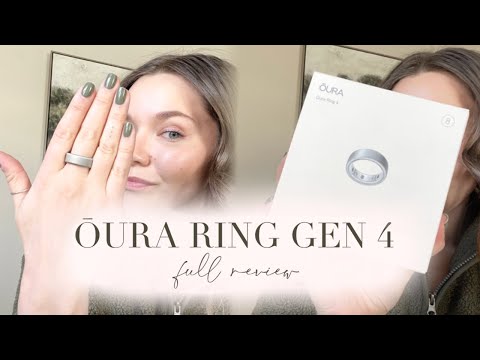
The Oura Ring 4, announced on October 3 and shipping from October 15, 2024, is the most technically accomplished consumer health ring available anywhere in 2026. It is not an iterative update to the Gen 3 — it is a ground-up hardware redesign built around a proprietary sensing architecture called Smart Sensing that fundamentally changes how the ring measures your physiology.
| 🏆 Oura Ring 4 — At a GlancePrice: $349 (Silver · Black · Stealth) · $449 (Gold · Rose Gold · Brushed Silver) · $499 (Ceramic) Core technology: Smart Sensing — 18-path multi-wavelength adaptive PPG Design: All-titanium body · recessed smooth interior · Horizon shape only Sizes: US 4–15 (12 sizes — the widest range on the smart ring market) Battery: Up to 8 days on a single charge Water resistance: 100m (swimming · showering · sauna) Membership: $5.99/month or $69.99/year (6 months free with new ring purchase) |
The Most Important Gen 4 Hardware Change: No More Sensor Bumps
The single most impactful design change in the Gen 4 is something you feel the moment you put it on: the raised interior sensor domes are gone. Completely. The Gen 4 interior is a perfectly smooth titanium surface with no protrusions whatsoever. This eliminates the comfort complaints that followed the Gen 3 throughout its three-year lifecycle and makes the Gen 4 feel genuinely like a piece of fine jewellery rather than a technology device with hardware soldered to the inside.
The domes were removed because Smart Sensing makes them unnecessary. When you have 18 available signal pathways that the algorithm can dynamically select between, you no longer need a fixed dome positioning sensors at a specific optimal location. The optimal location is now determined in software, not in hardware — and the ring can measure just as accurately whether it is perfectly positioned or slightly rotated.
All-Titanium Construction
The Gen 3 used a titanium outer shell bonded to an epoxy resin interior coating. The Gen 4 is fully titanium throughout — inside and out. This change improves durability, biocompatibility (titanium is the gold standard for medical implants and surgical instruments), and overall structural integrity. Combined with PVD (Physical Vapor Deposition) colour coatings on non-silver models, the Gen 4 is meaningfully more resistant to wear and corrosion than previous generations.
The ring is also lighter than the Gen 3 despite the additional sensor pathways — starting at 3.3g for the smallest size versus approximately 4g for the equivalent Gen 3 size — because the removal of the interior dome structure reduces material.
Gen 4 Full Technical Specifications
| Specification | Oura Ring 4 (Gen 4) |
| Release date | October 15, 2024 |
| Body material | Full titanium (interior + exterior) with PVD coatings |
| Interior design | Recessed — smooth, flush titanium surface |
| Shape | Horizon only (Heritage discontinued) |
| PPG signal pathways | 18-path Smart Sensing (multi-wavelength, adaptive) |
| LED types | Red, infrared, and green LEDs |
| Temperature sensor | Digital NTC (±0.1°C precision) |
| Motion sensor | 3D accelerometer |
| SpO₂ signal quality vs Gen 3 | +120% improvement |
| SpO₂ accuracy vs Gen 3 | +30% average overnight accuracy |
| Night HR monitoring gaps vs Gen 3 | 31% reduction |
| Day HR monitoring gaps vs Gen 3 | 7% reduction |
| Breathing disturbance index vs Gen 3 | +15% accuracy |
| Sizes | US 4–15 (12 sizes) |
| Battery life | Up to 8 days |
| Charge time | Up to 120 minutes (full charge, puck charger) |
| Water resistance | 100m |
| Weight | 3.3g (size 6) to 5.3g (size 13) |
| Connectivity | Bluetooth Low Energy (BLE) |
| EMF / SAR | 0.0003 W/kg (~3,000× lower than a smartphone) |
| Price range | $349 – $499 depending on finish |
| Membership | $5.99/month or $69.99/year |
For a full independent review of the Gen 4 covering real-world use, accuracy, and value, see: Oura Ring Gen 4 Review: Is It Worth Buying? · For battery-specific guidance: Oura Ring 4 Battery Life Guide.
6. Smart Sensing: How the 18-Path PPG Technology Works
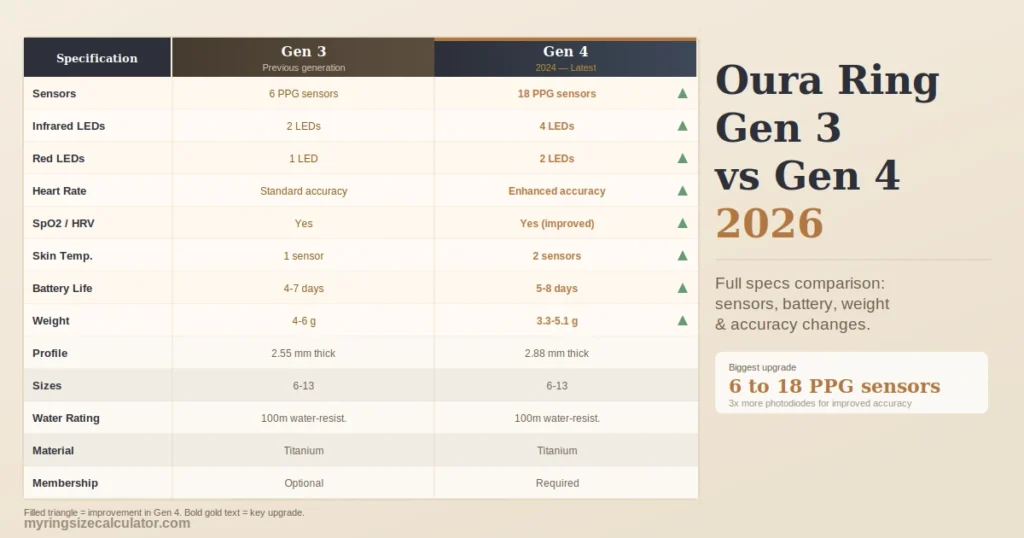
Smart Sensing is the proprietary technology platform that makes the Oura Ring 4 categorically different from every previous generation — and from every competing smart ring on the market in 2026. It is simultaneously the most important and least understood aspect of the Gen 4. This section explains exactly how it works, why it was developed, and why the accuracy improvements it delivers are so significant.
The Problem: Why Fixed PPG Pathways Fail
Photoplethysmography (PPG) works by shining light from an LED into the tissue beneath the ring and measuring the variation in light absorption caused by blood pulsing through the arteries with each heartbeat. The richer the arterial blood supply beneath the sensor, the stronger and more reliable the signal.
Every previous Oura Ring — and every competing smart ring — uses a fixed set of sensor pathways: the same LEDs fire, the same photodetectors receive, every measurement cycle. This is reliable when the ring sits perfectly positioned with its sensors facing the palm side of the finger — where the digital arteries run closest to the skin surface. But rings move. During sleep, they rotate. During exercise, they shift. Even tiny amounts of rotation can move a fixed sensor from directly over an artery to a position where it is measuring through less vascular tissue — resulting in weaker signals, missed beats, data gaps, and inaccurate readings.
In the Gen 3, this rotation problem caused the most common technical complaints from serious users: gaps in HRV data during sleep, inconsistent SpO₂ readings, and occasional missed sleep stage transitions. The issue was not unique to Oura — it affected every smart ring using fixed PPG pathways.
The Solution: 18 Adaptive Signal Pathways
Instead of using fixed pathways, the Gen 4 embeds 18 available LED-photodetector pathway combinations — using red, infrared, and green LEDs paired with multiple photodetectors distributed around the interior of the ring. A continuous real-time algorithm evaluates signal quality across all 18 pathways and selects the optimal combination for each measurement type and moment.
If the ring rotates 30 degrees during sleep, the algorithm simply selects a different pathway combination that now has optimal arterial proximity. The measurement never stops. Data gaps are eliminated. From the user’s perspective, nothing changes — but the underlying data quality improves dramatically and consistently.
Personalised Physiology Calibration
Smart Sensing does more than solve the rotation problem. The platform also performs physiological calibration — on first use (and periodically thereafter), it evaluates the user’s unique finger anatomy: diameter, skin tone and pigmentation, subcutaneous fat thickness, vascular depth and density, body mass index, and age. It uses this profile to build a personalised measurement strategy that prioritises the pathways most effective for that specific individual’s physiology.
This calibration addresses a longstanding equity issue in health wearables: fixed-pathway PPG systems are less accurate for people with darker skin tones, because melanin absorbs more of the light emitted by the sensor. Smart Sensing’s adaptive approach substantially reduces this disparity, making Gen 4 the first Oura Ring to deliver genuinely consistent accuracy across the full range of human physiological diversity.
Smart Sensing Accuracy: The Clinical Evidence
In August 2024, Oura commissioned an independent external study in which 60 participants — with diversity across gender, age, and skin tone — wore both Gen 3 and Gen 4 rings simultaneously during a structured overnight session, alongside clinical-grade reference devices including ECG heart monitors and EEG systems. Key findings:
| Measured Improvement | Gen 4 vs Gen 3 Result | Clinical Significance |
| SpO₂ signal quality | +120% improvement | Dramatically cleaner blood oxygen data during sleep |
| Average overnight SpO₂ | +30% accuracy increase | More reliable sleep apnea and breathing event detection |
| Breathing disturbance index | +15% accuracy improvement | Better identification of irregular breathing patterns |
| Night HR monitoring gaps | 31% fewer data gaps | More complete heart rate and HRV profiles during sleep |
| Day HR monitoring gaps | 7% fewer data gaps | More consistent cardiovascular data during active hours |
For the full scientific detail on the Gen 4’s measurement technology, see: How Does the Oura Ring 4 Work? · External research: Oura Smart Sensing Science Blog.
7. Oura Ring Gen 3 vs Gen 4: Complete Side-by-Side Comparison
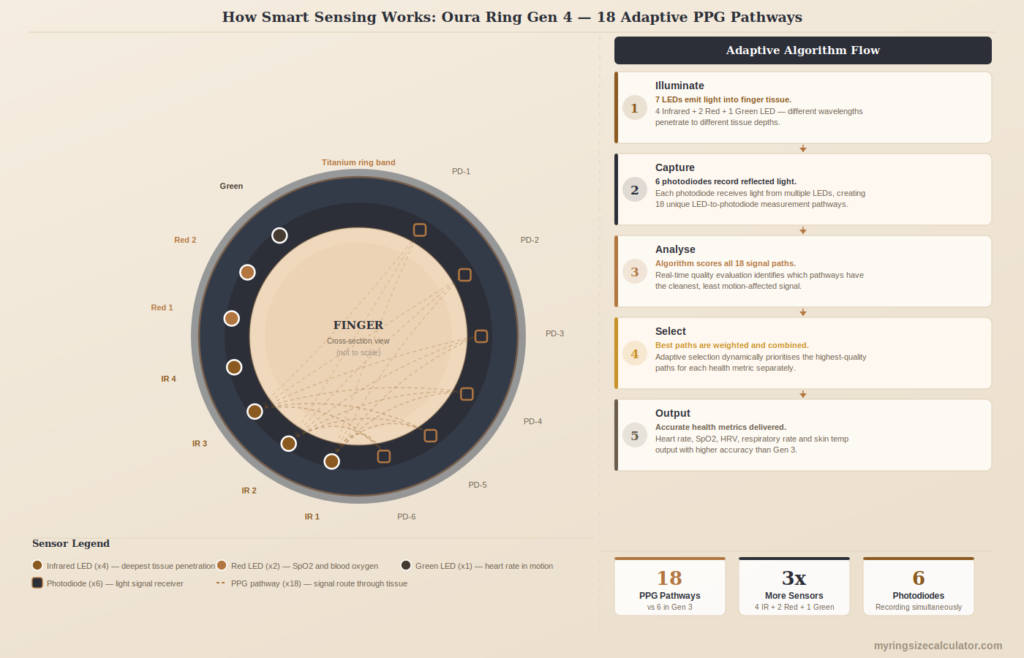
If you are deciding between a new Gen 4 and a discounted Gen 3 refurbished unit — or deciding whether to upgrade from a working Gen 3 — this is the section you need. We cover every meaningful difference, including the ones that are not obvious from spec sheets.
| Category | Oura Ring Gen 3 | Oura Ring Gen 4 |
| Release date | Late 2021 | October 15, 2024 |
| Body material | Titanium + epoxy interior | All-titanium, inside and out |
| Interior feel | Raised sensor domes — noticeable bumps | Completely smooth, recessed flush surface |
| PPG pathways | 8 fixed pathways | 18 adaptive Smart Sensing pathways |
| SpO₂ signal | Baseline | +120% signal quality |
| SpO₂ accuracy | Baseline | +30% accuracy improvement |
| Night HR data gaps | Baseline | 31% fewer gaps |
| Day HR data gaps | Baseline | 7% fewer gaps |
| Breathing (BDI) | Baseline | 15% more accurate |
| Ring rotation impact | Data gaps when ring rotates | Zero impact — algorithm re-routes instantly |
| Skin tone accuracy | Reduced for darker skin tones | Adaptive — consistent across all skin tones |
| Sizes | US 6–13 (8 sizes) | US 4–15 (12 sizes) |
| Shapes | Heritage + Horizon | Horizon only (Heritage discontinued) |
| Weight (size 6) | ~4g | 3.3g |
| Battery life | 4–7 days | Up to 8 days |
| Colours | 4 finishes | 6 finishes + Ceramic |
| Price (new) | $299 at launch — discontinued | $349–$499 |
| Availability | Refurbished only | Available new from ouraring.com |
| App support | Still supported | Fully supported + new features |
| 🔑 The Upgrade Decision Upgrade from Gen 3 → Gen 4 if you use SpO₂ data, experience data gaps or inconsistent sleep readings, have darker skin tone, need sizes below 6 or above 13, or find the interior dome bumps uncomfortable. Stay on Gen 3 if your ring works well, your data is consistent, and you primarily use Readiness Score and sleep staging. The Gen 3 continues to serve these functions adequately and still receives software support. Buying new in 2026? Buy the Gen 4. There is no case for the Gen 3. See our full upgrade analysis: Oura Ring Gen 4 vs Gen 3 vs Galaxy Ring |
8. Oura Ring Gen 4 Colors & Finishes: All Options Explained
The Oura Ring 4 ships exclusively in the Horizon shape — the smooth circular band. The Heritage flat-top design was retired with the Gen 3. Within the Horizon shape, seven finish options are available across two material categories.
| Finish | Material | Price (USD) | Notes |
| Silver | Titanium + PVD | $349 | Classic and versatile — the most popular finish |
| Black | Titanium + tungsten PVD | $349 | Deep gloss black — more durable and richer than Gen 3 black |
| Stealth | Titanium + PVD | $349 | Matte dark grey — the most subtle, understated option |
| Gold | Titanium + PVD | $449 | Warm yellow-gold tone — PVD coating, not solid gold |
| Rose Gold | Titanium + PVD | $449 | Pink-gold tone — the most popular option among women |
| Brushed Silver | Titanium + PVD | $449 | Textured matte silver — a premium everyday look |
| Ceramic | Zirconia ceramic | $499 | Scratch-resistant · heaviest · most premium · hypoallergenic |
A common question about the gold-toned finishes is whether they contain real gold. They do not — all metallic colour finishes are PVD coatings applied over a titanium base. PVD is extremely durable and is used in high-end watchmaking, but it is not solid gold or gold-filled. The Ceramic variant is the only finish made from a different base material (Zirconia ceramic rather than titanium). For a full guide to the rose gold and gold finishes: Is the Oura Ring Rose Gold Real?.
9. Oura Ring Gen 5: Release Date, Features & What We Know
As of March 2026, Oura Health has not announced the Gen 5 ring. No release date, no feature set, and no official specifications have been shared. Everything in this section is clearly labelled as confirmed fact, historical extrapolation, or unverified rumour.
Confirmed Facts About Gen 5 (as of March 2026)
- Oura Health has made no public announcement about a Gen 5 ring.
- No official release date, price, or specification has been shared.
- Based on Oura’s historical hardware release cadence (Gen 2: late 2018, Gen 3: late 2021, Gen 4: late 2024), a Gen 5 following the same ~3-year cycle would not be expected before late 2027 at the earliest.
- The Gen 4 launched in October 2024 and is less than one year old as of this writing — Oura will support it with software updates throughout its lifecycle.
What Industry Analysts and Patent Research Suggest (Rumoured — Unconfirmed)
- Blood pressure estimation: The most credibly rumoured feature. Samsung has introduced blood pressure monitoring to the Galaxy Ring ecosystem. Multiple Oura patent filings relate to cardiovascular physiological measurement. If cuffless BP estimation becomes sufficiently accurate for FDA clearance — a significant technical and regulatory bar — it would be transformational for the platform
- Enhanced glucose monitoring: Integration with CGM devices like Dexcom Stelo (which Oura already supports) may deepen into more direct metabolic sensing in future generations
- Gesture recognition: Oura has filed patents related to motion-based finger gesture recognition — allowing the ring to serve as an input device as well as a sensor
- Longer battery life: Each generation has improved battery life (Gen 3: 4–7 days; Gen 4: up to 8 days). A Gen 5 targeting 10–14 days is plausible based on ongoing LED efficiency improvements
- Additional form factors: Pure speculation — but the smart ring market expanding rapidly may prompt Oura to consider different ring profiles or even a dedicated athletic variant
| ⚠️ Do Not Wait for Gen 5 Waiting for an unannounced product that is years away is a poor trade against the genuine health value the Gen 4 provides today. Every month of Oura Ring ownership generates physiological baseline data that makes your health scores more accurate and more meaningful — data you cannot recover retroactively. The Gen 4 is outstanding. Buy it now. For the full Gen 5 analysis: Oura Ring Gen 5: Everything We Know |
10. Which Oura Ring Generation Should You Buy?
The answer is unambiguous in 2026: buy the Gen 4. But here is the full decision framework if your situation requires nuance.
Buy the Gen 4 if you are…
- A first-time buyer: The Gen 4 is the definitive Oura Ring. Buy it directly from ouraring.com, Best Buy, or Target. No other generation is relevant for new purchases
- A Gen 2 owner: Upgrade immediately. Gen 2 is out of app support. You are running on a discontinued, unsupported device
- A Gen 3 owner with data quality issues: If you experience SpO₂ inconsistencies, HRV gaps, or sleep stage irregularities — particularly if you sleep on your side or your ring rotates during the night — the Gen 4’s Smart Sensing directly solves these problems
- A user with darker skin tone: Gen 4’s adaptive calibration delivers significantly more consistent accuracy across all skin tones than the fixed-pathway Gen 3
- A user who needs size 4, 5, 14, or 15: These sizes exist only in the Gen 4
It May Be Fine to Stay on Gen 3 if…
- Your Gen 3 is working well with consistent, reliable data and you have no comfort issues with the sensor domes
- Your primary use case is Readiness Score and basic sleep staging — the Gen 3 continues to perform these functions acceptably while app support continues
- Budget is a significant constraint — a discounted refurbished Gen 3 costs considerably less than a new Gen 4
For a detailed cost-benefit analysis of the upgrade decision including total ownership cost over 3 years: Oura Ring Gen 4 Review.
11. Oura Ring Sizing by Generation: What Changed and Why It Matters
Oura Ring sizing is one of the most misunderstood aspects of the product — and the differences between generations make it more complicated than standard jewellery sizing. Oura Ring sizes are not the same as standard ring sizes, and the sizing dynamic changed meaningfully between Gen 3 and Gen 4.
How Gen 3 Sizing Worked
The Gen 3’s raised interior sensor domes occupied space inside the ring band, effectively reducing the internal circumference available for your finger. Most users found they needed to size up by half a size to a full size compared to their standard jewellery ring size. This created consistent confusion for first-time buyers who ordered based on their jewellery size and received a ring that was too tight.
How Gen 4 Sizing Works
The Gen 4’s smooth, recessed interior changes the sizing profile compared to the Gen 3. Without the dome protrusions, the internal geometry is different. Oura explicitly recommends that even existing Gen 3 users request a new Gen 4 Sizing Kit before ordering the Gen 4, rather than assuming their Gen 3 size transfers. This is important: even users who have worn a Gen 3 successfully may need a different size in Gen 4.
The Gen 4 Sizing Kit — a set of plastic rings in all available sizes (4–15) — is available free from ouraring.com and is also stocked at Best Buy and Target. Oura recommends wearing the sizing rings for at least 24 hours including sleep, because fingers can swell overnight by up to half a size.
As ring sizing specialists, we have extensive guidance on this exact topic. For a complete methodology including how to measure at home if you cannot access a physical sizing kit: How to Measure Your Oura Ring Size at Home · Oura Ring Size vs Regular Ring Size: Are They the Same? · Which Finger Should You Wear Your Oura Ring On?.
12. Frequently Asked Questions
Structured for Google Featured Snippets, People Also Ask, and AI Overviews.
How many Oura Ring generations are there?
There are four Oura Ring hardware generations: Gen 1 (2017), Gen 2 (2018), Gen 3 (2021), and Gen 4 (October 2024). A Gen 5 has not been announced. Only the Gen 4 is currently available as a new purchase. Gen 1 and Gen 2 are discontinued and no longer app-supported. Gen 3 may be found as refurbished stock.
What is the latest Oura Ring generation?
The latest Oura Ring is the Oura Ring 4 (Gen 4), released on October 15, 2024. It is the current flagship model featuring Smart Sensing technology with 18 PPG signal pathways, all-titanium construction, smooth recessed sensors, sizes US 4–15, up to 8 days of battery life, and seven finish options.
Is the Oura Ring Gen 4 worth upgrading from Gen 3?
For most users, yes — particularly if you use SpO₂ monitoring, experience HRV data gaps during sleep, have darker skin tone, or find the Gen 3’s interior domes uncomfortable. The Gen 4’s Smart Sensing platform delivers +120% SpO₂ signal quality, 31% fewer nighttime HR monitoring gaps, and fully recessed smooth sensors that eliminate comfort issues. If your Gen 3 provides consistent data and you have no fit issues, the upgrade is less urgent.
What is Smart Sensing in the Oura Ring 4?
Smart Sensing is Oura’s proprietary sensing platform in the Gen 4. It replaces the Gen 3’s fixed 8-pathway PPG system with 18 adaptive pathway combinations. A real-time algorithm evaluates all 18 pathways and selects the optimal combination based on current signal quality, ring position, and the user’s physiological profile (skin tone, finger size, vascular anatomy). This eliminates data gaps caused by ring rotation and adapts measurement to individual physiology — delivering up to 120% better SpO₂ signal quality and 30% more accurate overnight SpO₂ readings vs Gen 3.
When was the Oura Ring 4 released?
The Oura Ring 4 was announced on October 3, 2024 and began shipping on October 15, 2024. It is available directly from ouraring.com and at major retailers including Amazon, Best Buy, Target, and John Lewis (UK). For full release details: When Was the Oura Ring 4 released?.
Will there be an Oura Ring Gen 5?
Yes, eventually — but not soon. As of March 2026, Oura has made no announcement about a Gen 5. Based on the historical 3-year release cadence (Gen 2 → Gen 3 → Gen 4), a Gen 5 is not expected before late 2027 at the earliest. Do not delay purchasing a Gen 4 in anticipation of an unannounced product. For the latest developments: Oura Ring Gen 5: Everything We Know.
What sizes does the Oura Ring Gen 4 come in?
The Oura Ring 4 is available in US sizes 4 through 15 — a total of 12 sizes, the widest range of any smart ring on the market. This extends the Gen 3’s range (sizes 6–13) in both directions. Oura provides a free sizing kit to ensure accurate fit. Oura Ring sizing differs from standard jewellery sizing — always use the kit before ordering.
Does the Oura Ring Gen 4 have a Heritage style?
No. The Heritage ring shape — the flat-top design with subtle angular edges — was discontinued with the Gen 3. The Oura Ring 4 is available exclusively in the Horizon shape (smooth circular band). All seven finish options — Silver, Black, Stealth, Gold, Rose Gold, Brushed Silver, and Ceramic — are Horizon only.
What are the most common Oura Ring 4 problems?
The Gen 4 is a reliable device. Reported issues include occasional Bluetooth sync delays, faster battery drain when continuous SpO₂ monitoring is enabled, and mild skin sensitivity from wearing the ring without drying it thoroughly after water exposure. For a full troubleshooting guide: Common Oura Ring 4 Problems & Fixes.
Explore Every Oura Ring Guide
| 🔗 Complete Oura Ring Resource Hub — myringsizecalculator.com Parent Page→ Oura Ring: The Complete Guide (Main Hub) Generation & Model Articles→ Oura Ring Gen 4 Review: Is It Worth Buying?→ When Was the Oura Ring 4 Released?→ Oura Ring Gen 3 vs Gen 4 Thickness & Design Changes→ Oura Ring Gen 4 vs Gen 3 vs Samsung Galaxy Ring→ Benefits of the Oura Ring 4→ Is the Oura Ring Rose Gold Real?→ Oura Ring Gen 5: Everything We Know Features & Health Tracking→ How Does the Oura Ring 4 Work? Sensors Explained→ Does the Oura Ring Measure Blood Pressure?→ Can the Oura Ring Detect Sleep Apnea?→ Oura Ring 4 Battery Life Guide→ Common Oura Ring 4 Problems & Fixes Buying & Sizing→ Best Oura Rings to Buy in 2026→ Free Ring Size Calculator — measure before you order |
Sources & External References
Primary Sources — Oura Official
- Oura Ring 4 Official Product Page
- Smart Sensing: Unparalleled Accuracy and Personalization — Oura Blog
- Introducing the Oura Ring 4 — Official Announcement
- Oura Ring 4 Technology Breakdown
- Oura Ring 4 Support Documentation & Specs
- Oura Science & Research Overview
Peer-Reviewed Clinical Research
- Sleep Medicine Journal (2024): Oura Ring Gen 3 PSG Validation — 96 Participants, 421,045 Epochs
- PMC / OTO Open (2026): Systematic Review & Meta-Analysis — Oura Ring vs Clinical Sleep Studies
- UCSF TemPredict Study — Illness Detection via Wearable Temperature Data
- PubMed: JMIR (2024) — Consumer Wearable Sleep Tracker Accuracy Comparison
Last updated: March 2026 · Author: MyRingSizeCalculator.com Editorial Team · Disclosure: This article contains affiliate links. We may earn a commission at no additional cost to you. Our editorial opinions are independent and based on research and use. Medical Disclaimer: The Oura Ring is not a medical device. Consult a qualified healthcare provider for any health concerns.