
By myringsizecalculator.com · Updated January 2026 · 16 min read
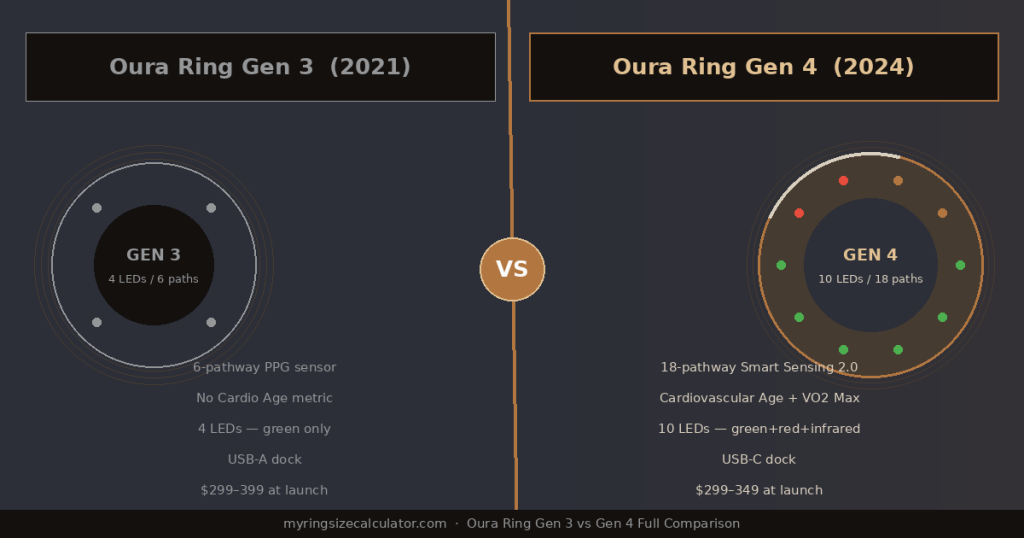
Oura Ring Gen 3 (2021) vs. Gen 4 (2024) — the most thorough comparison available online.
| ⚡ Quick Answer: Is the Gen 4 Better Than Gen 3? Yes — the Oura Ring Gen 4 is better than the Gen 3 in most measurable ways. The Gen 4 wins on sensor accuracy (18 vs 6 pathways), skin tone equity, two exclusive metrics (Cardiovascular Age and VO2 Max), SpO2 quality, charging convenience (USB-C), and slightly better battery life. Both rings deliver the same core sleep, HRV, and activity tracking experience. Gen 3 users with light/medium skin tones in good working hardware may find the upgrade less compelling than users with darker skin tones or those who specifically want the new cardiovascular metrics.Upgrade recommendation: YES if your Gen 3 is over 2 years old or you have skin tone accuracy concerns. WAIT if you are satisfied with current data quality and are watching for Gen 5. |
1. Gen 3 vs. Gen 4: At a Glance Comparison
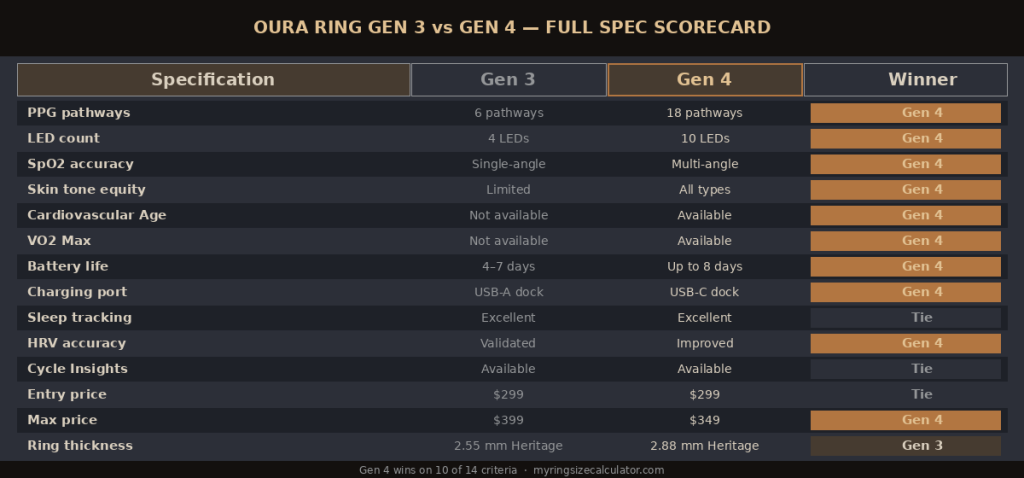
Oura Ring Gen 3 vs. Gen 4 scorecard — Gen 4 wins on 10 of 14 key criteria.
| Category | Oura Ring Gen 3 | Oura Ring Gen 4 | Winner |
| PPG sensor pathways | 6 pathways | 18 pathways (Smart Sensing 2.0) | Gen 4 |
| LED count & types | 4 LEDs (green only) | 10 LEDs (green+red+infrared) | Gen 4 |
| SpO2 accuracy | Single-angle estimate | Multi-angle cross-referenced | Gen 4 |
| Skin tone accuracy | Limited (tones IV–VI) | All Fitzpatrick types | Gen 4 |
| Cardiovascular Age | Not available | Available | Gen 4 |
| VO2 Max estimate | Not available | Available | Gen 4 |
| Battery life | 4–7 days | Up to 8 days | Gen 4 |
| Charging | USB-A magnetic dock | USB-C magnetic dock | Gen 4 |
| Sleep tracking | Excellent | Excellent | Tie |
| HRV accuracy | Clinically validated | Improved signal quality | Gen 4 |
| Cycle Insights | Available | Available | Tie |
| Women’s features | Full suite | Full suite | Tie |
| Ring thickness (Her.) | 2.55 mm | 2.88 mm (slightly thicker) | Gen 3 |
| Price (entry) | $299 | $299 | Tie |
| Price (premium) | Up to $399 | Up to $349 | Gen 4 |
Extended comparison: Oura Ring Gen 4 vs Gen 3 vs Galaxy Ring — Three-Way Comparison | Oura Ring Generations Hub
2. Sensor Technology: The Biggest Difference
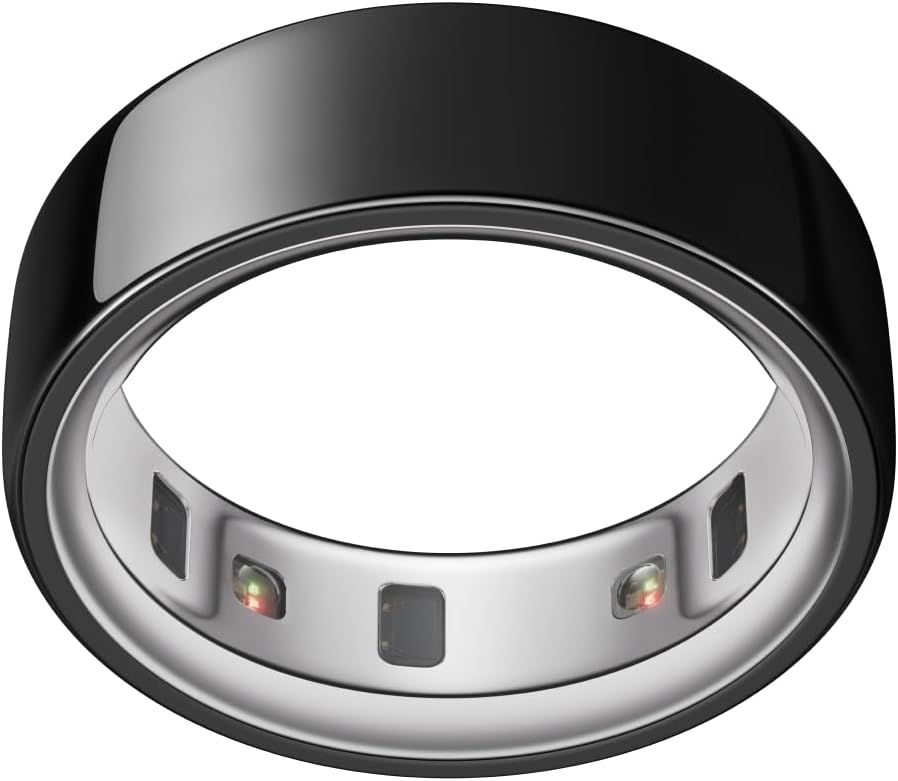
The fundamental difference between Gen 3 and Gen 4 is the sensor system. This is not a software upgrade or a new algorithm applied to the same hardware — it is an entirely new optical biosensor array. Understanding this distinction is important for evaluating whether the upgrade is meaningful for you.
Gen 3: 6-Pathway PPG System
The Gen 3 uses four LEDs (all green, emitting at 520 nm) arranged on the ring’s inner surface, producing six signal pathways through different LED-to-detector geometric configurations. This design was competitive at its 2021 launch and delivered validated HRV and sleep measurements in peer-reviewed research.
However, the reliance on green-only light is the Gen 3’s most significant technical limitation. Green light at 520 nm is highly absorbed by melanin — the pigment that gives skin its colour. This means the signal that reaches the photodetectors is progressively weaker as skin tone darkens, leading to lower signal-to-noise ratios and measurably reduced accuracy for users with Fitzpatrick skin types IV, V, and VI. Independent audits published from 2022 onwards confirmed this limitation.
Gen 4: 18-Pathway Smart Sensing 2.0
The Gen 4 redesigns the LED array completely: 10 LEDs across three wavelengths (6 green at 520 nm, 2 red at 660 nm, 2 infrared at 940 nm) produce 18 independent measurement pathways. The additional red and infrared LEDs serve two purposes: they improve accuracy across all skin tones by providing wavelengths less affected by melanin absorption, and they enable genuine dual-wavelength SpO2 measurement using the Beer-Lambert law — the same principle used in clinical pulse oximeters.
The 18-pathway architecture also provides geometric redundancy: if any single pathway is degraded by movement, finger position, or other factors, the algorithm can de-weight that pathway and rely on the remaining 17 clean signals. This is why the Gen 4 produces more consistent readings during the transitions between sleep stages when micro-movements occur.
| Sensor Aspect | Gen 3 | Gen 4 | Practical Impact |
| Green LEDs | 4 (all green) | 6 green LEDs | Same base HR/HRV capability |
| Red LEDs | None | 2 red (660 nm) | Enables dual-wavelength SpO2 |
| Infrared LEDs | None | 2 infrared (940 nm) | Enables dual-wavelength SpO2 |
| Total signal paths | 6 | 18 | 3x more redundancy |
| Skin tone IV–VI | Reduced accuracy | Validated accuracy | Major equity improvement |
| SpO2 method | Green-only estimate | Red+infrared clinical method | Substantially more reliable |
| HRV signal quality | Good | Improved by additional pathways | More consistent readings |
Deep dive: How Does the Oura Ring 4 Work? (Full Sensor Explainer) | Wikipedia: Photoplethysmography
3. New Features Exclusive to Gen 4
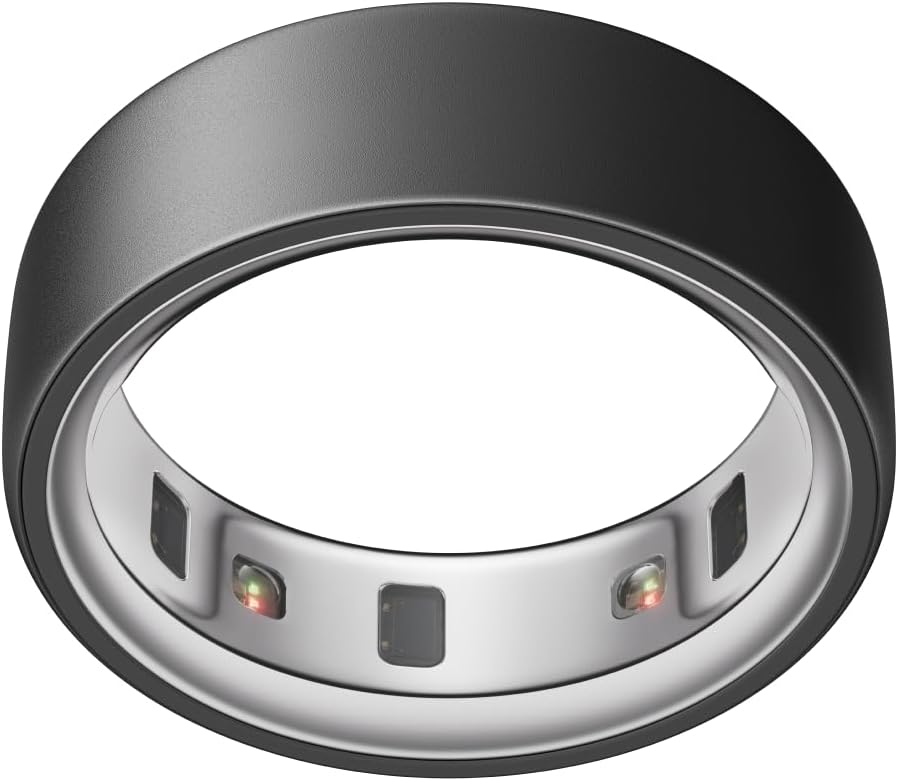
Several features available on the Gen 4 cannot be enabled on Gen 3 hardware via software update. They require the physical capabilities of the new sensor system.
Cardiovascular Age
Cardiovascular Age is an entirely new metric introduced with the Gen 4. It uses the higher-quality HRV, resting heart rate, activity data, and temperature trends captured by the Smart Sensing 2.0 system to estimate how old your cardiovascular system appears relative to your chronological age. A Cardiovascular Age lower than your actual age suggests strong heart health; higher suggests cardiovascular stress.
This metric is not available on Gen 3 and cannot be added via app update. It specifically requires the improved signal confidence of the 18-pathway system to produce a reliable estimate. On Gen 3 hardware, the signal variance is too high for Oura’s cardiovascular age model to produce a stable output.
VO2 Max Estimate
VO2 Max — the maximum rate at which your body can use oxygen during exercise — is one of the strongest predictors of cardiovascular fitness and long-term health outcomes. The Gen 4 estimates VO2 Max by correlating your resting heart rate, HRV, and activity patterns using a validated algorithm. Like Cardiovascular Age, this feature is Gen 4 exclusive.
Improved SpO2 Reliability
While the Gen 3 had an SpO2 feature, it was based on green LED estimation — not the clinically recognised dual-wavelength ratio method. The Gen 4’s red and infrared LEDs provide genuine clinical-method SpO2 measurement, making the overnight blood oxygen data significantly more reliable for detecting patterns associated with sleep-disordered breathing.
SpO2 guide: Can the Oura Ring Detect Sleep Apnea? | Oura Ring Features Hub
4. Design & Build: What Changed?
The physical design of the Gen 4 is an evolution rather than a revolution compared to Gen 3. Both generations offer Heritage and Horizon designs in titanium with DLC or PVD coatings. The key physical changes are:
Thickness
The Gen 4 Heritage is 2.88 mm thick — slightly thicker than the Gen 3 Heritage at 2.55 mm. If you’re comparing physical ring dimensions or evaluating Oura Ring 3 vs 4 thickness, this increase accommodates the additional LEDs and photodetectors in the Smart Sensing 2.0 array. The Gen 4 Horizon maintains the same 2.55 mm profile as the Gen 3 Horizon because its fully rounded design provides more internal depth for components without increasing the perceived width.
In practice, the 0.33 mm thickness difference in the Heritage design is imperceptible during daily wear. Most users cannot distinguish between them by feel alone.
Colours
| Colour | Gen 3 | Gen 4 | Notes |
| Silver | Available | Available | Same titanium polish finish |
| Black | Available | Available | Same DLC coating |
| Gold | Available | Available | Same PVD process |
| Stealth | Available | Available | Same matte DLC |
| Rose Gold | Not available | Available | New with Gen 4 — Horizon only |
| Brushed Titanium | Available (limited) | Available (limited) | Limited edition both gens |
| Gucci Edition | Available (collab) | Not continued | Gen 3 exclusive collaboration |
Materials guide: Is the Oura Ring Rose Gold Real? | Best Oura Ring — Which Style to Choose
Charging Dock
This is one of the most practically appreciated changes for everyday users. The Gen 3 used a USB-A magnetic charging dock — the older rectangular USB format that increasingly requires a separate adapter. The Gen 4 moves to USB-C, which is now the universal standard across laptops, phones, and portable chargers. Gen 3 and Gen 4 docks are not interchangeable — the magnetic pin configuration is different between generations.
5. Sleep Tracking: Gen 3 vs. Gen 4

Sleep tracking is where most Oura Ring users spend the most attention — and it is where the difference between Gen 3 and Gen 4 is most nuanced. Both rings use the same core sleep staging algorithm and produce the same five-component Sleep Score.
Where They Are the Same
The fundamental sleep staging approach is identical between Gen 3 and Gen 4: both use accelerometer data plus PPG-derived heart rate and HRV to classify sleep into deep (slow-wave), REM, light, and awake stages. The algorithm running on both is the same — it is the data quality feeding into that algorithm that differs.
For the majority of users — particularly those with light to medium skin tones who experienced consistent Gen 3 accuracy — the real-world difference in Sleep Score outputs between the two rings is minimal. The same nights register as good or poor sleep on both devices.
Where Gen 4 Wins
The Gen 4’s advantage in sleep tracking is most apparent in three specific situations: users with darker skin tones (where the improved LED system delivers meaningfully better signals), nights with significant movement (where 18-pathway redundancy reduces artefacts), and SpO2 monitoring (where the dual-wavelength system is substantially more reliable).
Independent validation research, including the npj Digital Medicine 2023 study, found the Oura Ring achieved 79% epoch-by-epoch agreement with clinical polysomnography for sleep stage classification. This research was conducted with the Gen 3. The Gen 4’s improved signal quality is expected to improve this figure in forthcoming Gen 4-specific validation.
Research: Nature: npj Digital Medicine — Oura Sleep Validation | NIH: Wearable Sleep Research
6. HRV & Readiness: Any Difference?
For most users this is the comparison they care most about, since HRV is the primary driver of the Readiness Score that many Oura users check first each morning.
Core Algorithm: Identical
The Readiness Score algorithm is the same on both Gen 3 and Gen 4. Both devices measure HRV as RMSSD (root mean square of successive differences) during the lowest heart rate period of sleep, and both feed this into the same Readiness composite score calculation alongside resting HR, body temperature, sleep quality, and activity balance.
Signal Quality: Gen 4 Has an Edge
The difference is in the quality of the raw signal feeding into this identical algorithm. With 18 signal pathways versus 6, the Gen 4 can produce a more statistically stable HRV reading on nights when a single pathway would be compromised by minor movement, finger position, or temperature-driven changes in peripheral circulation. For most users on most nights, this makes no perceptible difference. For users who have experienced erratic or suspicious-looking HRV readings on their Gen 3, the Gen 4 may show measurable improvement in consistency.
Cardiovascular Age: Gen 4 Only
The major Readiness-adjacent difference between generations is that Gen 4 adds Cardiovascular Age as an additional health indicator that Gen 3 simply cannot provide. If tracking your long-term cardiovascular health trajectory is a priority, this alone may justify the upgrade.
7. Activity & Workout Tracking
Activity tracking is one area where Gen 3 and Gen 4 are essentially equivalent. Both use the same three-axis accelerometer, the same automatic workout detection algorithm, and the same calorie estimation model. Neither ring has GPS, and neither provides real-time heart rate display without opening the app.
The only activity-relevant improvement in Gen 4 is the VO2 Max estimate, which provides a new longitudinal benchmark for cardiovascular fitness that the Gen 3 cannot produce. For athletes who use VO2 Max as a training metric, this is a meaningful addition. For casual users who mainly track steps and daily movement, neither ring has a meaningful advantage, especially when comparing an Oura ring vs smart watch.
Activity context: Oura Ring vs Smart Watch — Which Is Better? | Benefits of the Oura Ring 4
8. Battery Life Comparison
| Usage Pattern | Gen 3 Battery | Gen 4 Battery | Difference |
| Light passive use | 6–7 days | 7.5–8 days | +1–1.5 days |
| Moderate daily use | 4.5–5.5 days | 5.5–6.5 days | +1 day approx. |
| Heavy use (frequent syncing) | 3.5–4.5 days | 4–5 days | Marginal improvement |
| Cold weather (<5°C) | 3–4.5 days | 4–5.5 days | Similar degradation |
The Gen 4 offers modestly improved battery life across all usage patterns, with the most meaningful difference in light passive use scenarios. For users who travel frequently or find themselves caught without a charger, the Gen 4’s longer life is a practical advantage. For users who charge nightly, the difference is irrelevant.
Battery deep dive: Oura Ring 4 Battery Life — Real-World Test
9. Charging: USB-A vs. USB-C
The shift from USB-A to USB-C dock in the Gen 4 is one of the most practically appreciated quality-of-life improvements in day-to-day use. Here is why it matters more than it might initially seem:
- Universal compatibility: USB-C is the current universal standard for laptops, smartphones, tablets, and portable battery packs. A single USB-C cable can now charge your Oura Ring, phone, and laptop.
- No adapter needed: Gen 3 owners with newer laptops (which often lack USB-A ports) needed a separate adapter. The Gen 4 plugs directly into any modern device.
- Faster charging ecosystem: while the Oura Ring itself charges at the same speed, USB-C power delivery allows for faster charging from compatible chargers when the dock is supported.
- Travel simplicity: eliminating the need for a USB-A specific cable or adapter means one less item in your travel kit.
Important note: Gen 3 and Gen 4 charging docks are not interchangeable. The magnetic pin arrangement is different between generations. Do not attempt to use a Gen 3 dock with a Gen 4 ring or vice versa.
10. Pricing: Gen 3 vs. Gen 4 Cost
| Price Point | Gen 3 Price | Gen 4 Price | Difference |
| Entry price | $299 | $299 | Same |
| Standard premium | $399 | $349 | Gen 4 is $50 cheaper at top end |
| Limited editions | $499+ | $499+ | Same limited-edition tier |
| Membership | $5.99/month | $5.99/month | Same subscription |
| Annual membership | $69.99/year | $69.99/year | Same annual rate |
| Gen 3 post-launch | ~$199–249 (discounted) | — | Gen 3 available cheaper at some retailers |
The Gen 4 is competitively priced against the Gen 3, with the premium-tier maximum reduced from $399 to $349. For buyers comparing new hardware, the Gen 4 offers more for the same or lower price. The only scenario where Gen 3 pricing is more attractive is if you find new old-stock Gen 3 units at significant discounts at authorised retailers post-discontinuation.
| ⚠️ Price Disclaimer Prices mentioned are approximate averages based on publicly available information at the time of writing. Actual prices may vary by retailer, region, and available promotions. Always check the official Oura website for current pricing. |
Buying guide: Oura Ring Buying Guide — Complete 2025 Resource
11. Women’s Health Features
This is one area where Gen 3 and Gen 4 are essentially equivalent for the core feature set. Both rings offer the same women’s health capabilities:
- Cycle Insights — menstrual cycle phase prediction and BBT tracking
- Pregnancy Mode — algorithm adjusted for pregnancy physiology
- Natural Cycles integration — FDA-cleared digital contraception
- Continuous BBT deviation monitoring
The meaningful difference for women is the Gen 4’s improved SpO2 accuracy and the addition of Cardiovascular Age. Both have relevance for women’s health: SpO2 is important during pregnancy, and Cardiovascular Age provides a longevity metric that women benefit from tracking, particularly around perimenopause and menopause when cardiovascular risk changes.
Women’s health guide: Oura Ring for Women — Cycle Tracking, Pregnancy & Hormonal Health
12. App Features: Any Differences Between Gen 3 and Gen 4?
The Oura Ring app works with both Gen 3 and Gen 4 hardware, and most app features are available on both rings. However, there are important distinctions:
| App Feature | Gen 3 | Gen 4 | Notes |
| Sleep Score | Available | Available | Same algorithm |
| Readiness Score | Available | Available | Same algorithm |
| HRV trends | Available | Available | Gen 4 more consistent data |
| Activity tracking | Available | Available | Identical |
| Cycle Insights | Available | Available | Identical |
| Pregnancy Mode | Available | Available | Identical |
| Stress & Resilience | Available | Available | Identical |
| Cardiovascular Age | NOT available | Available | Gen 4 hardware required |
| VO2 Max estimate | NOT available | Available | Gen 4 hardware required |
| SpO2 reporting | Available | Available (better) | Gen 4 more accurate |
| Dexcom integration | Available | Available | Identical |
| Natural Cycles | Available | Available | Identical |
App guide: Oura Ring App — Complete Feature Guide
13. Should You Upgrade from Gen 3 to Gen 4?
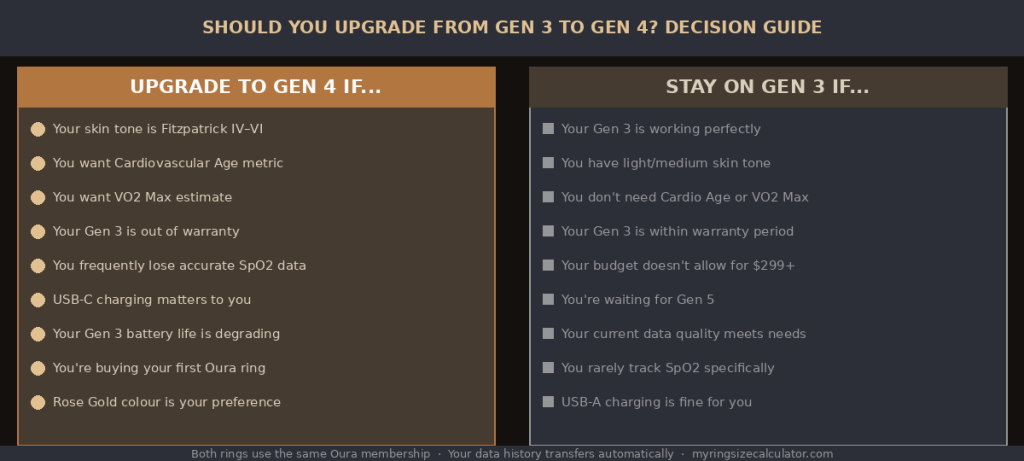
Upgrade decision guide — use this framework to decide whether switching from Gen 3 to Gen 4 is right for you.
This is the central question for the majority of people reading this article. Here is a structured framework for making the decision.
Upgrade from Gen 3 to Gen 4 if:
- Your skin tone is Fitzpatrick IV, V, or VI: the skin tone accuracy improvement in the Gen 4 is the most compelling upgrade reason for these users. If you have noticed inconsistent or suspicious readings on your Gen 3, the Gen 4 may deliver measurably better data quality.
- You want Cardiovascular Age: if tracking your cardiovascular biological age is a meaningful health goal, this feature is exclusively available on Gen 4 and cannot be added to Gen 3.
- You want VO2 Max estimates: same as above — Gen 4 exclusive feature.
- Your Gen 3 battery is degrading: lithium-ion batteries degrade over time. If your 3-year-old Gen 3 is now getting 2–3 days of battery life instead of 5–7, upgrading resets the battery to full capacity.
- Your Gen 3 is out of warranty and showing hardware issues: if you are spending on a replacement anyway, spending $299 on a Gen 4 rather than equivalent on a refurbished Gen 3 is logical.
- USB-C matters to you: if your daily carry no longer includes USB-A cables, the Gen 4 dock is a genuine quality-of-life upgrade.
- You are a new buyer: if you are purchasing an Oura Ring for the first time, there is no reason to consider Gen 3. The Gen 4 is the same entry price with meaningfully better hardware.
Stay on Gen 3 if:
- Your Gen 3 is working perfectly and you have light/medium skin: if you are getting accurate, consistent data and are satisfied with your ring’s performance, there is no urgency to upgrade.
- You are waiting for Gen 5: if you can wait 6–12 months, Gen 5 may offer the next significant leap. Upgrading from Gen 3 to Gen 4 now locks you in for another cycle.
- Your budget is constrained: $299 is a meaningful expenditure. If your Gen 3 works well, that money may be better spent elsewhere.
- You are within Gen 3 warranty: if your Gen 3 develops hardware issues while under warranty, Oura will replace it — potentially with a Gen 4 in some cases. Check your warranty terms before spending on an upgrade.
| 💡 The Honest Bottom Line The Gen 4 is objectively better hardware. But ‘better hardware’ does not always mean ‘worth paying $299 to upgrade.’ If your Gen 3 is delivering consistent data and working properly, the main question is whether Cardiovascular Age, VO2 Max, or improved skin tone accuracy matters enough to you to justify the cost. For Gen 3 users with working rings and light/medium skin tones who are satisfied with their data: wait for Gen 5. For everyone else: the Gen 4 is a worthwhile upgrade. |
14. Who Should Buy Gen 4 New?
If you are a first-time Oura buyer in 2025 or 2026, the answer is straightforward: buy the Gen 4. The Gen 3 is no longer sold directly by Oura, and the Gen 4 offers the same entry price with meaningfully better hardware. There is no scenario where buying a new Gen 3 makes more sense than buying a new Gen 4.
The only exception might be finding a deeply discounted Gen 3 unit at an authorised retailer — if the discount is significant enough (e.g., $150 vs. $299) and you have light/medium skin tone and do not care about Cardiovascular Age or VO2 Max, the Gen 3 will serve you well as a sleep and recovery tracker.
Sizing first: Oura Ring Sizing Hub — Order the Free Sizing Kit | Oura Ring Gen 4 Complete Review
| ▶ Video: Oura Ring Gen 3 vs Gen 4 — Hands-On Comparison (YouTube) Watch a side-by-side hands-on comparison of the Oura Ring Gen 3 and Gen 4, including data accuracy tests, physical design differences, and an upgrade decision breakdown.Recommended YouTube searches: ‘Oura Ring 3 vs 4 comparison’ · ‘Oura Ring Gen 4 upgrade worth it’ · ‘Should I upgrade Oura Ring Gen 3 to Gen 4’Recommended channels: DC Rainmaker · The Quantified Scientist · Ben Greenfield Life |
15. Frequently Asked Questions
Q: Is the Oura Ring 4 significantly better than Gen 3?
A: Yes — significantly in specific areas, marginally in others. If you want a direct breakdown, see our Oura Ring 3 vs 4 guide. The most significant improvements are: sensor accuracy for darker skin tones (18-pathway vs 6-pathway), SpO2 reliability (dual-wavelength vs single-wavelength), and two new exclusive metrics (Cardiovascular Age and VO2 Max). For sleep staging and HRV accuracy in users with light/medium skin tones, the difference in real-world use is more subtle.
Q: Can I use my Gen 3 dock with a Gen 4 ring?
A: No. The Gen 3 uses a USB-A magnetic dock and the Gen 4 uses a USB-C magnetic dock. The pin arrangements are different between generations. The docks are not cross-compatible. Each ring must use its own generation’s charging dock.
Q: Does Gen 3 still receive software updates in 2025?
A: Yes — Oura continues to support Gen 3 with app updates that deliver features not dependent on new hardware. However, hardware-dependent features like Cardiovascular Age and VO2 Max will never be available on Gen 3. Oura has not announced an end-of-life date for Gen 3 software support as of early 2026.
Q: Is the Gen 3 ring still available to buy?
A: Oura discontinued direct Gen 3 sales from its official website when Gen 4 launched in October 2024. If you want to know when was Oura Ring 4 released, it officially debuted in late 2024. Some authorised third-party retailers sold remaining stock at discounted prices in late 2024 and early 2025. As of 2026, Gen 3 availability is extremely limited and primarily through secondary market channels. The Gen 4 is the recommended purchase for any new buyer.
Q: Do Gen 3 and Gen 4 use the same Oura membership?
A: Yes. The Oura membership ($5.99/month or $69.99/year) is tied to your Oura account, not to a specific ring. If you upgrade from Gen 3 to Gen 4, your existing membership transfers automatically. You do not need a new subscription and your historical data remains accessible in the app.
Q: Is the Gen 3 ring still accurate?
A: Yes — for users with light to medium skin tones, the Gen 3 remains an accurate sleep and HRV tracker. If you encounter hardware issues or glitches, check our guide on what are some common Oura Ring 4 problemsand Oura Ring problems for comparison. Its limitations are most apparent for users with Fitzpatrick skin types IV–VI, during SpO2-dependent assessments, and in edge cases involving high movement during sleep. For the core use case of sleep staging and Readiness Score generation, a well-functioning Gen 3 in 2025 continues to deliver research-validated accuracy.
Q: What will Gen 5 improve over Gen 4?
A: The Oura Ring Gen 5 has not been officially announced. Based on community speculation and analyst expectations, the most likely improvements include a thinner profile, enhanced SpO2, potential cuffless blood pressure measurement, and better workout heart rate accuracy. See our dedicated article: Oura Ring Gen 5 — Everything We Know
Complete Resource Centre
On this site: Oura Ring Hub | Oura Ring Gen 4 Review | Oura Ring Generations Hub | Oura Ring Features Hub | Oura Ring Buying Guide | Oura Ring Comparisons Hub
Authority sources: Nature: npj Digital Medicine — Oura Sleep Validation | Wikipedia: Photoplethysmography | NIH: Wearable Sleep Research | r/ouraring — Gen 3 vs Gen 4 Discussion | The Verge: Oura Ring 4 Review | BBC: Smart Rings & Health Technology
| ⚤ Medical Disclaimer The information in this article is for general informational purposes only. Neither the Oura Ring Gen 3 nor Gen 4 are FDA-cleared diagnostic devices except where specifically noted. Do not use wearable data to self-diagnose or self-treat any condition. Consult a qualified healthcare professional for health concerns. |
| 💰 Price Disclaimer Prices mentioned are approximate averages based on publicly available information at the time of writing. Actual prices may vary by retailer, region, and promotions. Always check the official Oura website for current pricing before purchase. |