
| ⚡ Quick Answer: Silicone & Smart Ring Sizing Silicone rings: order 0.5 to 1 full size LARGER than your metal ring size. Silicone is less rigid than metal and sits differently on the finger, requiring more knuckle clearance. Smart rings (Oura, Galaxy Ring, Ultrahuman): ALWAYS use the brand’s official sizing kit worn for 24 hours before ordering. Smart rings cannot be resized and incorrect size means the sensors do not maintain proper contact with your skin. For both types: measure in the evening, size up if between sizes, and account for activity-related swelling if you plan to wear the ring 24/7. |
1. Silicone vs Smart Rings: What’s the Difference?
Silicone rings and smart rings are both alternatives to traditional metal jewellery, but they serve entirely different purposes and require completely different sizing approaches.
| Feature | Silicone Ring | Smart Ring (e.g. Oura Gen 4) |
| Primary purpose | Lifestyle / safety ring alternative | 24/7 health & wellness tracking |
| Material | Medical-grade silicone (flexible) | Titanium shell + sensor array |
| Contains technology | No electronics | PPG sensors, accelerometer, NTC thermistor |
| Can be resized | No — buy a new one (inexpensive) | No — proprietary hardware inside |
| Sizing approach | +0.5 to 1 size from metal ring size | Official brand sizing kit, worn 24 hrs |
| Consequence of wrong size | Discomfort or falls off | Poor sensor contact = inaccurate health data |
| Typical width | 4–10 mm | 7–8 mm |
| Waterproof | Yes — fully waterproof | Yes — typically 100m rated |
| Price range | £5–40 | £250–£450+ |
Related: How the Oura Ring 4 Works | Oura Ring Sizing Hub | Benefits of the Oura Ring 4
2. How to Choose the Perfect Silicone Ring Size
Silicone rings are flexible, stretch-resistant wearables made from medical-grade silicone. Because the material has a different interaction with the finger than rigid metal, the standard ring size number you wear in metal does not translate directly to silicone. Understanding why — and how to compensate — is the key to choosing the perfect silicone ring size.
Why Silicone Rings Fit Differently Than Metal
A metal ring maintains its shape entirely regardless of how hard you squeeze it. A silicone ring is flexible — it deforms slightly when you slide it over your knuckle, then springs back to its original shape on your finger. This flexibility means silicone rings can pass over a knuckle at a slightly smaller diameter than an equivalent metal ring. However, this same flexibility creates a tighter grip on the finger once it is on, because the silicone grips the skin rather than sliding freely.
The practical result: most people need a silicone ring that is 0.5 to 1 full size larger than their metal ring size. The silicone’s flexibility compensates for the larger opening needed to slide comfortably on and off, while the grip of the material ensures the ring stays securely in place during activity.
Silicone Ring Sizing: The General Rule
| 📌 The Silicone Ring Sizing Rule Start with your metal ring size. Add 0.5 to 1 full size for silicone. Example: if you wear a metal ring at Size 7, order a silicone ring in Size 7.5 or Size 8. If you are between two silicone sizes, choose the LARGER one. A slightly loose silicone ring is far safer than a tight one — silicone does not expand with swelling the way metal can be resized, and a too-tight silicone ring during a medical emergency is as dangerous as a too-tight metal ring. |
Factors That Affect How Much to Add
| Factor | Adjustment from Metal Size |
| Narrow knuckle, same as base | +0.5 size — minimal adjustment needed |
| Knuckle notably wider than base | +1.0 size — needs more clearance |
| Active lifestyle (gym/outdoor) | +0.5 to +1.0 — fingers swell during exercise |
| Sedentary lifestyle | +0.5 is usually sufficient |
| Hot climate / warm months | +0.5 extra — heat swells fingers |
| Cold climate / winter use | +0.5 standard — fingers contract but silicone grips |
| Wide silicone band (8mm+) | +0.5 additional for band width (standard rule applies) |
3. Silicone Ring Sizing: Metal Size vs. Silicone Size Reference
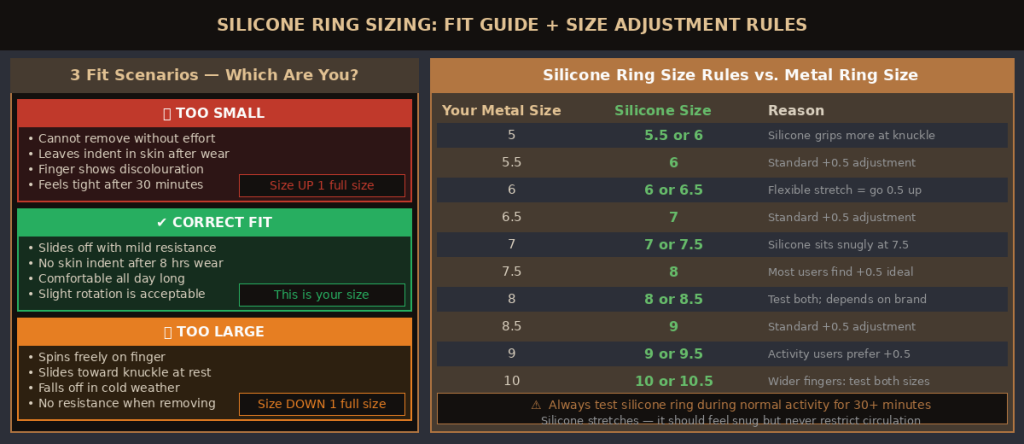
Left: three fit scenarios for silicone rings (too small, correct, too large) with clear identification signs. Right: metal ring size to silicone ring size conversion reference.
Use this reference to find your starting silicone ring size from your known metal ring size. Always test by wearing the ring for at least 30 minutes of normal activity before committing.
| Metal Ring Size | Silicone Starting Size | If Active / Hot Climate |
| 4 | 4.5 – 5 | 5 |
| 4.5 | 5 | 5 – 5.5 |
| 5 | 5.5 – 6 | 6 |
| 5.5 | 6 | 6 – 6.5 |
| 6 | 6.5 – 7 | 7 |
| 6.5 | 7 | 7 – 7.5 |
| 7 | 7.5 – 8 | 8 |
| 7.5 | 8 | 8 – 8.5 |
| 8 | 8.5 – 9 | 9 |
| 8.5 | 9 | 9 – 9.5 |
| 9 | 9.5 – 10 | 10 |
| 10 | 10.5 – 11 | 11 |
| 11 | 11.5 – 12 | 12 |
How to Test Silicone Ring Fit Correctly
- Put the silicone ring on your finger. It should require mild resistance to pass the knuckle — not effort, but not freely either.
- Once on, the ring should sit snugly without rotating freely when you shake your hand.
- Wear the ring for at least 30 minutes of normal activity, including making a fist, gripping objects, and any typical hand movements.
- After 30 minutes: if the ring has left a visible indent in your skin or your finger has any discolouration, it is too small. Size up immediately.
- If the ring spins freely or has slid toward your knuckle, it is too large. Size down.
- If the ring feels comfortably snug with no marks and stays in position, this is your silicone ring size.
4. How Smart Rings Work — Why Sizing Matters More Than You Think
Smart rings are fundamentally different from both metal and silicone rings because they are active measurement devices. Understanding how they work explains why getting the size precisely right is critical — not just for comfort, but for the accuracy of every health metric the ring produces.
The Sensor Array Inside a Smart Ring
A smart ring such as the Oura Ring Gen 4 contains a dense array of optical sensors on its inner surface that must maintain consistent, firm contact with the skin of your finger to function correctly. The Gen 4 uses 10 LEDs (six green, two red, two infrared) and four photodetectors arranged to create 18 independent signal pathways. These sensors work by shining light into the capillaries on the underside of your finger and measuring the reflected light to detect pulse, blood oxygen, and temperature.
If the ring is too large, it rotates on the finger. This moves the sensors away from their optimal position on the finger’s palm-side surface — where the blood vessels are closest to the skin. The result is noisy, inaccurate readings. If the ring is too small, it creates pressure that compresses capillaries, also distorting readings. The correct fit is one where the sensors maintain consistent contact without compressing tissue.
What Smart Rings Measure
| Metric | Sensor Used | Why Correct Fit Matters |
| Heart rate (resting) | Green LED + PPG | Ring rotation moves sensor off pulse point |
| Heart rate variability | Green LED + PPG | Noise from movement ruins RMSSD accuracy |
| Blood oxygen (SpO2) | Red + infrared LED | Requires consistent skin contact depth |
| Skin temperature | NTC infrared thermistor | Needs stable contact for accurate baseline |
| Activity / steps | 3-axis accelerometer | Less affected by fit; sensor is motion-based |
| Respiratory rate | PPG signal analysis | Movement noise corrupts breathing detection |
| Sleep staging | Combined sensor data | Ring rotation during sleep causes staging errors |
Deep dive: How Does the Oura Ring 4 Work? (Full Sensor Guide) | Wikipedia: Photoplethysmography
The Correct Smart Ring Fit
The correct smart ring fit has a specific definition that differs from conventional ring fit. The ring should:
- Sit on the base of the finger without rotating when you shake your hand.
- Pass over the knuckle with mild resistance when putting on and taking off.
- Not leave an indentation mark in the skin after 30 minutes of wear.
- Feel snug but not tight — you should be able to slide a fingernail under it with effort, but it should not slide freely.
- Maintain the sensor array on the palm-side (underside) of the finger, not rotate to the top.
5. Best Way to Measure for a Smart Ring Size
The best way to measure for a smart ring size is to use the brand’s official sizing kit — a set of plastic sizing rings in every available size that you wear for 24 hours to identify the correct fit under real daily conditions. This is the method recommended by every major smart ring brand, and for good reason: smart rings cannot be resized, returns may not cover used rings, and an incorrect size compromises the accuracy of every health measurement the ring produces.
Why Home Measurement Alone Is Not Enough for Smart Rings
Standard home measurement methods — paper strip, string, tape measure — give you your finger’s circumference at a single point in time. This is insufficient for smart ring sizing because:
- Finger size varies by up to 1 full ring size across the day: morning (smallest) to evening (largest after activity).
- Sensor contact sensitivity: a ring that is correctly sized in the morning may be too small by evening, compressing capillaries and distorting sensor readings.
- Activity swelling: exercise can temporarily increase finger circumference by 0.5–1 ring size. A smart ring worn during workouts must accommodate this.
- Sleep position: lying on your hand compresses fingers. A ring that fits well during the day may cause discomfort overnight in certain sleeping positions.
The 24-Hour Sizing Kit Protocol
Every major smart ring brand offers a free or low-cost sizing kit. Here is how to use it correctly:
- Start at your estimated size: use your standard ring measurement to identify your approximate size.
- Also try one size up: because smart ring sensor contact requires a slightly tighter fit than conventional rings, start with your circumference-based size and one size larger.
- Wear through the evening: start wearing the sizing ring in the afternoon when fingers are at their daily maximum size.
- Wear overnight: sleep with the sizing ring on. This tests comfort in all sleeping positions and simulates the ring’s continuous overnight tracking use.
- Test during morning activity: check the ring fits after waking up and after morning exercise if applicable.
- Check for rotation: throughout the 24 hours, the sizing ring should not rotate freely. If it does, move to the next smaller size.
- Check for pressure marks: if the ring leaves a visible mark or causes discomfort at any point, move to the next larger size.
- Record the size: the sizing ring that meets all conditions for 24 hours is your smart ring size.
| 💡 If Between Two Sizes on a Smart Ring If both a size and the next size up feel comfortable across 24 hours, choose the LARGER size. Here is why: fingers swell during illness, medication changes, hot weather, and pregnancy. A ring that is slightly too large can be worn with a thin silicone insert while remaining functional. A ring that is too small during swelling will compress capillaries and produce inaccurate health data — defeating the entire purpose of the device. |
6. Smart Ring Sizing by Brand: Oura, Galaxy Ring & More
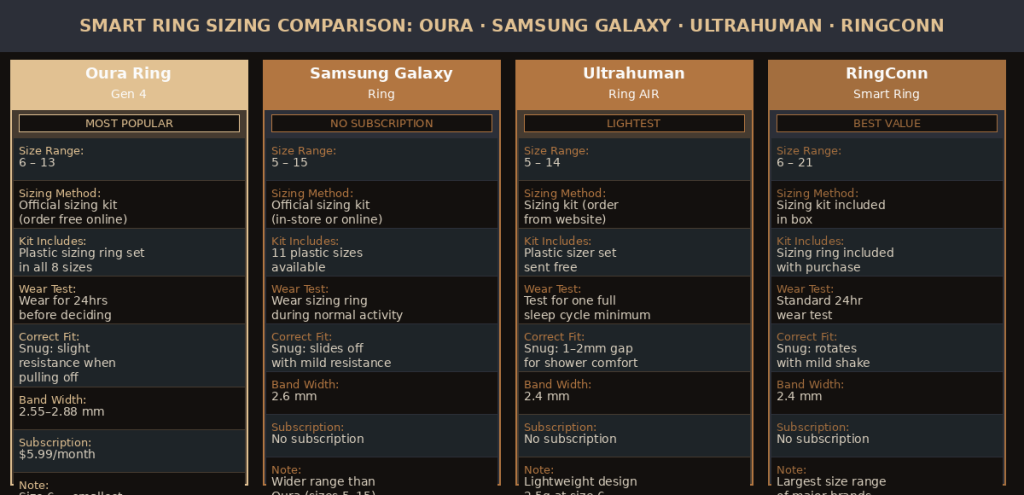
Sizing comparison across the four major smart ring brands: size ranges, sizing kit methods, correct fit criteria, and subscription requirements.
Oura Ring Gen 4
The Oura Ring Gen 4 is available in sizes 6 through 13 in two designs: Heritage (flat top, 2.88mm thick) and Horizon (dome, 2.55mm thick). Oura offers a free sizing kit that ships in approximately 3–5 business days. The kit contains plastic sizing rings in all 8 sizes. The correct Oura fit: the ring should stay on your finger when you hold your hand sideways, but slide off smoothly when you shake it downward over a surface.
Full sizing guide: Oura Ring Sizing Hub — Complete Fit Guide | Oura Ring 4 Battery Life Guide
Samsung Galaxy Ring
The Samsung Galaxy Ring is available in sizes 5 through 15, giving it the widest size range of any major smart ring brand. Sizing kits are available from Samsung stores and online. The Galaxy Ring uses a similar 24-hour wear test protocol. One important distinction: the Galaxy Ring does not require a monthly subscription for its core health features, making the investment lower if you buy the correct size the first time.
Ultrahuman Ring AIR
The Ultrahuman Ring AIR is available in sizes 5 through 14. It is the lightest mainstream smart ring (2.5g at size 6) and uses a subscription-free model. Ultrahuman recommends wearing their sizing kit for at least one full sleep cycle, as the ring’s primary data-gathering period is overnight.
RingConn Smart Ring
The RingConn Smart Ring has the widest size range of any major brand, from size 6 through size 21. The sizing ring is included in the product box (you receive it before the actual ring). RingConn recommends a standard 24-hour test. The subscription-free model and wide size range make it a good option for users with larger fingers (size 14+) who cannot find a fit with other brands.
| Brand | Sizes | Kit Cost | Sizing Method | Subscription |
| Oura Ring Gen 4 | 6 – 13 | Free (ships 3–5d) | 24-hr plastic sizing kit | $5.99/month |
| Samsung Galaxy | 5 – 15 | Free in-store | 24-hr plastic sizing kit | None |
| Ultrahuman AIR | 5 – 14 | Free | Sleep cycle sizing kit | None |
| RingConn | 6 – 21 | Included in box | 24-hr sizing kit in box | None |
| Circular Ring | 6 – 12 | Free | Standard sizing kit | None |
| ▶ Video: How to Use a Smart Ring Sizing Kit Correctly (YouTube) Watch a step-by-step demonstration of the 24-hour smart ring sizing kit process, including how to evaluate fit during sleep, activity, and temperature changes. Recommended searches: ‘Oura Ring sizing kit how to use’ · ‘how to size a smart ring’ · ‘silicone ring size guide’ Recommended channels: The Quantified Scientist · DC Rainmaker · Oura Official |

7. The 24-Hour Sizing Kit Test — How to Do It Correctly
The 24-hour sizing kit test is the most important step in getting a smart ring right. Here is the complete protocol for maximum accuracy.
Before You Start
- Order the sizing kit: most brands offer free kits on their website. Order at least one week before you plan to buy.
- Identify your starting sizes: use the standard paper strip measurement to identify your approximate size. Order sizing rings for that size and one size larger.
- Choose the right day: do the test on a typical day that represents your normal lifestyle. Do not test on an unusually sedentary or unusually active day.
The 24-Hour Test Protocol
- Morning start: put on the sizing ring in the morning after waking. Note the fit: it should feel snug but not tight at this point.
- Mid-morning activity: perform normal morning activity. Check that the ring has not rotated significantly.
- Afternoon check: by early afternoon, fingers are approaching their daily maximum. If the ring now feels noticeably tighter or leaves a mark, size up.
- Exercise test: if you exercise, wear the ring during your workout. Check for pressure or rotation during activity.
- Evening evaluation: the ring should still feel snug in the evening when fingers are at maximum size. If it now feels very tight, size up.
- Overnight test: sleep with the ring on. In the morning, check for indentation marks. If marks are present, size up.
- Final evaluation: the sizing ring that passes all 24 hours without leaving marks, restricting circulation, or rotating freely is your correct size.
Red Flags That Mean You Need a Different Size
| Sign | Meaning | Action |
| Ring leaves indent after 1+ hours | Too small | Size up to next size |
| Finger turns slightly purple/blue | Much too small | Size up immediately; do not continue test |
| Ring rotates freely when shaken | Too large | Size down to next size |
| Ring slides toward knuckle at rest | Much too large | Size down two sizes |
| Ring uncomfortable only at night | Borderline small | Choose the larger of the two sizes |
| Ring tight only after exercise | Borderline small | Choose the larger of the two sizes |
8. Silicone Ring Fit Guide: Too Small, Correct, Too Large
Because silicone rings cannot be resized, identifying correct fit before committing to a size is essential. Here is how to definitively identify whether your silicone ring is the right size.
Signs Your Silicone Ring Is Too Small
- Significant resistance or pain when sliding over the knuckle.
- Visible indentation or groove in the skin after wearing for 30 minutes.
- Finger appears slightly swollen or discoloured around or below the ring.
- Tingling or numbness during or after wear.
- Ring feels noticeably tight by afternoon or after activity.
If any of these signs appear, size up immediately. Never force a too-small silicone ring to stretch over time — silicone has limited elastic recovery and a stretched ring loses its structural integrity.
Signs Your Silicone Ring Is Correctly Sized
- Slides over the knuckle with mild resistance — not easily, not with force.
- Sits snugly at the finger base without rotating when you make a fist.
- No visible skin indent after 8 hours of continuous wear.
- Can be removed with deliberate effort but not accidentally.
- Comfortable throughout full day including exercise.
Signs Your Silicone Ring Is Too Large
- Rotates freely with any hand movement.
- Slides up toward the knuckle when at rest.
- Falls off during activity or in cold weather.
- Can be removed without any resistance at all.
9. Common Sizing Mistakes for Silicone & Smart Rings
| Mistake | Why It Happens | The Fix |
| Ordering metal ring size for silicone | Assuming sizes are equivalent | Add 0.5–1 size for silicone |
| Skipping the 24-hr smart ring test | Wanting to order quickly | Always use the official sizing kit |
| Only measuring in the morning | Fingers are smallest on waking | Test sizing in the afternoon and evening too |
| Not testing during exercise | Forgetting fingers swell during activity | Wear sizing kit during your typical workout |
| Ordering too small ‘for sensor contact’ | Misconception about fit | Sensor contact needs snug, not tight |
| Ignoring activity lifestyle | Sedentary test on an active person | Test on a representative day |
| Not reading brand-specific fit guide | Assuming all smart rings fit the same | Each brand defines correct fit differently |
| Returning and guessing second size | Not testing methodically | Use sizing kit; document signs at each size |
10. Frequently Asked Questions
How do you choose the perfect silicone ring size?
Start with your metal ring size and add 0.5 to 1 full size. Silicone grips the finger more than metal and needs extra knuckle clearance. If you are between sizes, choose the larger one. Test by wearing the ring for 30+ minutes of normal activity: the correct fit passes over the knuckle with mild resistance, stays snug at the base without rotating, and leaves no skin indent after extended wear.
How do smart rings work?
Smart rings use optical sensors (LEDs + photodetectors) on their inner surface to measure blood flow through the capillaries on the underside of your finger. The LED light enters the skin, reflects off moving blood cells, and the photodetector measures the reflected light to calculate heart rate, HRV, blood oxygen, and respiratory rate. An NTC thermistor measures skin temperature. A 3-axis accelerometer tracks movement and steps. Data is stored on the ring (typically up to 6 weeks) and synced to an app via Bluetooth when you open it.
What’s the best way to measure for a smart ring size?
The only reliable method is the brand’s official 24-hour sizing kit test. Standard ring measurement gives you a starting size estimate, but smart rings must fit correctly across your full daily size variation — from morning minimum to evening maximum including exercise swelling. Order the sizing kit (free from Oura, Samsung, Ultrahuman, RingConn), wear each candidate size for 24 hours, and choose the size that stays snug without leaving marks or rotating freely at any point in the day.
Is silicone ring sizing the same as metal ring sizing?
No. Silicone ring size runs 0.5 to 1 full size larger than equivalent metal ring size. If you wear a metal ring at Size 7, your silicone ring size is likely 7.5 or 8. This is because silicone grips the skin more than metal, requiring a larger opening to pass over the knuckle comfortably while still sitting snugly at the base. Always verify by wearing a silicone ring for 30+ minutes before committing to a size.
Can a smart ring be resized?
No. Smart rings contain a precision sensor array and proprietary electronics embedded in the ring body. Unlike hollow metal bands, they cannot be cut and reformed. If you order the wrong size, you will need to exchange it (subject to the brand’s return policy, which typically requires the ring to be unworn) or purchase a new one. This is the primary reason the 24-hour sizing kit test is so important.
What happens if my smart ring is the wrong size?
If too small: discomfort, restricted circulation, and compressed capillaries that distort all sensor readings, producing inaccurate health data across every metric. If too large: the ring rotates, moving the sensor array away from its optimal position on the palm-side of the finger, producing noisy and unreliable readings, particularly for sleep staging and HRV. In both cases, the device becomes inaccurate regardless of its technical capabilities.
Does the Oura Ring come in half sizes?
No. The Oura Ring Gen 4 is available in whole sizes only: 6, 7, 8, 9, 10, 11, 12, and 13. If you measure between two sizes, Oura recommends choosing the larger size. This is because a slightly larger ring can still maintain sensor contact through natural daily snugness variation, while a too-small ring may become uncomfortable and distort readings during evening swelling.
Should I size up or down for a silicone ring?
When in doubt between two silicone ring sizes, always size UP. A silicone ring that is slightly too large can still be worn comfortably and is safe. A silicone ring that is slightly too small creates continuous pressure on the finger that builds throughout the day as fingers swell, and in a medical emergency (hand injury, swelling from illness) cannot be removed safely without cutting.
Further Reading
On this site: Oura Ring Sizing Hub | How Does the Oura Ring 4 Work? | Oura Ring Gen 4 Review | Benefits of the Oura Ring 4 | Wide Band Ring Sizing Guide
External: Wikipedia: Photoplethysmography | Wikipedia: Smart Ring | r/ouraring — Sizing Discussion | BBC: The Rise of Smart Rings | GIA: Ring Size Chart
| ⚤ Medical Disclaimer This article provides general guidance on ring sizing for silicone and smart rings. Smart ring health data is intended for wellness monitoring only and does not constitute medical advice or diagnosis. If you experience discomfort, numbness, or skin changes related to ring wear, remove the ring immediately and consult a healthcare professional. |