
The quick answer
Yes, your ring size can change with weight loss or gain, but it’s not linear and it’s highly individual — genetics and where your body stores fat matter more than the number on the scale. As a rough pattern: 10 to 15 pounds often changes nothing noticeable, 20 to 40 pounds commonly shifts a quarter to half a size, and 50-plus pounds can mean a full size or more. Day-to-day, temperature and swelling move your finger size far more than weight does — that’s usually the real explanation when a ring feels different from morning to evening.
- Small weight changes (under 15 lbs): usually no noticeable ring size change
- Moderate changes (20-40 lbs): commonly ¼ to ½ a size
- Large changes (50+ lbs): can be a full size or more, but varies widely by person
- Before resizing after a weight change: wait until your weight has been stable for 1-2 months, so you’re not sizing to a number that’s still moving
Does weight loss or gain actually change your ring size?
Fingers do carry fat, just less of it than most other parts of the body, and that fat responds to weight change the same way fat elsewhere does — unevenly, and on its own timeline relative to the rest of you. This is why the relationship isn’t predictable pound-for-pound: some people notice their rings loosening after losing as little as 10 pounds, while others lose 40 and see almost no change, because their body simply doesn’t store or release fat in the hands the way it does elsewhere. Genetics and fat distribution pattern explain most of that gap, not effort or diet type.
A few things worth knowing before you resize:
- Water weight moves faster than fat. In the first couple of weeks of a weight change, most of what you’re seeing is fluid shifting, not fat loss — which is part of why finger size can fluctuate before your actual body composition has meaningfully changed.
- Weight regained often means size regained. If you resize down during a weight loss period and later regain a similar amount, your original size commonly fits again, though this isn’t guaranteed for everyone as skin elasticity changes over time too.
- If your weight is still actively changing, hold off on resizing. A ring sized to a moving target will likely need resizing again soon after. Wait for roughly a month or two of stability first.
- A hinged or slightly adjustable band is worth considering if your weight fluctuates regularly rather than trending steadily in one direction — it saves you from repeat trips to the jeweler for the same few pounds each time.
Daily and seasonal swelling matters more than most people expect
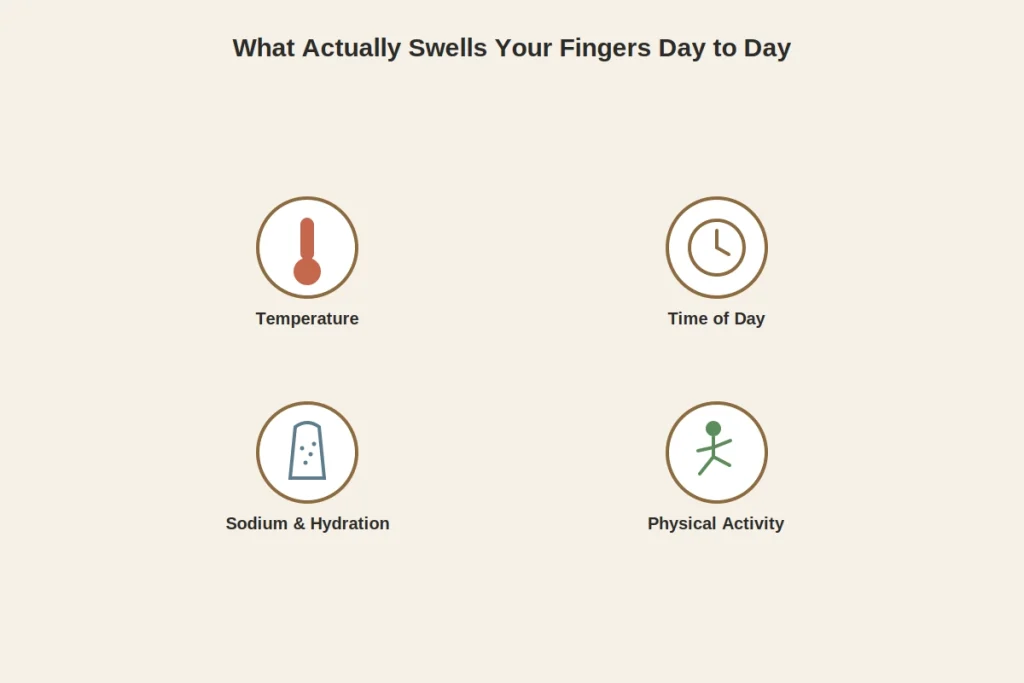
Long before weight change enters the picture, your fingers already vary in size throughout a single day — often by more than a typical weight-related shift. A few drivers account for most of it:
- Temperature. Cold shrinks fingers, heat swells them; this alone can shift a reading by close to half a size.
- Time of day. Fingers are usually smallest in the morning and largest by evening, as fluid redistributes through the day.
- Sodium and hydration. A salty meal or dehydration both tend toward puffier fingers the next day.
- Physical activity. Exercise increases blood flow to the hands during and shortly after a workout, temporarily swelling fingers.
- Pregnancy and hormonal changes cause more pronounced fluid retention than typical daily swelling, and finger size often doesn’t fully return to a pre-pregnancy baseline afterward.
If a ring that fit fine yesterday feels tight today, this list is almost always the explanation, not a sudden weight change — see our how to measure ring size guide for how to measure in a way that accounts for this rather than getting caught by it.
What’s your “fattest” finger, and does it matter for sizing?
There’s no single finger that’s universally largest across everyone — it depends on individual hand proportions, and even differs somewhat between your dominant and non-dominant hand. What is fairly consistent: the thumb is usually the largest digit by circumference for most people, followed closely by whichever finger you use most for gripping and typing, which tends to run slightly larger than its counterpart on the other hand from years of asymmetric use.
For ring sizing purposes, “fattest finger” mostly matters in one practical way: if you’re estimating a ring size by borrowing measurements from a different finger than the one the ring will actually be worn on, correct for the difference rather than assuming it transfers directly — our ring size guide by finger and gender breaks down the typical offset between fingers if you need those numbers.
Sizing tips for larger or fuller fingers
If your fingers run larger than a standard chart’s typical range, or you’ve been told your fingers are “chubby” by a well-meaning but unhelpful salesperson, a few practical adjustments make a bigger difference than chasing a specific number:
- Comfort-fit bands — which curve slightly on the inside rather than sitting flat — pass over a fuller knuckle more easily and tend to feel more comfortable at rest, often running about a quarter size larger than a flat-inside band at the same labeled number.
- Wider bands need sizing up. A chunky 8mm band fits tighter than a thin 2mm band at the identical labeled size, because more metal surface contacts the finger — if you’re moving to a wider style, plan for that ahead of ordering.
- Size to your knuckle, not just the base, if there’s a meaningful gap between the two. A ring sized purely to the base of the finger may never clear the knuckle at all.
- Ignore generic “average size” charts as a target. They’re a reference point for where most people land, not a size you should feel obligated to fit — actual finger size varies enormously and has no bearing on anything other than which ring size you order.
Pinky ring sizing
Pinky rings deserve their own note because the sizing math is different from a standard ring finger order: the pinky typically runs a full size to a size and a half smaller than the ring finger on the same hand, and men’s and women’s typical pinky sizes both sit noticeably below their respective ring-finger averages. Because the pinky’s base and knuckle are often closer in width than on other fingers, a snugger fit than you’d choose elsewhere is usually more comfortable and less likely to spin. For the full finger-to-finger offset table and typical size ranges by gender, see our ring size guide by finger and gender rather than guessing from your regular ring size.
Myth check: is ring size the same as shoe size?
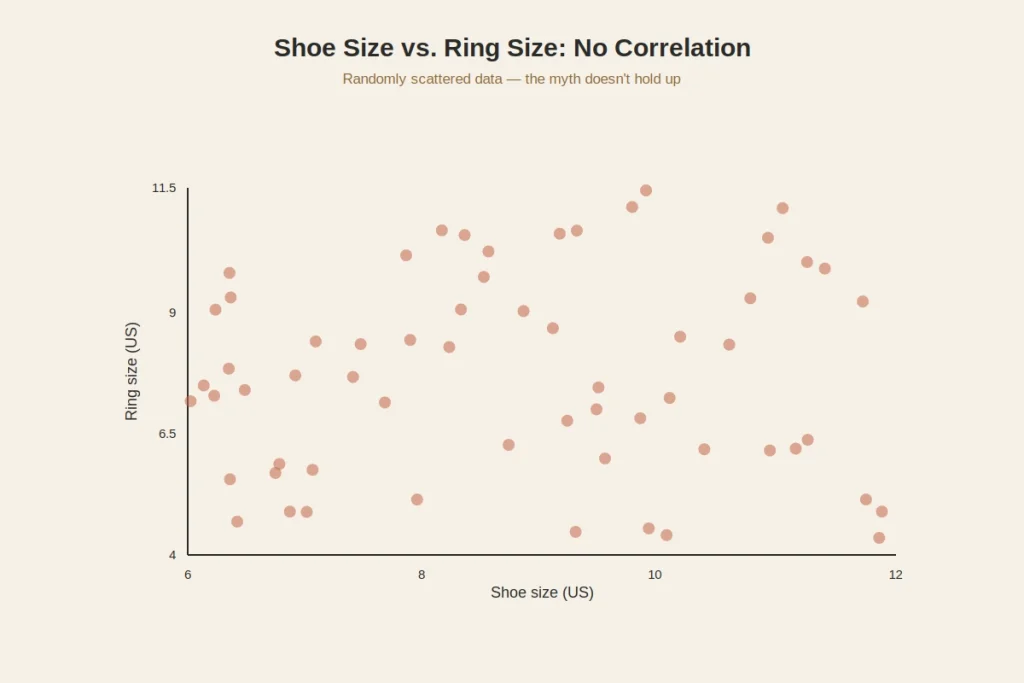
No — there’s no real correlation between the two, despite this being a genuinely popular claim online. Shoe size reflects foot length and is influenced by height and overall body proportions in ways that don’t map onto finger circumference, which is governed by entirely different genetic and anatomical factors. The myth likely persists because both are expressed as small, memorable numbers and because a same-size coincidence is more memorable than the far more common case of the two not matching at all. If you’re trying to estimate someone’s ring size discreetly, shoe size isn’t a shortcut worth relying on — the borrowed-ring method in our measuring guide is a far more reliable option.
Frequently asked questions
How many pounds does it take to change ring size?
There’s no fixed number — it depends heavily on individual fat distribution. As a general pattern, under 15 pounds usually changes nothing noticeable, 20 to 40 pounds commonly shifts a quarter to half a size, and 50-plus pounds can mean a full size or more, but this varies significantly person to person.
Should I resize my ring right after losing weight?
Wait until your weight has been stable for about one to two months first. Resizing to a weight that’s still actively changing often means needing another resize shortly after.
Is ring size the same as shoe size?
No, there’s no meaningful correlation between the two. They’re governed by different anatomy and don’t scale together.
Do fingers get smaller in cold weather?
Yes, cold temperatures constrict blood vessels and reduce swelling, which can shrink finger size by close to half a size compared to a warm day — often more than a typical weight-related change.
What if my weight fluctuates regularly rather than trending in one direction?
Consider a hinged or slightly adjustable band instead of repeatedly resizing a fixed ring, or size to the middle of your typical range rather than whatever you happen to measure on a given day.