
What is a promise ring? It is a ring that symbolizes a pledge, most often a commitment to a partner before engagement. It is simpler and less costly than an engagement ring, and it has no fixed rules. People also give promise rings for friendship, abstinence, or as a personal vow to themselves.
This guide explains what a promise ring means, where it came from, and which finger and hand to wear it on. You will also see how it differs from an engagement ring, when to give one, what to spend, and how to find the right size, even when the gift is a surprise. If you already know who the ring is for, our ring size calculator turns a measurement into a size in seconds.
| Key Takeaways A promise ring is a symbol of commitment or a personal vow, not a proposal. Most people wear one on the left ring finger or the right ring finger. Customs differ by family, culture and country, so there is no single rule. When an engagement happens, the promise ring often moves to the right hand or onto a necklace chain. Many promise rings cost between about $100 and $500, though you can spend less or more. Promise rings are not only for couples. Friends, same-sex couples and people making a promise to themselves wear them too. For a surprise, find the ring size first. One US size is only about 0.81 mm of inner diameter, so a guess can miss. |
What Is a Promise Ring?
A promise ring is a gift that stands for a promise between two people, or a promise you make to yourself. It is often called a commitment ring or a pre-engagement ring. Wikipedia defines a pre-engagement ring as a ring worn to show commitment to a monogamous relationship and a promise of an engagement in the future.
That definition covers the most common use, but it is not the only one. A purity ring marks a pledge of abstinence until marriage. A friendship ring marks a close bond. A sobriety ring or self-love ring marks a personal goal. Each kind is a promise ring because the wearer or giver decides what it promises.
Promise rings are usually modest. Many have a heart or infinity design, a birthstone or a few small accent stones instead of a large center diamond. Common metals include sterling silver, gold, titanium and tungsten. Brilliant Earth says promise rings generally cost a few hundred dollars, and anyone can wear one.
What makes a promise ring different from an engagement ring is the message. An engagement ring says marriage is the plan. A promise ring says “I am committed to you” or “I am committed to this,” with no wedding date attached. For a full side-by-side, read our guide to promise ring vs engagement ring.
Promise Ring Meaning: What Does a Promise Ring Mean?
A promise ring means whatever the giver and wearer agree it means. The most common meaning is a commitment to a partner, but a promise ring can also stand for loyalty, friendship, abstinence or a personal vow. Because there is no official rulebook, it helps to say out loud what the ring stands for when you give it.
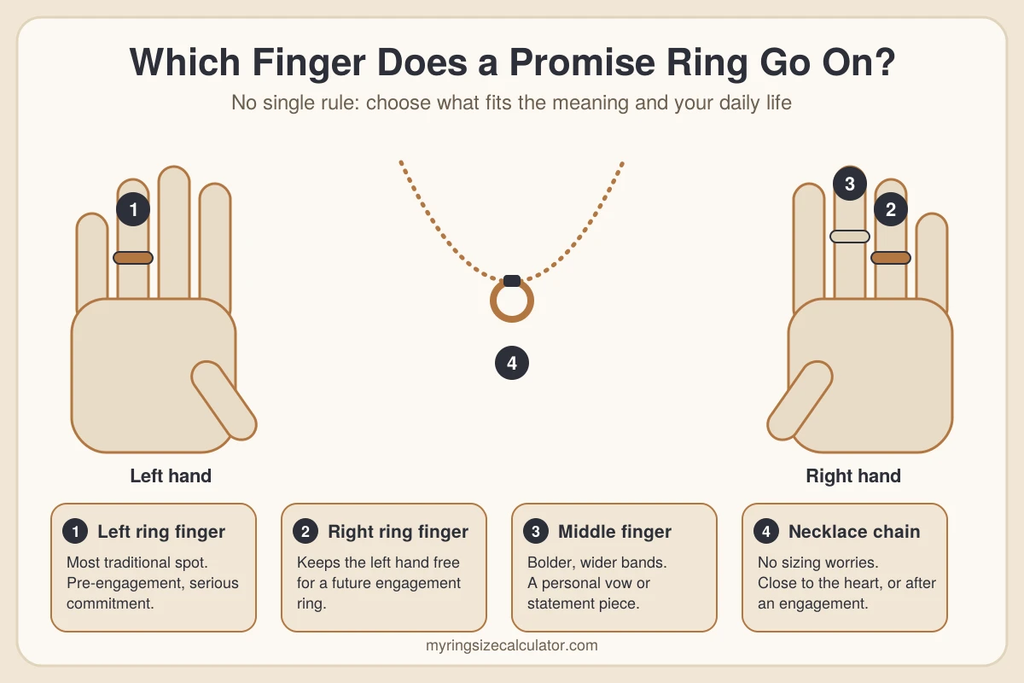
1. Promise of Commitment / Pre-Engagement
This is the classic meaning. The ring tells your partner that you are serious and exclusive, and that you may want to get engaged later. It suits couples who are committed but not ready for marriage, often because of age, money, school or work.
One source cited by Wikipedia says these rings are typically given after six months to a year of dating. Treat that as a pattern, not a rule. The right time is when you both know what the ring means.
2. Promise of Fidelity and Loyalty
A promise ring can mean faithfulness and loyalty. It is common in a long-distance relationship, where a ring gives a daily reminder of the person far away.
A claddagh ring is a well-known loyalty symbol. In the Irish design, the heart stands for love, the hands for friendship and the crown for loyalty. How you wear a claddagh is said to show your relationship status, but Wikipedia notes that much of this folklore is oral and local customs vary.
3. Purity and Abstinence Rings
A purity ring is a ring worn to signify a pledge to sexual abstinence until marriage, usually tied to a religious vow. Wikipedia says the Silver Ring Thing, a US program, was founded in 1995, and that True Love Waits, created by Southern Baptists, began in 1993.
4. Friendship Promise Rings
A friendship ring promises loyalty between friends, siblings or family. Some people buy matching rings for a best friend. Friendship rings often carry the same simple designs as other promise rings, so the meaning comes from how you give it. State the meaning clearly when you hand it over, especially if the recipient could read it as romantic.
5. Self-Promise Rings (Promise Rings for Me)
Promise rings for me are rings you buy yourself to mark a personal commitment. People choose them to mark sobriety, a recovery milestone, a health goal, a graduation or a decision to put themselves first. A self-love ring works the same way.
6. Promise Rings for Same-Sex Couples (Her and Her, His and His)
Promise rings work the same way for same-sex couples as for any couple. There are no gender rules about who gives the ring, who wears it or which finger it goes on. Some couples exchange matching rings. Others choose different designs that suit each person.
If you want matching styles, see our matching couples promise rings guide. Remember that two people almost never share the same ring size, so measure each finger separately.
A Short History of Promise Rings
Promise rings have a long history as love tokens, but the term “promise ring” is fairly recent. Earlier rings, including posy rings and fede rings, carried similar meanings. Wikipedia reports that the term entered jewelry vocabulary in the 1970s, and that the idea became very visible in the late 2000s and early 2010s.
Posy rings. Posy rings were plain gold bands with a short inscription, usually on the inside. They were popular in England and France from the 15th through the 17th centuries. Early inscriptions are mostly in Norman French, and later ones use French, Latin or English. Lovers gave them as romantic gifts.
Fede and claddagh rings. The fede ring family, which Wikipedia says dates to ancient Rome, shows clasped hands as a sign of faith and trust. The Irish claddagh grew from this tradition. Its modern form was first made in the 17th century in Galway, and the name “claddagh ring” was not used before the 1830s.
The Victorian era. In the 1800s, sentimental jewelry was popular. Acrostic rings used gemstones whose first letters spelled a word, such as REGARD (ruby, emerald, garnet, amethyst, ruby, diamond) or DEAREST. Robinson’s Jewelers notes that the style began in France, then spread to Britain and America, and that the Victorians took it to its peak. These rings were love and friendship tokens before the modern promise ring existed.
Modern use. The purity ring movement started in the United States in the early 1990s. The commitment-ring idea reached a wide audience in the late 2000s and early 2010s, helped by celebrity news.
What Finger Do You Wear a Promise Ring On?
There is no single rule. Most people wear a promise ring on the left ring finger, the traditional spot for love rings, or on the right ring finger, which keeps the left free for a future engagement ring. You can also wear it on another finger or on a necklace chain. Choose the finger that fits the meaning and your daily life.
Sources do not agree on a default, which shows how flexible the custom is. Brilliant Earth says promise rings are often worn on the right ring finger. Whiteflash says they are often worn on the left ring finger and that couples have more freedom than they do with engagement rings. Wikipedia says they are typically worn on the left ring finger, but can go on any finger.
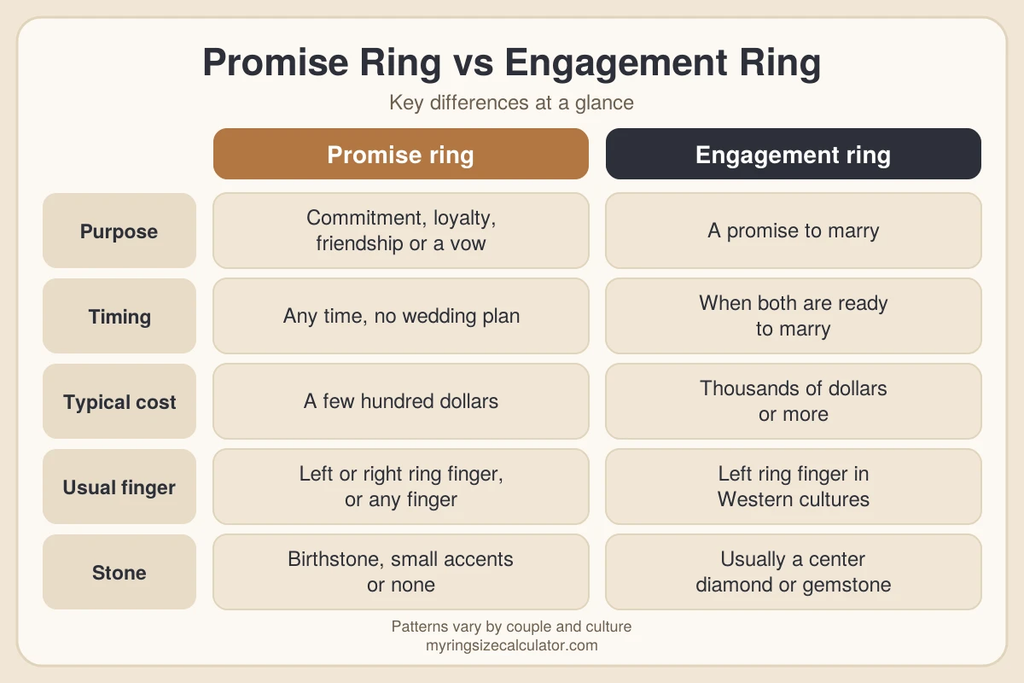
Left Ring Finger
The left ring finger is the traditional spot for engagement and wedding rings in many Western countries, and an old belief links it to the “vena amoris,” a vein said to run straight to the heart. Many people wear a promise ring here because it feels like a pre-engagement ring and signals a serious relationship.
If you wear it on the left, plan for the future. When you get engaged, the engagement ring usually takes this finger, and the promise ring needs a new place.
Read more about How Do I Know My Engagement Ring Size? Complete Guide for Accurate Measurement
Right Ring Finger
The right ring finger is a popular choice because it keeps the left free for an engagement ring. It also makes the ring easy to tell apart from a wedding set. Many people who wear a promise ring on the right never need to move it.
Other Fingers and Wearing It on a Necklace
A promise ring can go on any finger. The middle finger or index finger can work for a bolder ring, such as a wide band, and the pinky suits a small stackable ring. Pick the finger by comfort and by whether the ring will catch on things at work or at the gym.
A necklace chain is another good choice. It works if the ring does not fit yet, if you cannot wear rings at work, or if you want the ring close to your heart. After a proposal, many people move a promise ring onto a chain. Whichever finger you choose, remember that sizes can differ between fingers and hands. Measure the exact finger the ring will go on.
What Hand Does a Promise Ring Go On?
A promise ring can go on either hand. The left hand matches the engagement ring tradition, and the right hand leaves the left free for later. Both are correct. If you may get engaged one day, the right hand is the safer choice because you will not need to move the ring.
The hand you wear it on can also depend on your culture. In some countries, engagement rings are worn on the right hand, so a promise ring may follow different customs. Ask your partner what they expect, or choose the hand where the ring will be comfortable and safe.
What to do with a promise ring after an engagement. When the engagement ring arrives, you have several options. Whiteflash says the promise ring typically moves to the right hand so the engagement ring can take the left. Brilliant Earth adds two more ideas: wear the ring as a pendant, or fold it into wedding jewelry. If you wear it on the right ring finger from the start, you can simply keep wearing it.
Promise Ring vs Engagement Ring: Key Differences
A promise ring symbolizes commitment without a set plan to marry, and an engagement ring promises marriage. Promise rings are usually simpler, cost less and have no set rules for timing or fingers. Engagement rings are traditionally given with a proposal, usually have a center stone, and are worn on the left ring finger in Western countries.
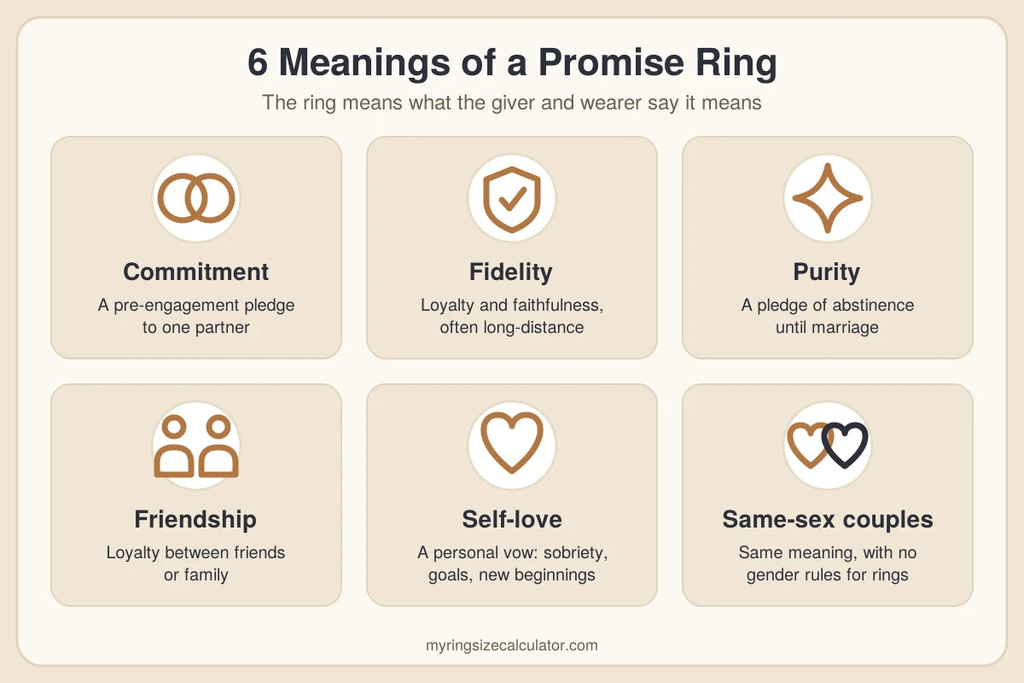
| Feature | Promise ring | Engagement ring |
|---|---|---|
| Purpose | Commitment, loyalty, friendship or a personal vow | A promise to marry |
| Timing | Earlier in a relationship, with no wedding plan | When both partners are ready to marry |
| Typical cost | A few hundred dollars | Thousands to tens of thousands of dollars |
| Usual finger | Left or right ring finger, or any finger | Left ring finger in Western cultures |
| Stone | Often a birthstone, small accents or none | Usually a center diamond or gemstone |
| Presentation | Casual, with no set protocol | Traditionally a proposal |
When Should You Give a Promise Ring?
Give a promise ring when you are both committed and ready to say so, but not ready to get engaged. There is no standard time. One source cited by Wikipedia puts it at six months to a year of dating, but the right time depends on your relationship and your ages.
Common moments include an anniversary, a birthday, graduation, the start of a long-distance relationship, Valentine’s Day or a move to a new city.
How Much Should You Spend on a Promise Ring?
Many promise rings cost between about $100 and $500. Jewlr says you can expect to spend $100 to $500 on a high-quality ring, and Helzberg says many couples choose sterling silver styles under $200. There is no required amount, so set a budget that is comfortable for you.
| Budget tier | What you can expect |
|---|---|
| Under $100 | Simple designs in sterling silver or gold-plated metal, often with cubic zirconia. Jewlr lists rings from $84. |
| $100 to $250 | Sterling silver styles, hearts, birthstones and engraved bands. Helzberg says many couples spend under $200. |
| $250 to $500 | Diamond promise rings with mixed metals and classic styling, according to Helzberg. |
| $500 and up | Gold and lab-grown diamond promise rings with more elevated designs. Helzberg puts gold diamond styles at around $400 to $700. |
These ranges are from retailers and vary by metal, stone and brand, so use them as a guide. The main price drivers are the metal, the stone and the design. Gold costs more than silver, and a larger diamond costs more than a small accent stone. Helzberg suggests lab-grown diamonds as a way to get more sparkle for the money, and moissanite is another lower-cost stone that sparkles.
A modest ring chosen with care means more than an expensive one that stretches your finances. If money is tight, browse affordable promise rings.
Popular Promise Ring Styles and Metals
The most popular promise rings are simple bands, hearts, infinity designs, birthstone rings and rings with a small accent diamond. Common metals are sterling silver, gold, titanium and tungsten. The best style is the one the wearer will actually wear every day.
- Sterling silver is the most budget-friendly metal. It can tarnish, but it polishes easily.
- Gold costs more and lasts longer. Ten-karat gold is a common choice for promise rings because it is more affordable than higher karats, according to Brilliant Earth.
- Titanium and tungsten are durable metals that many men’s promise rings use. Tungsten cannot usually be resized, so get the size right first.
- Diamond or moissanite accents add sparkle. Small accent stones keep the ring modest.
Band width changes the look and the fit. Brilliant Earth says wedding bands for women are most often 2 to 3 mm wide and for men 5 to 6 mm, and a promise ring often follows the same pattern. A wider band feels tighter, so you may need a larger size.
For more ideas, see these guides: promise rings for her, men’s promise rings and gold vs silver vs diamond promise rings.
How to Find Her (or His) Promise Ring Size Secretly
To find a promise ring size in secret, borrow a ring she or he already wears, measure the inside diameter in millimeters, and match it to a size chart. If you cannot borrow one, use a photo, a friend’s help or a printable sizer. Always confirm the finger, because sizes differ between fingers and hands.
Here are six practical methods:
- Borrow a ring that fits. Take a ring from their jewelry box that fits the finger you want, and note which finger it is worn on. Press it on a piece of paper and trace the inside circle, or measure the inside width with a ruler. A US size 6 has an inner diameter of about 16.5 mm, and each full size adds about 0.81 mm.
- Use a ring size chart. Match your measurement to the ring size chart to get a US, UK or EU size.
- Use a printable sizer. Print our printable ring sizer at 100% scale, check it against a credit card, and place the borrowed ring on the circles to find the match.
- Ask a friend or family member. A sibling, close friend or parent may know the size or can find out casually. Ask for the ring size of the specific finger.
- Compare with a ring you know. If you know your own ring size, put a ring on your finger and compare it with a ring they wear, noting how the two differ. This is an estimate only.
- Pick a seller with free exchanges. If you cannot confirm the size, choose a seller that offers free resizing or exchange, and plan to adjust the size after the gift.
Do not guess from shoe size, height or glove size. None of these tracks finger size reliably. Once you have a measurement, how to measure ring size at home shows how to confirm it. If a measurement falls between two sizes, choose the larger one for a wide band and the smaller one for a thin band, then confirm after the gift.
Promise Ring Etiquette: Dos and Don’ts
The best etiquette for a promise ring is to be clear, kind and comfortable with the meaning. Customs differ by culture, so ask before you assume. These dos and don’ts apply in most situations.
Do:
- Talk about what the ring means before or when you give it.
- Choose a ring that suits the wearer’s style, metal allergies and daily life.
- Respect the wearer’s choice of finger and hand.
Don’t:
- Treat a promise ring as a proposal unless you both agree that it is one.
- Give a promise ring to apply pressure or to avoid a hard conversation.
- Assume the meaning is the same in every culture or family.
Frequently Asked Questions
Is a promise ring the same as an engagement ring?
No. A promise ring symbolizes commitment without a plan to marry, while an engagement ring represents a promise to marry and is usually given with a proposal. Promise rings are also simpler and cost less. A promise ring can come before an engagement ring, but it is a separate gift.
Can a guy wear a promise ring?
Yes. Promise rings can be worn by any gender. Brilliant Earth says men’s styles are often broader and made from durable metals such as tungsten, titanium or stainless steel. Choose a width and metal that suit daily wear, and measure the finger carefully because wide bands fit tighter.
Can you buy yourself a promise ring?
Yes. A self-promise ring marks a personal vow, such as sobriety, a health goal or a new beginning. There is no rule against it. Choose a design that feels like a reminder, engrave a date or word inside, and wear it on the finger that feels right to you.
Can you wear a promise ring and an engagement ring together?
Yes. Many people wear the promise ring on the right hand and the engagement ring on the left, or move the promise ring to a necklace chain. If you stack them on one finger, size up a little, because two rings feel tighter than one.
How long after a promise ring do you get engaged?
There is no standard timeline. Some couples get engaged within a year or two, and others never plan to. A promise ring signals commitment but does not promise a proposal. If you want to know what your partner expects, ask them directly rather than reading it into the ring.
What do you say when giving a promise ring?
Say what the ring means to you in plain words. For example: “This ring is my promise that I’m committed to you and to us.” Mention the specific promise, such as loyalty, a future together or staying in touch during a long-distance period. Keep it honest and short.
Are promise rings still a thing?
Yes. Jewelers still sell them in large ranges, and many couples, friends and individuals choose them. The idea became especially visible in the late 2000s and early 2010s, according to Wikipedia. Today people use them for couples, friendship, self-promises and sobriety milestones, so the tradition is broader than before.
Should both partners wear promise rings?
It is up to the couple. Some give one ring to one partner, and others exchange matching rings so both wear one. Matching rings suit couples who want a shared symbol. Discuss it first so neither partner feels left out or pressured. Measure each person’s finger separately, because sizes will differ.
Conclusion
What is a promise ring? It is a ring that stands for a promise, most often commitment before engagement, and its meaning belongs to the people who give and wear it. You can wear one on the left ring finger, the right ring finger, another finger or a necklace chain. Customs differ, so choose what feels right.
When it comes to the ring itself, the size matters most. A ring that does not fit stays in a drawer. Use our ring size calculator to turn a measurement into a US, UK or EU size, and confirm it with a second measurement before you buy. Take your time, say what the promise means, and choose a ring that fits the person and the promise.
Sources and Further Reading
- Promise ring (Wikipedia): definition, typical timing, finger and history of the term.
- Posy ring (Wikipedia) and Claddagh ring (Wikipedia): posy ring history and the fede and claddagh traditions.
- Purity ring (Wikipedia): purity pledges and the 1990s programs.
- Robinson’s Jewelers, article on Victorian acrostic jewelry, for the acrostic ring history.
- Brilliant Earth, Whiteflash, Helzberg Diamonds and Jewlr promise ring guides, for finger customs, price ranges and band widths.