
Quick Answer: Ring sizes are not gendered — a size 7 ring measures exactly 17.35mm in diameter (54.4mm circumference) whether it’s labeled a “men’s” or “women’s” ring.
- The scale itself is universal — US, UK, and EU sizing all convert the same way regardless of gender.
- The confusion comes from averages: the average U.S. women’s ring size is 6–7, while the average U.S. men’s ring size is 9–10.
- Band width matters more than gender — a wide band (6mm+), common on men’s wedding bands, fits snugger than a thin band at the same labeled size, so up to a half-size adjustment may be needed.
1. The Quick Answer: Yes, Ring Sizing Is a Single Universal Scale
Ring sizing is one of the most misunderstood concepts in jewelry shopping, but the mechanics are simple. A ring size is a direct measurement of the inner circumference (or diameter) of the ring’s band. That measurement is captured on a numeric scale — 4, 5, 6, 7, and so on in the U.S. system, and the scale itself has no concept of gender built into it. A size 7 ring is 17.35mm in diameter no matter what department it’s sold in.
What jewelers label “men’s rings” and “women’s rings” are style categories, not sizing categories. A men’s collection tends to favor heavier metals, wider bands, and bolder finishes; a women’s collection tends to favor thinner bands, more delicate settings, and a broader range of small sizes. But if you hand a jeweler a size 7 ring from either collection, it will fit a size-7 finger, full stop.
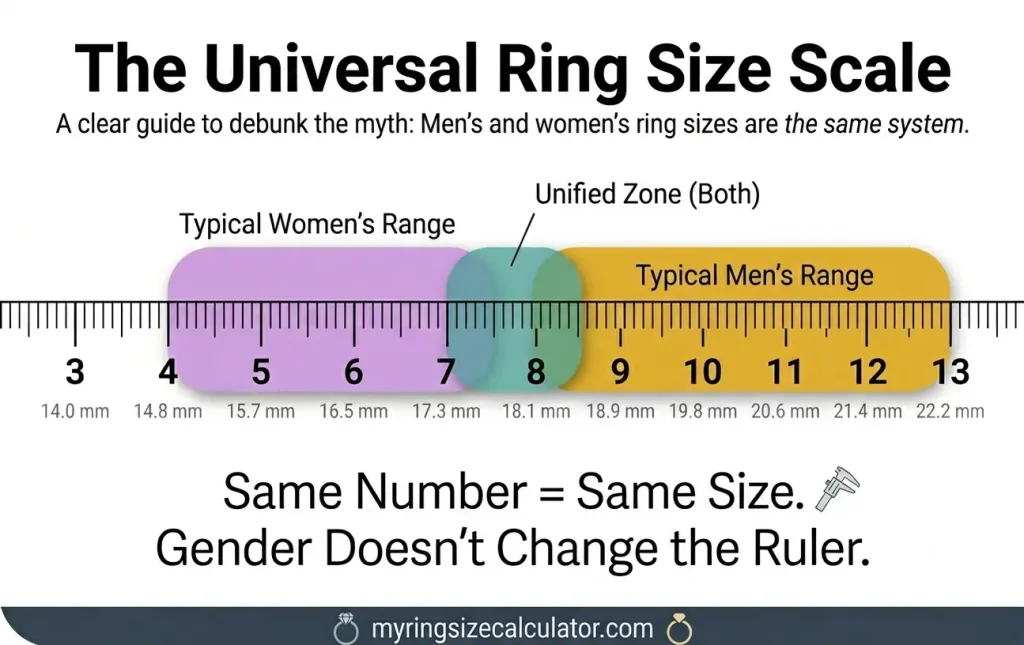
How the Ring Size Scale Actually Works (US, UK/AU, EU, mm)
Every major sizing system — U.S., U.K./Australian, and European — is simply a different label attached to the same underlying millimeter measurement. Once you know your circumference or diameter in millimeters, you can convert to any of them instantly, and gender never enters the calculation. See the full conversion table in Section 3 below.
Is a Men’s Size 7 the Same as a Women’s Size 7? (Proof + Math)
Yes. A size 7 ring has an inner diameter of 17.35mm and an inner circumference of 54.4mm, regardless of which collection it was pulled from. If you measure a man’s finger and a woman’s finger and both come out to 17.35mm, the identical size-7 ring fits both of them equally well.
2. So Why Does It Feel Like Men’s and Women’s Sizes Are Different?
If the scale is universal, why does this question get searched thousands of times a month? Because of two real, measurable factors — not because the sizing system itself changes.
Average finger size: On average, men’s fingers are physically larger than women’s, driven by bone structure and hand size. That’s a biological average, not a rule — plenty of women wear a size 9+ and plenty of men wear a size 7 or below. Because of this average, retailers stock “women’s” lines heavier in sizes 4–7 and “men’s” lines heavier in sizes 8–13, which creates the illusion of two separate systems when it’s really one system with two different stocking ranges.
Band width and design: Men’s rings, especially wedding bands, are disproportionately wide (6mm–10mm) compared to the average women’s fashion ring (2mm–4mm). A wider band contacts more of the finger’s surface area, which makes the same numeric size feel tighter. This is a fit-comfort effect, not a sizing-scale effect — but it’s the single biggest reason people insist men’s and women’s sizes “must” be different.
Average Ring Size by Gender
| Group | Typical Range | U.S. Average |
|---|---|---|
| Women | 4 – 8 | 6 – 7 |
| Men | 7 – 13 | 9 – 10 |
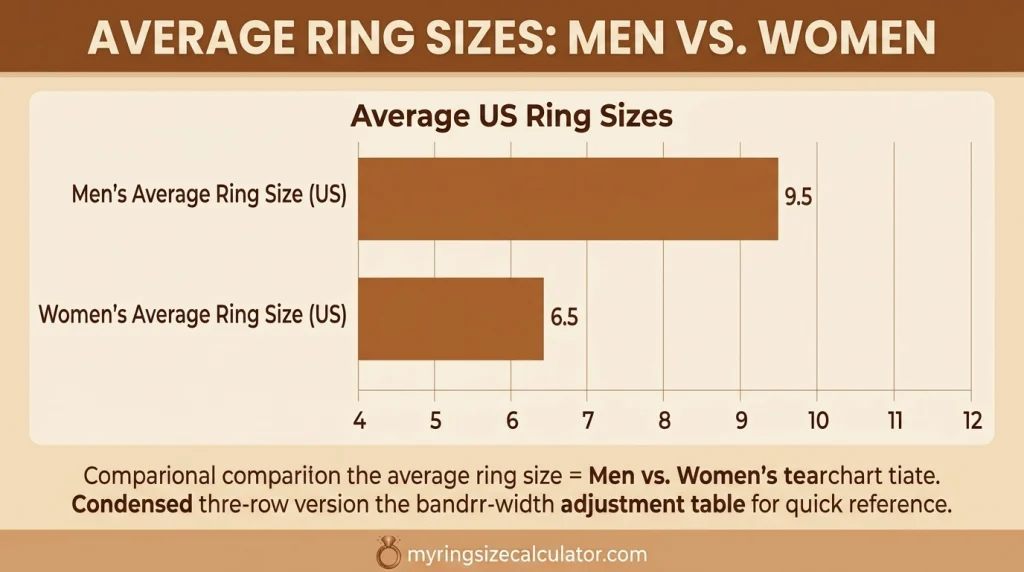
Hand and Finger Size Differences, Explained
Finger circumference correlates with overall hand and bone size, which on average runs larger in men than in women — similar to average differences in height or shoe size. It’s a population trend, not an individual guarantee, so always size to the actual finger, not to a gender assumption.
Retailer Inventory Bias: Why “Men’s” and “Women’s” Collections Only Stock Certain Ranges
Jewelers stock inventory to match demand. Since most buyers in a “women’s” collection fall in the 4–7 range and most buyers in a “men’s” collection fall in the 8–13 range, retailers rarely stock the full 4–13 spectrum in both sections — even though nothing about the ring itself would prevent it. This inventory pattern, not the sizing system, is what creates the appearance of two separate scales.
3. Men’s vs Women’s Ring Size Conversion Chart (mm, US, UK, EU)
Use the chart below as your reference; every column reflects the same underlying measurement, just expressed in the sizing convention used in that region or by that retailer. If you know your circumference or diameter in millimeters, you can convert to any national sizing system instantly, and gender never enters the calculation.
| US Size | Diameter (mm) | Circumference (mm) | UK/AU | EU | Typical Wearer Range |
|---|---|---|---|---|---|
| 4 | 14.86 | 46.7 | H | 47 | Women — petite |
| 5 | 15.70 | 49.3 | J½ | 49 | Women — small |
| 6 | 16.51 | 51.9 | L½ | 52 | Women — small/average |
| 6.5 | 16.92 | 53.1 | M½ | 53 | Women — U.S. average |
| 7 | 17.35 | 54.4 | N½ | 54 | Crossover — unisex |
| 8 | 18.19 | 57.0 | P½ | 57 | Men — small / Women — large |
| 9 | 18.89 | 59.5 | R½ | 60 | Men — U.S. average |
| 9.5 | 19.41 | 60.8 | S½ | 61 | Men — average/large |
| 10 | 19.84 | 62.1 | T½ | 62 | Men — large |
| 11 | 20.68 | 64.6 | V½ | 65 | Men — large/XL |
| 12 | 21.49 | 67.2 | X½ | 67 | Men — XL |
| 13 | 22.22 | 69.7 | Z½ | 70 | Men — XXL |
Where Men’s and Women’s Sizes Overlap (The “Crossover Zone”)
Sizes 7 through 8 sit in what we call the crossover zone — the range most commonly worn by both men and women, and the range where the “are these actually different” confusion peaks. If your size falls here, gender-based collections are irrelevant to you: shop by size, not by section.
4. Band Width Changes How a Ring Fits — Even at the Exact Same Size
Because men’s rings skew toward wider, heavier bands, this is the single most useful adjustment table on this page.
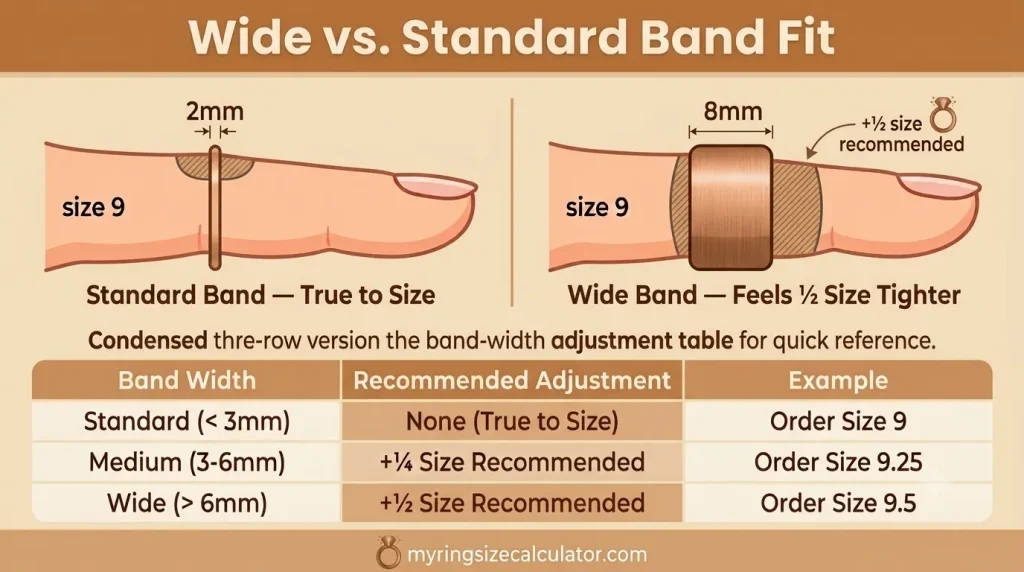
Why Wide Bands (6mm+) Feel Tighter Than Thin Bands
A wider band covers more surface area of your finger, creating more contact and pressure at the knuckle when you put the ring on or take it off. Two rings can share the exact same internal diameter, yet the wider one will feel noticeably snugger going over the same knuckle.
How Much to Size Up for Wide or Comfort-Fit Bands
| Band Width | Feel vs. Thin Band | Recommended Size Adjustment |
|---|---|---|
| 2mm – 4mm | True to measured size | No adjustment needed |
| 5mm – 6mm | Slightly snugger | +¼ to +½ size |
| 7mm – 8mm | Noticeably tighter | +½ size |
| 9mm and wider | Significantly tighter | +½ to +1 full size |
Standard Fit vs Comfort Fit: What’s the Difference
Comfort-fit bands have a slightly domed interior rather than a flat one, which reduces surface contact and often needs a smaller size adjustment than a flat-interior band of the same width. Check the specific jeweler’s or manufacturer’s sizing notes before ordering, since comfort-fit sizing conventions vary slightly by brand.
5. How to Convert Between Men’s and Women’s Ring Sizes
If you already know your ring size in one system, converting is a lookup, not a calculation. If you don’t know it yet, measure your circumference in millimeters with a soft tape or string, then match that number to the chart in Section 3 — no gendered guesswork required.
Step-by-Step Manual Conversion Method
- Wrap a soft measuring tape (or a strip of paper/string, then a ruler) snugly around the base of your finger.
- Mark or note the point where it meets, and measure that length in millimeters — this is your circumference.
- Match your circumference to the closest row in the conversion table in Section 3.
- Read across that row for your equivalent US, UK, or EU size — the gender label on the ring doesn’t change which row you use.
Use Our Free Ring Size Calculator (Fastest, Most Accurate)
For an instant, error-free result, use our free ring size calculator instead of doing the math by hand.
6. Buying a Ring for Someone Else? How to Get Their Size Right
Buying a ring as a gift — especially for a proposal — is where the men’s-vs-women’s mix-up causes the most expensive mistakes. A few reliable, low-risk methods:
The Borrow-a-Ring Method
Borrow a ring they already wear on the correct finger and trace or measure its inner diameter. This bypasses gender labeling entirely, since you’re measuring their actual finger data using our ring size guide by finger and gender.
Printable Ring Sizer / At-Home Measuring Without Guessing
Use a printable ring sizer or an at-home sizing kit rather than string or paper strips, which stretch and introduce error. For more detail, see our guide on how to check ring size at home without a tape measure.
Sizing Secretly for a Surprise Proposal
Enlist a friend or family member to discreetly borrow a ring, or size based on a ring the partner has previously worn on that hand. Our step-by-step measuring instructions work well for a quick, low-risk check.
7. People Also Ask
Is a men’s ring size chart different from a women’s ring size chart?
No — the numeric scale is identical. What differs is the range each collection tends to stock, and often the band width and styling shown on the chart’s sample images.
Can a woman wear a men’s-sized ring, or vice versa?
Yes, without exception. If the numeric size matches your measured finger circumference, the ring will fit correctly regardless of which section it was sold in.
What is the average ring size for a man? For a woman?
In the U.S., the average women’s ring size is approximately 6 to 7, and the average men’s ring size is approximately 9 to 10. These are population averages, not fitting rules.
Do ring sizes run the same across every jewelry brand?
Mostly, yes, within a given country’s sizing standard — but minor manufacturing variance exists between brands, so always confirm fit with a physical sizer for custom or fine jewelry purchases.
Does ring size change over time or by season?
Yes — temperature, hydration, and weight changes can shift finger size by a quarter to half a size throughout the year. Read more in our guide on why ring size changes over time.
8. Key Takeaways
- Ring sizing is one universal, gender-neutral scale — a size 7 is a size 7.
- Perceived differences come from average finger size by gender and from band width, not from the sizing system itself.
- Wide bands (6mm+) need a real, measurable size adjustment — up to a full size for very wide comfort bands.
- Use millimeter measurements as the source of truth when converting between US, UK, and EU sizing, or between “men’s” and “women’s” labeled charts.
Still unsure of your size? Use our free ring size calculator to get an exact match in under a minute, or check our guide on what to do if your ring arrives the wrong size.