
Diamond is harder and moissanite is cheaper. A diamond scores 10 on the Mohs scale and moissanite scores 9.25. Moissanite shows about twice the rainbow fire of a diamond and typically costs a fraction of the price. Both stones suit an engagement ring, and the best choice depends on budget, sparkle style and stone size.
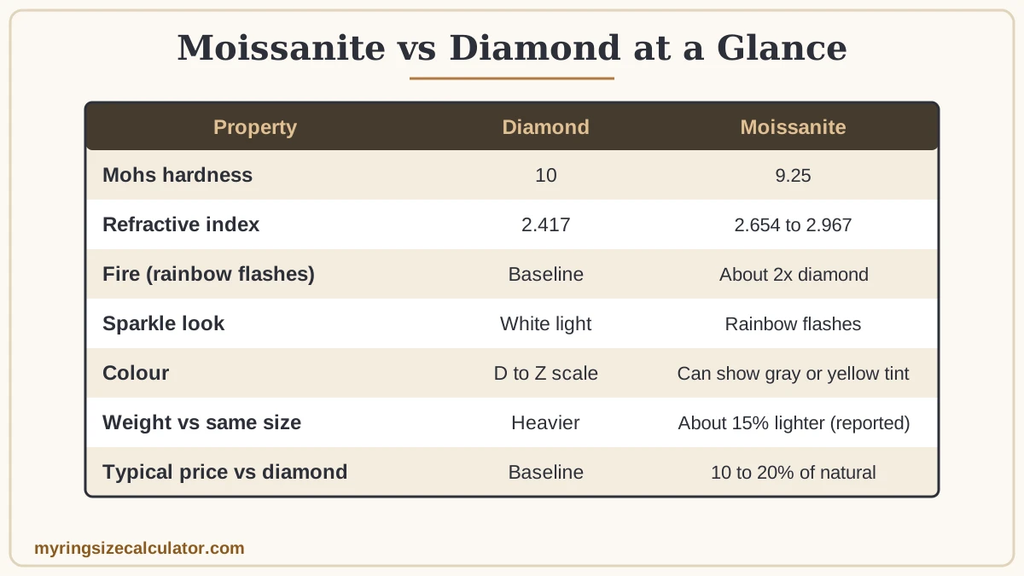
Moissanite vs Diamond at a Glance
| Property | Diamond | Moissanite |
|---|---|---|
| Material | Carbon | Silicon carbide |
| Mohs hardness | 10 | 9.25 |
| Refractive index | 2.417 | 2.654 to 2.967 |
| Fire | Baseline | About twice as much |
| Sparkle look | White light flashes | Rainbow flashes |
| Color | Graded D (most colorless) to Z | Can show a gray or yellow tint |
| Weight for the same size | Heavier | About 15% lighter, as reported |
| Sold by | Carat weight | Millimeter size |
| Price | Highest | About 10 to 20% of a comparable natural diamond |
Hardness and Durability
Diamond scores 10 on the Mohs scale and, per Blue Nile, cannot be scratched except by another diamond. Moissanite scores 9.25, which is scratch-resistant and resistant to chipping, but slightly less durable than a diamond. For a ring worn every day, both are hard enough for an everyday setting. A thick band is also tougher on the stone, so read about choosing the right wide band ring sizer before you order.
Sparkle, Fire and Brilliance
Moissanite has a higher refractive index than diamond, 2.654 to 2.967 against 2.417, and shows around twice as much fire. A diamond throws mostly white light, which is called brilliance. Moissanite throws more rainbow flashes, and some people find that look less natural, while others prefer it. Seeing both stones in person under daylight and shop lighting is the best test.
Color and Clarity
Diamonds are traditionally graded from D, the most colorless, to Z. Moissanite is not a true colorless stone and may show gray or yellow tints in some lighting, especially in larger stones, and some resemble a K color-grade diamond. Moissanite is typically around VS clarity on the GIA scale, while a flawless diamond is extremely rare.
Size: Carat vs Millimeters
Diamonds are sold by carat weight, which is a measure of weight. Moissanite is usually sold by millimeter size, with a diamond-equivalent carat weight, because moissanite weighs less than a diamond of the same size. When you compare, compare millimeters. The table shows typical round-stone sizes.
| Diamond carat weight | Typical round stone diameter (mm) |
|---|---|
| 0.5 ct | 5.0 |
| 0.75 ct | 5.8 |
| 1 ct | 6.5 |
| 1.5 ct | 7.4 |
| 2 ct | 8.2 |
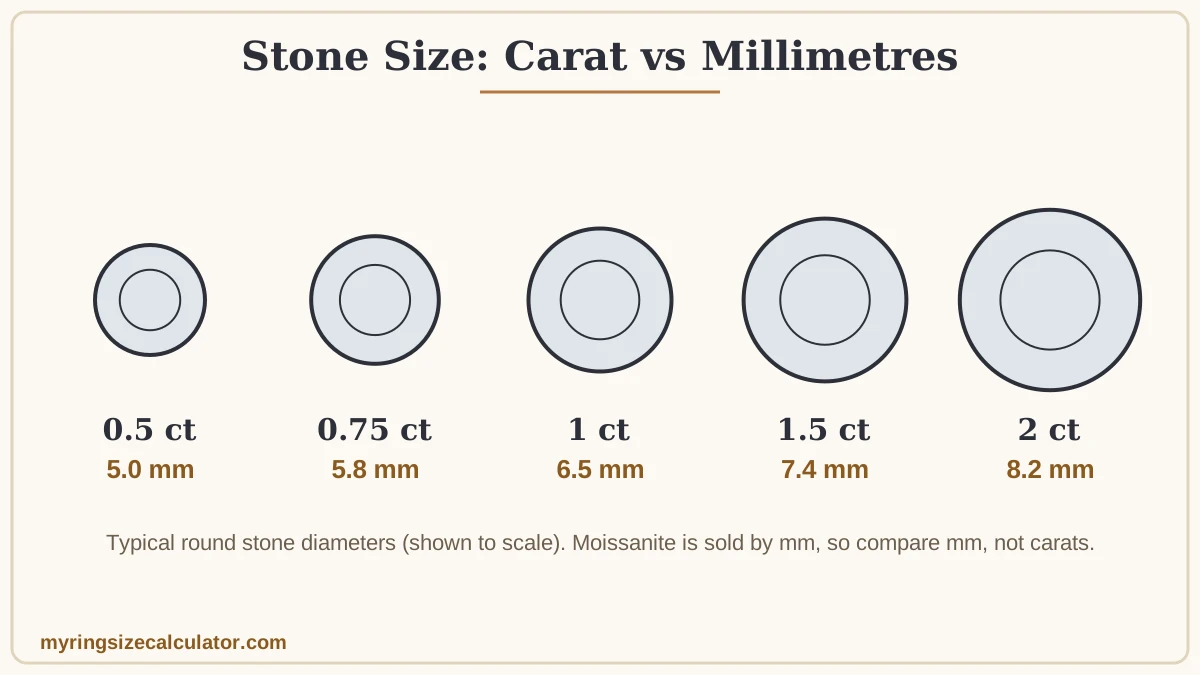
Alt text: Five round stones from 5.0 mm to 8.2 mm shown to scale with their carat weights
Caption: Typical round stone diameters by carat weight.
A bigger stone also looks different on different fingers, so size your finger first. Our guide on how to know your engagement ring size explains how to measure, and average diamond size for an engagement ring shows what most buyers choose.
Moissanite vs Diamond Price
Pricescope reports that moissanite costs about 50% of a comparable lab-grown diamond and about 10 to 20% of a comparable natural diamond. Blue Nile puts a 1-carat diamond at around $3,000 to $5,000 and a 1-carat moissanite at around $500 to $600. Those figures are undated, so check current prices with the seller. For lab-grown options, see how to choose the right lab-grown diamond ring for your budget.
Moissanite vs Lab-Grown Diamond
A lab-grown diamond is a real diamond, with the same carbon structure and a Mohs score of 10. Moissanite is a different material, silicon carbide. Both are made in a lab, since natural moissanite is rare and found in meteorites. Lab-grown diamonds look like mined diamonds, while moissanite shows more rainbow fire. Brilliant Earth notes that telling them apart usually needs gemological tools that measure refraction, hardness and fluorescence. If you want a lab-grown diamond from a trusted seller, read finding a trusted lab diamond jeweller.
How to Tell Moissanite from a Diamond
- Sparkle: moissanite shows rainbow flashes, diamond shows white light.
- Tools: jewelers separate them by structure, weight, light refraction and color.
- Paperwork: ask for the stone type and size in writing.
Which Should You Choose?
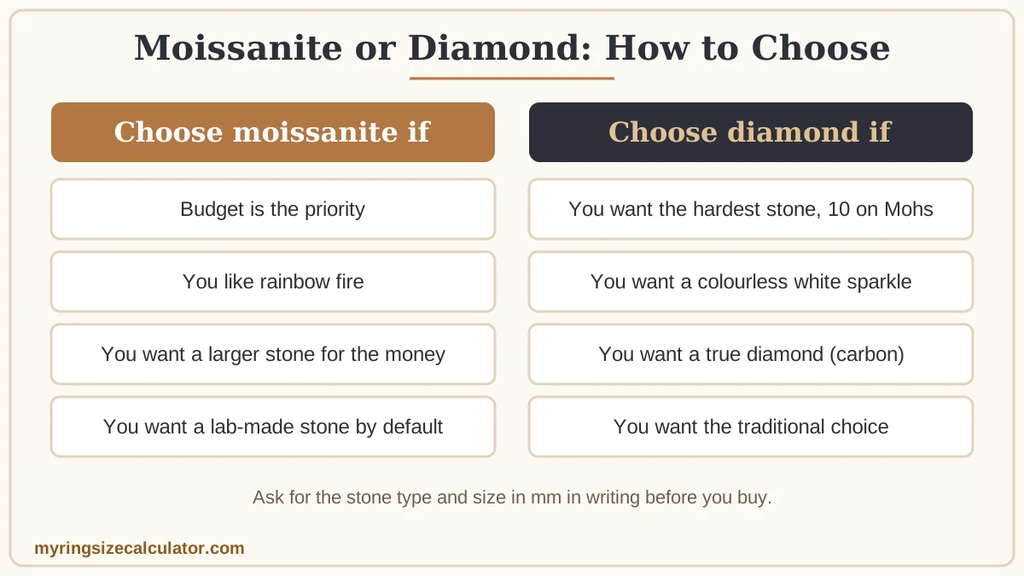
- Choose moissanite if budget is the priority, you like rainbow fire, or you want a larger stone for the money.
- Choose a diamond if you want the hardest stone, a colorless white sparkle, or a true diamond.
- Choose a lab-grown diamond if you want diamond hardness and look at a lower price than a mined stone.
Whatever stone you choose, check the finger size before you order. If the ring needs adjustment later, see ring resizing cost and process.
Frequently Asked Questions
Is moissanite a real diamond?
No. Moissanite is silicon carbide and a diamond is carbon. Moissanite is a real gemstone, but not a diamond.
Is moissanite harder than diamond?
No. Moissanite scores 9.25 on the Mohs scale and diamond scores 10.
Which sparkles more, moissanite or diamond?
Moissanite has a higher refractive index and about twice the fire, so it shows more rainbow flashes. A diamond shows more white light brilliance.
Is moissanite cheaper than a lab-grown diamond?
Yes. Pricescope reports moissanite at about 50% of the price of a comparable lab-grown diamond.
Can moissanite look yellow?
It can show a gray or yellow tint in some lighting, especially in larger stones.
Is moissanite sold by carat?
It is usually sold by millimeter size, with a diamond-equivalent carat weight shown, because it is lighter than a diamond of the same size.
Is moissanite good for an everyday engagement ring?
Yes. At 9.25 on the Mohs scale it is scratch-resistant and resistant to chipping, though slightly less durable than a diamond.
Sources: Blue Nile: moissanite vs diamond, Brilliant Earth: moissanite vs lab diamond and Pricescope: moissanite vs diamond.