
The quick answer
Most ring resizing costs somewhere between $20 and $150, with the exact number driven almost entirely by two things: what metal the ring is made of, and whether you’re sizing down or up. Sizing down is consistently the cheaper direction, since the jeweler removes metal rather than sourcing and adding it.
- Silver: $20–$60
- Gold: $30–$150 (sizing down toward the lower end, sizing up toward the higher end)
- Platinum: $50–$250, often 2–3x the equivalent gold job
- Rings with pavé, halo, or eternity-style stone settings: add $50–$150+ on top of the base metal cost
- Titanium, tungsten, and ceramic: often can’t be resized at all — see below
These are national averages pulled from current industry pricing; your actual quote depends on your jeweler, region, and the specific ring, so treat this as a budgeting range, not a fixed price. If you don’t have your size measured yet, start with our how to measure ring size guide so you’re requesting the right size when you ask for a quote.
Why sizing up costs more than sizing down
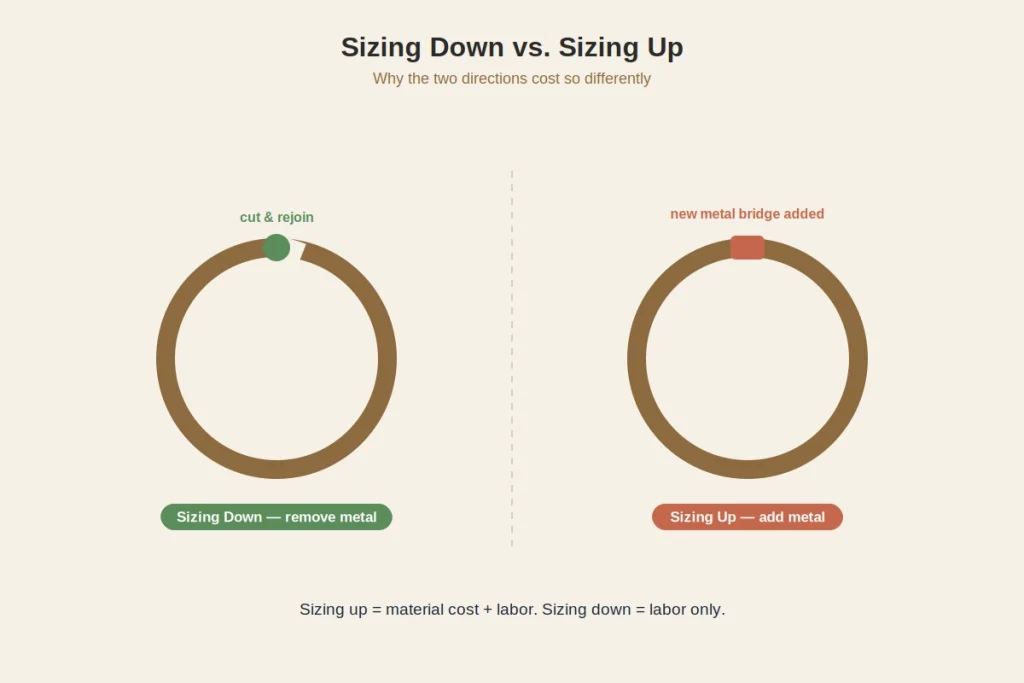
This is the single biggest driver of price, more than the metal type itself. Sizing a ring down is a subtractive process — the jeweler cuts out a small section of the band and rejoins the ends, so there’s no new material cost, just labor. Sizing up is a constructive process: the band gets cut, pulled apart, and a new bridge of matching metal is soldered or laser-welded into the gap. That bridge has to be sourced in the correct karat and color match, which adds material cost on top of the extra labor — and the more sizes you need to go up, the larger that bridge, and the higher the price climbs.
As a rough rule of thumb, going up multiple sizes at once (more than about two) starts to approach the cost of reconstructing the band entirely, and some jewelers will say so directly rather than quote a linear per-size price.
Can every ring be resized?
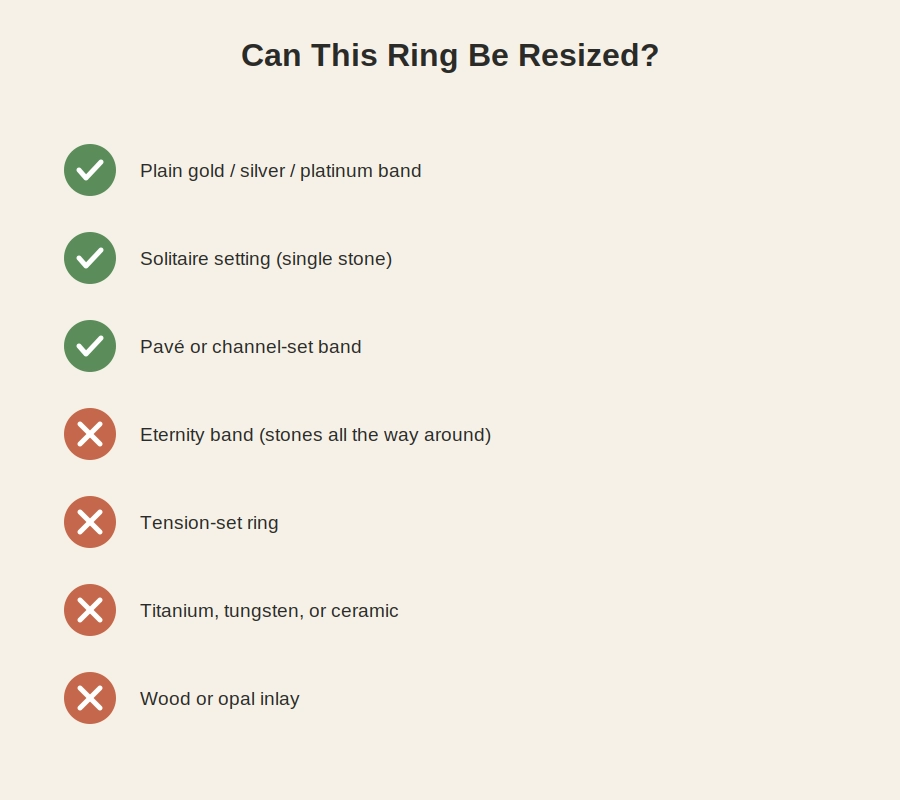
No, and this matters more than the price question for some rings. A jeweler should tell you upfront if your specific ring is a poor or impossible candidate, but knowing the general categories ahead of time saves you a wasted trip:
- Eternity bands — where stones run the full circumference — often can’t be resized at all, since there’s no plain metal section left to cut or stretch without disturbing a stone.
- Tension-set rings, which hold a stone purely through the pressure of the band itself, generally require the entire setting to be reconstructed rather than simply resized, which is a different and pricier job.
- Titanium, tungsten, and ceramic are usually not resizable with standard jewelry tools — some specialty shops offer limited sizing with dedicated equipment, but it’s uncommon, and replacement is often the more realistic path.
- Very thin bands, or bands that have already been resized once or twice, get progressively more fragile with each cut; a jeweler may decline a third resize on structural grounds.
- Inlay rings (wood, opal, or other material set into a channel around the band) usually can’t be resized without damaging the inlay.
If your ring falls into one of these categories, ask specifically about a ring guard or spacer (below) as a non-permanent alternative, or a full remake if the ring is valuable enough to justify it.
What the resizing process actually involves
- Assessment. The jeweler inspects for existing damage, worn prongs, or stone looseness before doing anything — resizing puts heat and stress on a ring, and problems that already exist tend to surface during the process.
- Sizing down: the band is cut at one point, a small section removed, and the two ends rejoined with solder or a laser welder, then reshaped round again.
- Sizing up: the band is cut, the ends pulled apart, and a new section of matching metal added to bridge the gap before rejoining and reshaping.
- Finishing. The join is polished smooth, and any affected stones are re-checked and re-tightened. White gold rings typically need a fresh rhodium plating afterward to restore the finish, since the heat can dull it.
Turnaround is usually a matter of days to about two weeks depending on complexity: a plain band at a local jeweler with in-house resizing might be ready in a few days, while a ring with stones, or one that has to be shipped out to a manufacturer (common for rings bought through a big-box or online retailer), can take one to two weeks or more.
Ring resizing at major jewelers
If you bought your ring from a large retailer — Kay Jewelers, Zales, Jared, Brilliant Earth, and similar chains are common searches — the first thing worth checking isn’t the price, it’s your warranty or protection plan paperwork. Many major jewelers include free or discounted resizing within a set window after purchase (commonly tied to a return period or an optional lifetime protection plan), separate from what they’d charge a walk-in customer with a ring bought elsewhere. Specific policies, windows, and fees vary by retailer and change over time, so the reliable move is calling the store or checking your purchase paperwork directly rather than assuming a number — but it’s worth checking before you pay out of pocket, since a ring still inside its free-resize window can save you the entire cost above.
Independent local jewelers, by contrast, almost always charge per the ranges above regardless of where you bought the ring, but tend to offer faster in-house turnaround since the work isn’t shipped to a central service center.
Temporary and DIY alternatives to full resizing
If your ring is only slightly loose, or you’re not ready to commit to a permanent resize, a few lower-cost or non-permanent options exist:
- Ring guards or spacers — small clips or coils that attach to the inside of the band — can tighten a slightly loose ring for a few dollars, without any cutting. They’re a genuinely good option for a ring that’s loose by less than half a size, or for a sentimental ring you don’t want permanently altered.
- Sizing beads, small metal balls soldered to the inside of the band, work similarly but are a semi-permanent jeweler-applied fix rather than a removable one.
- A silicone or elastic insert is the lowest-cost, fully non-permanent option, though it’s the least durable and most noticeable of the three.
None of these substitute for a proper resize on a ring that’s more than about half a size off — at that point the fit and comfort issues outweigh what a spacer can realistically fix, and it’s worth booking the real resizing service instead.
Frequently asked questions
Is it cheaper to size a ring down or up?
Sizing down is almost always cheaper, since it only removes material and labor, while sizing up requires sourcing and adding new metal that matches the ring’s karat and color.
How long does ring resizing take?
A simple band at a local jeweler with in-house service is often ready in a few days; rings with stones, or those shipped to a manufacturer, commonly take one to two weeks.
Does resizing damage a ring?
Done correctly by an experienced jeweler, no — but each resize does remove or add a small amount of metal, and a band that’s been resized multiple times over its lifetime gets progressively thinner and more fragile. Most rings can be safely resized two to three times before that becomes a real concern.
Will my jeweler resize a ring I didn’t buy from them?
Most will, and pricing is typically the same regardless of where the ring was purchased — the exception is a ring still covered under another retailer’s free-resize warranty window, which usually only applies if you return to that specific retailer.
What if my ring can’t be resized at all?
Ask about a ring guard or spacer for a minor fit issue, or discuss a full remake with a jeweler if the ring is valuable or sentimental enough to justify rebuilding the band from scratch — this comes up most with eternity bands, tension-set rings, and hard metals like titanium or tungsten.