
The Oura Ring 4 operates in one of the most hotly contested categories in consumer technology. Since Samsung launched the Galaxy Ring in July 2024, the smart ring market has exploded: Ultrahuman, RingConn, Circular, Movano, and a wave of CES 2025 entrants have all staked their claim. Meanwhile, WHOOP and Apple Watch continue to compete for the wrist-based health wearable crown, and Fitbit — now owned by Google — still counts tens of millions of users. Which device is actually right for you?
This hub collects every major Oura Ring comparison into one authoritative guide — with real specs, independent accuracy data, full 3-year cost analysis, and a clear verdict for each matchup. Whether you’re weighing up Oura vs Samsung Galaxy Ring, Oura vs WHOOP, Oura vs Apple Watch, Oura vs Ultrahuman, Oura vs RingConn, or simply wondering whether a smart ring or smartwatch is the better choice — this is the only guide you need.
| ⚡ Quick Answer — Oura Ring 4 vs The CompetitionBest overall for sleep & health depth: Oura Ring 4 — most clinically validated consumer wearable, 50+ biometrics, deepest platform. Best for Android / Samsung users: Samsung Galaxy Ring — no subscription, lightweight, Galaxy ecosystem integration. Best for serious athletes: WHOOP 4.0 — unmatched Strain/Recovery model, 14-day battery, dedicated athletic coaching. Best all-in-one device: Apple Watch Series 10 — GPS, ECG, notifications, apps. A different category entirely. Best subscription-free smart ring: Ultrahuman Ring Air — comparable tracking, zero monthly fee, ultra-light. Best on a budget: RingConn Gen 2 — $299 total, no subscription, 12-day battery, solid core metrics. |
1. The 2025 Smart Wearable Landscape: Where Oura Fits In
The smart ring market was valued at $348.56 million in 2024 and is projected to grow at over 20% CAGR through 2030. Oura created the category with the original ring in 2017; Samsung’s Galaxy Ring launch confirmed its mainstream legitimacy; and by early 2025 there were more than a dozen competing devices available globally. The broader wearable technology market — which includes smartwatches, fitness bands, and health rings — is forecast to exceed $150 billion by 2030 according to multiple market research reports.
Within this landscape, each device occupies a distinct strategic position:
- Oura Ring 4: Premium, science-led, full health intelligence platform — best for sleep, recovery, and longevity-focused users willing to pay $5.99/month
- Samsung Galaxy Ring: Mainstream no-subscription alternative — best for Android/Galaxy ecosystem users wanting solid core tracking without ongoing fees
- WHOOP 4.0: Performance athlete specialisation — best for training load management and serious athletic recovery coaching
- Apple Watch Series 10: All-in-one smartwatch — best for users needing GPS, ECG, notifications, and apps alongside health monitoring
- Ultrahuman Ring Air: Subscription-free smart ring — best for biohackers wanting Oura-comparable tracking at lower long-term cost
- RingConn Gen 2: Budget smart ring — best for cost-conscious users prioritising battery life and core metrics without any subscription
Understanding where each device sits — and what it prioritises — is the essential starting point. A wearable purchase is ultimately about which tool solves your specific health monitoring problem, not which device has the longest spec sheet.
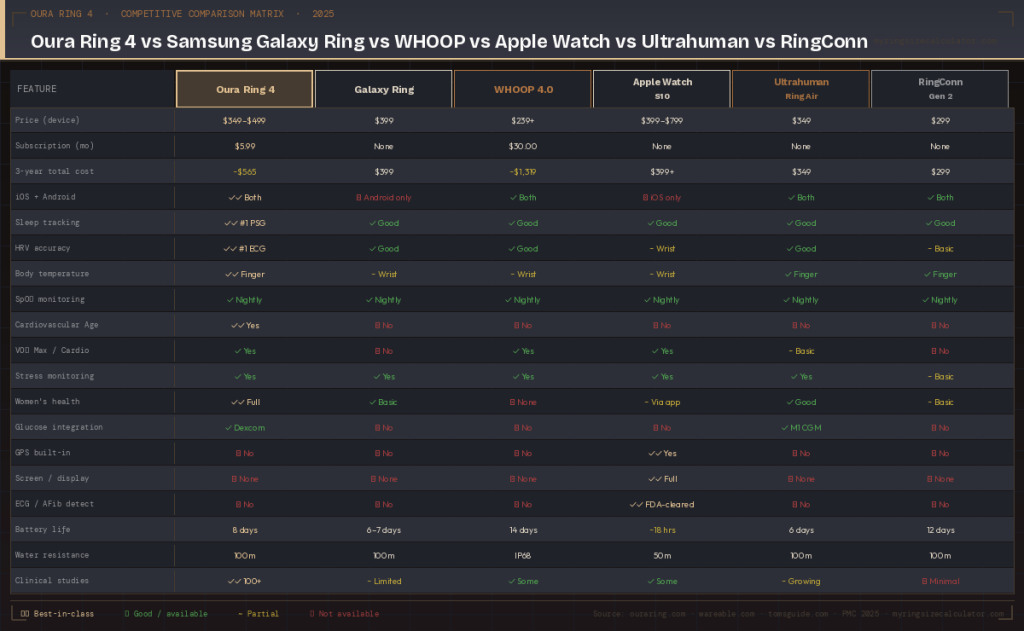
2. Master Comparison Matrix: Oura Ring 4 vs 5 Competitors
The following image summarises 19 key features across all six devices. Full detail on each head-to-head comparison follows in dedicated sections.
| 📷 cmp_img1_matrix.png Caption: Oura Ring 4 vs Samsung Galaxy Ring vs WHOOP 4.0 vs Apple Watch Series 10 vs Ultrahuman Ring Air vs RingConn Gen 2 — 19-feature competitive comparison matrix, 2025.Alt: “Oura Ring 4 vs Samsung Galaxy Ring vs WHOOP vs Apple Watch vs Ultrahuman Ring Air vs RingConn Gen 2 comparison matrix showing 19 features including sleep accuracy, HRV, price, subscription, battery life, and more” |
Key takeaways from the matrix:
- Only Oura Ring 4 offers Cardiovascular Age: A clinically derived estimate of arterial health — unavailable on any competing ring, band, or smartwatch as of 2025
- Samsung Galaxy Ring is Android-only: Every other device in the comparison supports both iOS and Android — for iPhone users, Galaxy Ring is not an option
- WHOOP is the most expensive over 3 years: At $1,319+ (vs $565 for Oura), WHOOP’s $30/month subscription means it costs more than double Oura over a 3-year period
- Apple Watch is the only device with GPS and ECG: These two features place it in a different product category — a smartwatch with health features rather than a dedicated health wearable
- Oura has by far the most peer-reviewed clinical validation: 100+ published studies validate its accuracy vs ‘limited’ or ‘minimal’ for all competitors
3. Oura Ring 4 vs Samsung Galaxy Ring: Full Head-to-Head
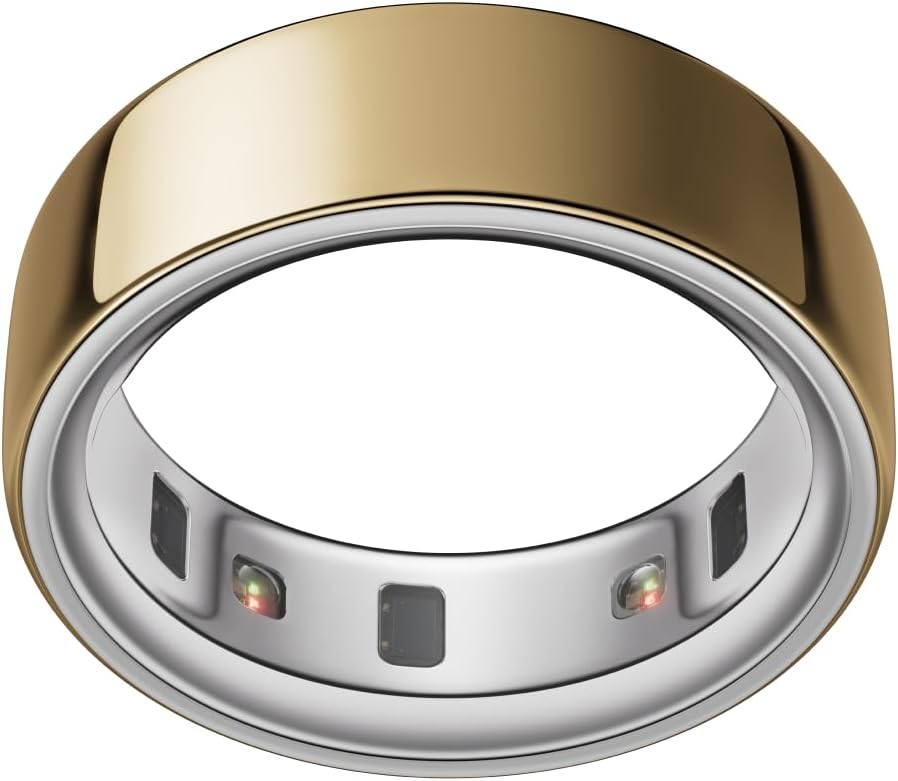
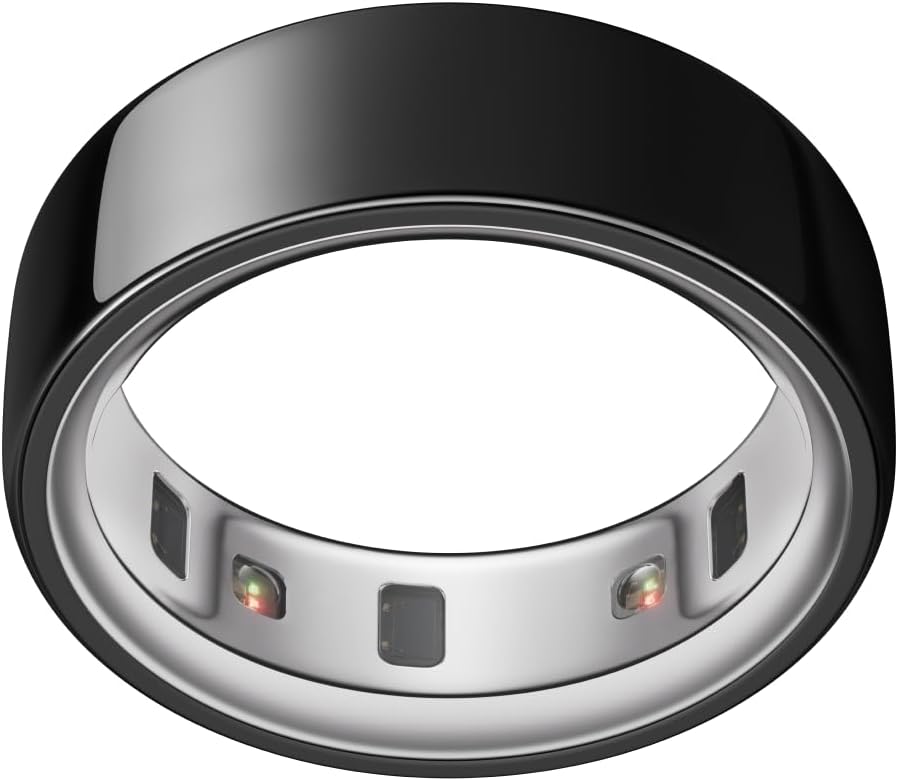
The Samsung Galaxy Ring, launched July 2024, is Oura’s most consequential competitor. Not because it matches Oura feature-for-feature — it doesn’t — but because Samsung’s brand power, zero-subscription model, and ultra-lightweight design created the first mainstream smart ring challenge to Oura’s seven-year dominance. The matchup generates more search volume than any other smart ring comparison in 2025.
Reviewers at Wareable who wore both rings simultaneously for weeks concluded that Oura wins on health insight depth and compatibility, while Samsung wins on weight, design comfort, and long-term cost. Android Central noted that Samsung’s health tracking accuracy remains limited compared to Oura’s mature platform.
Full Specs Comparison
| Specification | Oura Ring 4 | Samsung Galaxy Ring |
| Price (device) | $349–$499 (varies by finish) | $399 (all colours same price) |
| Monthly subscription | $5.99/month (required for insights) | None — free forever |
| 3-year total cost | ~$565 (annual plan) | $399 |
| iOS compatible | Yes — full feature parity | No — Android only |
| Android compatible | Yes | Yes |
| Sizes available | US 4–15 (12 sizes) | US 5–13 (9 sizes) |
| Minimum weight | 3.3g | 2.3g (lightest smart ring available) |
| Width / thickness | 7.9mm wide / 2.88mm thick | 7mm wide / 2.6mm thick |
| Body material | Full titanium (all-titanium, flush interior) | Titanium with concave design |
| Battery life | Up to 8 days | Up to 7 days (real-world ~5–6 days) |
| Water resistance | 100m | 100m |
| Charging method | Magnetic puck (ring off wrist) | Portable charging case |
| PPG pathways | 18-path Smart Sensing (adaptive) | Standard fixed-path optical PPG |
| Sleep staging | 4-stage + 8 contributors + PSG-validated | 4-stage sleep tracking |
| HRV accuracy | #1 (independent ECG comparison, PMC 2025) | Good — not independently ranked |
| Body temperature | Finger-based (superior signal) | Wrist-adjacent (less accurate baseline) |
| SpO₂ monitoring | Nightly (120% better signal vs Gen 3) | Nightly |
| Cardiovascular Age | Yes — unique to Oura | No |
| VO₂ Max estimate | Yes (Cardio Capacity, 6-min walk test) | No |
| Stress monitoring | Yes — Daytime Stress + Resilience | Yes — Energy Score contributor |
| Women’s health | Full: Cycle Insights, Fertility, Pregnancy | Basic cycle tracking only |
| Glucose integration | Yes — Dexcom Stelo CGM | No |
| App ecosystem | Oura app (iOS + Android), 40+ integrations | Samsung Health (Android-optimised) |
| Health score system | Readiness + Sleep + Activity (3 scores) | Energy Score + Sleep Score |
| AI health coaching | Oura Advisor — personalised AI | Basic Samsung AI tips |
| Find my ring | No | Yes (Samsung Galaxy ecosystem only) |
| Clinical research | 100+ peer-reviewed validation studies | Very limited (first-gen product) |
Where Oura Ring 4 Wins
- iOS compatibility: The Galaxy Ring requires an Android phone — iPhone users have no choice. Oura supports both platforms with full feature parity
- Health intelligence depth: 50+ biometrics vs Galaxy Ring’s core metrics. Cardiovascular Age, Cardio Capacity, Resilience, Symptom Radar, Dexcom glucose — none available on Galaxy Ring
- Size range: US 4–15 vs 5–13. The two extra sizes at the bottom matter significantly for smaller-fingered users, particularly women
- Clinical validation: 100+ independent peer-reviewed studies vs very limited data for the first-gen Galaxy Ring. Oura’s accuracy claims are substantiated by science
- Long-term platform evolution: Seven years of algorithm refinement and a continuous feature release cadence (Oura Labs) vs a first-generation ring from Samsung
- Women’s health: Full Cycle Insights, Fertile Window, Pregnancy Insights, and Natural Cycles integration vs Samsung’s basic cycle tracking
Where Samsung Galaxy Ring Wins
- No subscription — ever: $0/month makes the total 3-year cost $399 vs $565 for Oura — and the gap only grows over time
- Lightest smart ring available: At 2.3g, the Galaxy Ring is noticeably lighter than the Oura Ring 4’s 3.3g minimum. For sensitive sleepers, this matters
- Slimmer design: 2.6mm vs 2.88mm — the Galaxy Ring is thinner and many reviewers find it more comfortable for all-day wear
- Portable charging case: The Galaxy Ring charges in a pocket-sized case (similar to wireless earbuds) vs Oura’s stationary magnetic puck
- Samsung Galaxy ecosystem: Find My Ring, Samsung Health dashboard, Galaxy Watch cross-device data sharing — a genuinely unified ecosystem for Samsung phone users
| 🏆 Verdict: Oura Ring 4 vs Samsung Galaxy RingChoose Oura Ring 4 if: you have an iPhone, want Cardiovascular Age or advanced health intelligence, need women’s health features, require size 4 or 14+, or value the full 7-year depth of Oura’s platform.Choose Samsung Galaxy Ring if: you have an Android phone and live in the Samsung ecosystem, want to eliminate monthly subscriptions, prefer the lightest and slimmest ring available, or want solid core health tracking without platform complexity. |
4. Oura Ring 4 vs WHOOP 4.0: Sleep & Recovery Showdown
Oura and WHOOP are the two dominant wearables in the biohacking and performance-optimisation space — occupying meaningfully different positions within it. WHOOP targets serious athletes with a Strain/Recovery model built around training load. Oura targets a broader health audience with a Sleep/Readiness/Activity model built around holistic well-being. Both are screenless, subscription-required, and focused exclusively on health data rather than productivity.
A 2025 independent study published in Physiological Reports (PMC), comparing five wearables across 536 nights against an ECG reference, found Oura Ring Gen 3 and Gen 4 achieved the highest HRV accuracy (concordance correlation coefficients of 0.97 and 0.99 respectively), while WHOOP showed moderate HRV agreement (CCC = 0.94). For sleep staging, a 2024 Brigham and Women’s Hospital study found Oura significantly outperformed both Fitbit and Apple Watch; WHOOP’s four-stage sleep classification remains less independently validated.
Head-to-Head Specs
| Specification | Oura Ring 4 | WHOOP 4.0 |
| Form factor | Ring (finger-worn) | Wrist band — no screen |
| Price (device) | $349–$499 | $239 (included with membership) |
| Subscription cost | $5.99/month ($69.99/year) | $30/month ($239/year) — mandatory |
| 3-year total cost | ~$565 (annual sub) | ~$1,319 (monthly plan) |
| Battery life | Up to 8 days | Up to 14 days |
| Charging method | Magnetic puck (ring off 20–30 mins) | External battery pack — worn while charging |
| Water resistance | 100m (sauna-safe) | IP68 — not sauna-rated |
| Sleep tracking | 4-stage PSG-validated + 8 contributors | 4-stage + Sleep Coach + Sleep Debt |
| HRV accuracy | #1 vs ECG (PMC 2025, CCC = 0.99) | Good vs ECG (PMC 2025, CCC = 0.94) |
| Body temperature | Finger-based nightly deviation | Wrist-based — less accurate baseline |
| SpO₂ monitoring | Nightly — 120% better signal (Gen 4) | Nightly |
| Workout/Strain model | Activity Score (balanced recovery) | Daily Strain 0–21 (athlete-grade) |
| VO₂ Max | Yes — Cardio Capacity (walk test) | Yes — Strain-based estimate |
| Cardiovascular Age | Yes | No |
| Women’s health | Full — Cycles, Fertility, Pregnancy | Yes — menstrual cycle tracking |
| Glucose integration | Yes — Dexcom Stelo | No |
| AI coaching | Oura Advisor (personalised) | Coach (performance-focused) |
| Screen / notifications | None | None |
| iOS + Android | Both | Both |
| Best for | Holistic health, sleep, longevity | Athletic performance, training load |
The Subscription Cost Reality
The subscription economics of this comparison are stark. WHOOP charges $30/month — five times more expensive than Oura’s $5.99. Over three years, WHOOP users pay approximately $1,080 in subscriptions alone, bringing total ownership cost to ~$1,319 vs Oura’s ~$565. That is a $754 difference over 3 years — for a device that, outside athletic performance tracking, offers less comprehensive health monitoring than Oura.
WHOOP offers one genuine operational advantage: its external battery pack slides over the band to charge while worn, enabling uninterrupted 24/7 monitoring without ever removing the device. For athletes who race or compete and need continuous data through all training periods, this is a meaningful benefit that Oura’s 20–30 minute charging interruption cannot match.
| ▶ YouTube Video Resource Oura Ring vs WHOOP — Full Comparison (Wear What Matters) — Watch on YouTubeDetailed side-by-side comparison of Oura Ring and WHOOP covering sleep staging accuracy, subscription value, form factor comfort, athletic use cases, and which platform suits different user types. One of the most thorough head-to-head reviews available. |
| 🏆 Verdict: Oura Ring 4 vs WHOOP 4.0Choose Oura Ring 4 if: you want best-in-class sleep tracking, the broadest health intelligence platform, Cardiovascular Age, glucose integration, women’s health features, or a lower long-term cost. Oura is the better value for 90% of users. Choose WHOOP 4.0 if: you are a competitive athlete, CrossFit competitor, or endurance sports participant who needs granular Daily Strain tracking, advanced recovery coaching calibrated to training load, and the ability to charge without removing the device. The premium subscription is justified for this specific use case. |
5. Oura Ring 4 vs Apple Watch Series 10: Ring vs Smartwatch
The Oura Ring vs Apple Watch comparison is fundamentally a category mismatch — these serve different purposes. The Apple Watch Series 10 is a wrist computer: it makes calls, shows notifications, runs apps, provides GPS navigation, processes Apple Pay, and offers health monitoring as one of many functions. The Oura Ring 4 is a dedicated health monitoring device: it tracks your physiology around the clock with no screen, no notifications, and no productivity features.
NBC News reviewer Harry Rabinowitz, who wore both simultaneously for most of 2025, described the Apple Watch as ‘a tiny computer on my wrist’ and the Oura Ring as ‘a stylish ring I forget about until I open the app.’ His conclusion was that the devices are complementary rather than competing — and that many health-conscious users own both.
Head-to-Head Specs
| Specification | Oura Ring 4 | Apple Watch Series 10 |
| Form factor | Ring (finger) — no screen | Smartwatch — full always-on display |
| Price | $349–$499 | $399–$799 (40mm–46mm) |
| Subscription | $5.99/month (Oura Membership) | None (optional Apple Fitness+) |
| Battery life | Up to 8 days | ~18 hours normal / 36hrs low-power |
| GPS | No | Yes — built-in precision GPS |
| Screen | None | Always-on LTPO OLED Retina display |
| Notifications | None | Full — calls, texts, app alerts |
| ECG | No | Yes — FDA-cleared single-lead ECG |
| AFib monitoring | Symptom Radar (indirect signal) | Yes — continuous AFib detection |
| Sleep tracking | #1 PSG-validated, 4-stage + 8 contributors | Good — 4-stage, less independently validated |
| Sleep battery | Ring worn all night, 8-day battery | Daily charging often skips overnight wear |
| HRV accuracy | #1 finger PPG vs ECG (PMC 2025) | Good — wrist PPG limitation |
| Body temperature | Finger-based nightly baseline | Wrist-based, less accurate |
| Blood oxygen (SpO₂) | Nightly (120% improved Gen 4) | Paused in US models (2024 patent dispute) |
| Cardiovascular Age | Yes — unique feature | No |
| Women’s health | Full Cycle Insights + Pregnancy + Fertility | Cycle tracking + Fertility window |
| Apple Pay / NFC | No | Yes |
| Third-party apps | No — Oura app only | Yes — full App Store |
| Emergency SOS | No | Yes — crash detect, fall detect |
| iOS required | No — iOS + Android | Yes — iOS only |
| Water resistance | 100m | 50m |
| Weight | 3.3–5.3g | 28–42g |
| Best for | Passive 24/7 health monitoring | Active productivity + health combination |
The Battery Life Problem for Overnight Sleep Tracking
Apple Watch’s 18-hour battery creates a fundamental dilemma for sleep tracking. Most users charge their watch overnight — precisely the time when sleep and recovery data is most valuable. Apple’s low-power mode extends battery to ~36 hours but degrades tracking accuracy. Oura’s 8-day battery means you never make this trade-off. Independent testing by NBC News confirmed that for users whose primary goal is sleep quality improvement, the Oura Ring is the more practical tool — the Apple Watch is constrained by a charging schedule that directly conflicts with its health monitoring use case.
Where Apple Watch Wins Decisively
- FDA-cleared ECG: Apple Watch is the only consumer device with a cleared single-lead ECG for AFib rhythm analysis — a clinically significant safety feature with no equivalent in any smart ring
- GPS: Essential for outdoor runners, cyclists, and hikers who need accurate route, pace, and distance data without carrying a phone
- Productivity: Calls, texts, Apple Pay, Siri, and the full iOS app ecosystem make Apple Watch a genuinely useful daily tool beyond health
- Real-time workout display: Live heart rate, pace, and metrics during exercise — the Oura Ring has no screen for real-time feedback
- Emergency safety: Crash detection, fall detection, and Emergency SOS are important features for older users and solo outdoor athletes
| 🏆 Verdict: Oura Ring 4 vs Apple Watch Series 10 Most power users own both — they serve complementary purposes. Buy Oura Ring 4 if: sleep accuracy, 24/7 passive monitoring, and depth of health insight are your priorities. The ring’s 8-day battery solves the overnight charging problem that fundamentally limits Apple Watch’s sleep tracking utility.Buy Apple Watch if: you need GPS, FDA-cleared ECG, real-time workout data, productivity features, or emergency safety functions. If you want one device to do everything, Apple Watch does more — the Oura Ring does health better. |
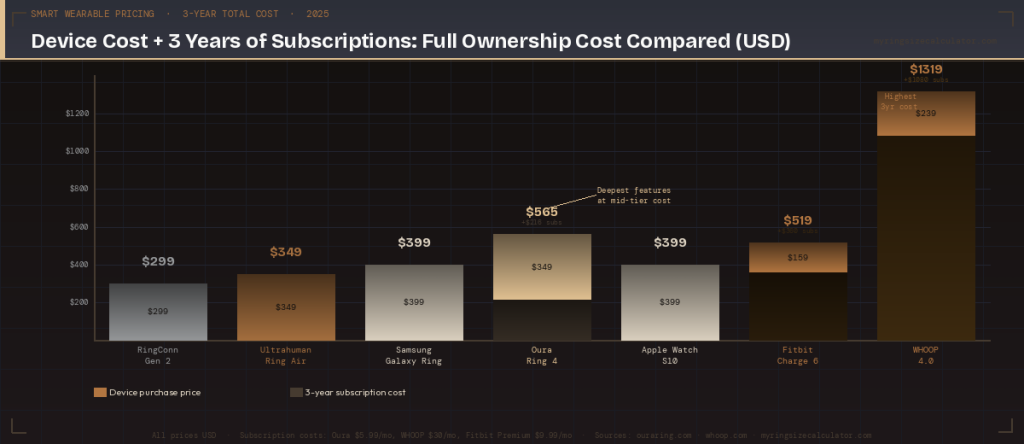
| 📷 cmp_img2_cost.png Caption: Smart wearable 3-year total cost of ownership: RingConn $299, Ultrahuman $349, Samsung Galaxy Ring $399, Oura Ring 4 $565, Apple Watch $399, Fitbit $519, WHOOP $1,319.Alt: “Smart ring and wearable 3-year total cost of ownership bar chart comparing device price and subscription costs for RingConn, Ultrahuman, Samsung Galaxy Ring, Oura Ring 4, Apple Watch, Fitbit, and WHOOP” |
6. Oura Ring 4 vs Ultrahuman Ring Air: The No-Subscription Case

The Ultrahuman Ring Air is the most direct feature-comparable alternative to the Oura Ring 4. Both are titanium smart rings tracking the same core biometrics — sleep, HRV, body temperature, SpO₂, activity — with a similar app experience grounded in physiological insight. The primary differentiator is simple and significant: Ultrahuman has no subscription fee, ever. One purchase price, lifetime access.
However, note that as of late 2025, the US International Trade Commission issued a ruling that Ultrahuman infringed Oura’s patents, directing it to pause US sales during appeals. The dispute is ongoing. Verify availability at ultrahuman.com before purchasing. RingConn Gen 2 reached a royalty agreement with Oura and remains freely available.
Head-to-Head Specs
| Specification | Oura Ring 4 | Ultrahuman Ring Air |
| Price (device) | $349–$499 | $349 (one price) |
| Monthly subscription | $5.99/month (required) | None — lifetime free access |
| 3-year total cost | ~$565 | $349 |
| 4-year total cost | ~$635 | $349 |
| Weight | 3.3–5.3g (by size) | 2.4–3.6g (lightest after Galaxy Ring) |
| Thickness | ~2.88mm | 2.45–2.8mm |
| Sizes available | US 4–15 | US 5–14 |
| Body material | Full titanium | Titanium + tungsten carbide carbon coating |
| PPG system | 18-path Smart Sensing (adaptive) | Standard fixed-path optical PPG |
| Sleep tracking | 4-stage, PSG-validated, 8 contributors | 4-stage sleep tracking |
| HRV accuracy | #1 vs ECG (PMC 2025) | Good — no equivalent independent rank |
| Body temperature | Nightly finger-based deviation | Nightly finger-based deviation |
| SpO₂ monitoring | Nightly (Gen 4: 120% better signal) | Nightly |
| Cardiovascular Age | Yes — unique | No |
| VO₂ Max estimate | Yes — Cardio Capacity | No |
| Women’s health | Full — Cycles, Fertility, Pregnancy | Good — cycles, ovulation, fertile window |
| Glucose integration | Yes — Dexcom Stelo CGM | Yes — M1 CGM (Ultrahuman ecosystem) |
| Stress monitoring | Daytime Stress + Resilience Score | Stress monitoring + active notifications |
| AI coaching | Oura Advisor | Ultrahuman app coaching |
| App approach | Passive — review when you choose | Active — pushes coaching notifications |
| Battery life | Up to 8 days | Up to 6 days |
| Scientific validation | 100+ peer-reviewed studies | Growing — fewer independent studies |
| US availability | Always | Restricted pending ITC patent ruling (2025) |
The Subscription Economics Over Time
Over a 4-year wearable lifecycle, the Oura Ring 4 costs approximately $635 total (device + annual subscriptions at $69.99/year) vs $349 for the Ultrahuman Ring Air. That is a $286 difference for broadly comparable core biometric tracking. For users primarily interested in sleep stages, HRV trends, and a daily readiness score — and who do not heavily use Oura’s advanced features like Cardiovascular Age, Cardio Capacity, Symptom Radar, or the Dexcom glucose integration — the cost case for Ultrahuman is genuinely compelling.
For users who do engage deeply with Oura’s platform — the Oura Advisor AI, Oura Labs experimental features, the 40+ third-party integrations, clinical research collaboration — the $69.99/year subscription is defensible. The critical question is whether you will actually use those advanced features, or whether the core metrics are sufficient.
| 🏆 Verdict: Oura Ring 4 vs Ultrahuman Ring AirChoose Oura Ring 4 if: you are on iOS, want Cardiovascular Age, actively use the Dexcom glucose integration, value Oura’s 100+ clinical study validation record, or engage with the platform’s advanced features enough to justify $5.99/month. Choose Ultrahuman Ring Air if: subscriptions are a dealbreaker, core biometrics (sleep, HRV, temperature, SpO₂) are sufficient for your needs, you prefer Ultrahuman’s more proactive coaching notification approach, and you have confirmed US availability is not restricted during ongoing patent litigation. |
7. Oura Ring 4 vs RingConn Gen 2: The Budget Smart Ring
The RingConn Gen 2 is the most practical alternative for budget-conscious users who want ring-form-factor health tracking without subscriptions and with the longest battery life in the category. At $299 with no subscription, it represents the lowest possible entry cost into genuine smart ring health monitoring. RingConn reached a royalty agreement with Oura following the 2025 ITC patent ruling, making it freely available in the US.
Tom’s Guide reported in early 2026 that a hands-on with the RingConn Gen 3 (successor to Gen 2) showed it ‘beats even the Oura Ring 4 in several crucial ways’ — primarily battery life and the charging case convenience. The Gen 2 remains the widely available model at time of writing.
Key Comparison Points
| Feature | Oura Ring 4 | RingConn Gen 2 |
| Price | $349–$499 | $299 |
| Subscription | $5.99/month | None |
| 3-year total cost | ~$565 | $299 |
| Ring battery life | 8 days | 12 days |
| Charging case | No — magnetic puck only | Yes — case adds up to 150 days |
| Sleep staging | 4-stage, PSG-validated | 4-stage (limited independent validation) |
| HRV accuracy | #1 vs ECG (PMC 2025) | Basic RMSSD — limited independent data |
| Breathing disturbance | Breathing Disturbance Index (BDI) | Sleep apnea signal (90%+ accuracy claimed) |
| Cardiovascular Age | Yes | No |
| Women’s health | Full platform | Basic cycle tracking |
| Clinical studies | 100+ peer-reviewed | Minimal independent research |
| App quality | Excellent — mature, polished | Good — improving with updates |
| US availability | Always available | Available (post-royalty agreement) |
| 🏆 Verdict: Oura Ring 4 vs RingConn Gen 2 Choose Ring Conn Gen 2 if: budget is your primary constraint ($299 vs $565 over 3 years), battery life is critical (12 vs 8 days, plus charging case for travel), and core sleep/HRV tracking without advanced features is sufficient. Choose Oura Ring 4 if: data accuracy, clinical validation, platform depth, women’s health features, or advanced metrics like Cardiovascular Age are important. The RingConn is a capable ring; the Oura Ring 4 is the most capable ring. |
8. Oura Ring 4 vs Fitbit: Legacy Tracker vs Modern Health Ring
The Fitbit brand — now owned by Google — pioneered consumer health awareness in the 2010s and still counts tens of millions of active users. The most capable current model, the Fitbit Charge 6 ($159), offers heart rate monitoring, SpO₂, stress tracking, sleep staging, GPS, Google Maps, and Google Wallet integration. Fitbit Premium, at $9.99/month, unlocks advanced insights — actually more expensive per month than Oura Membership at $5.99.
The 2024 Brigham and Women’s Hospital study found that the Oura Ring was 10% more accurate than Fitbit in four-stage sleep classification against polysomnography. A separate systematic review confirmed Oura’s superior accuracy across multiple sleep parameters where Fitbit showed more variable performance.
Key Comparison
| Feature | Oura Ring 4 | Fitbit Charge 6 |
| Price | $349–$499 | $159 |
| Subscription | $5.99/month (Oura Membership) | $9.99/month (Fitbit Premium — optional) |
| Form factor | Ring — no screen | Wrist band with small colour screen |
| GPS | No | Yes — built-in |
| Sleep accuracy | #1 consumer device (peer-reviewed) | 10% less accurate than Oura (B&W 2024) |
| HRV accuracy | #1 vs ECG (PMC 2025) | Good — wrist limitation |
| Body temperature | Finger nightly — highly accurate | Wrist skin temp — less precise baseline |
| Cardiovascular Age | Yes | No |
| Stress tracking | Daytime Stress + Resilience | Body Battery + EDA stress sensor |
| Women’s health | Full Cycle Insights + Pregnancy | Cycle tracking + Irregular period alerts |
| Google integration | Independent (Oura app) | Google Maps, Google Wallet, Google Health |
| Clinical validation | 100+ peer-reviewed studies | Moderate independent studies |
| Best for | Deep sleep & health insight | Budget step/activity tracking with GPS |
Fitbit remains a reasonable choice for users who want a budget-friendly, GPS-equipped wrist band for step tracking and general fitness with Google ecosystem integration. For users whose health goal is sleep quality improvement, HRV optimisation, or deep biometric insight, the Oura Ring 4 is categorically more capable — though at significantly higher device cost and with a lower monthly subscription than Fitbit Premium.
9. Smart Ring vs Smartwatch: Which Should You Buy?
The smart ring vs smartwatch decision hinges on a single question: do you primarily need a passive health monitor or an active productivity tool that also tracks health? These devices serve complementary functions, which is why many health-conscious users own both.
| Consideration | Smart Ring (Oura Ring 4) | Smartwatch (Apple Watch / Galaxy Watch) |
| Primary purpose | Passive 24/7 health & sleep monitoring | Active productivity + health tracking |
| Sleep tracking | Superior — ring worn all night, no battery anxiety | Limited — daily charging often skips overnight use |
| Discretion | Invisible — looks like jewellery | Conspicuous — always visible on wrist |
| Real-time workout data | No screen — data reviewed post-session | Yes — live HR, pace, distance, route on display |
| GPS tracking | No | Yes — essential for outdoor athletes |
| ECG / heart rhythm | No | Yes (Apple Watch — FDA-cleared) |
| Notifications / calls | None | Full smartphone notifications |
| Battery life | 8 days (Oura Ring 4) | ~18–36 hours (Apple Watch Series 10) |
| Sleeping comfort | Excellent — lightweight, no screen bulk | Moderate — band and case create bulk |
| Formal / professional wear | Ideal — unobtrusive ring | Less appropriate in some contexts |
| Data depth | 50+ biometrics, PSG-validated sleep | Good — less specialised than ring |
| Emergency features | None | Crash detection, fall detection, SOS |
| Best for | Health-first users, light sleepers, professionals | Active users wanting one device for everything |
The BBC Future has reported extensively on how constant smartphone notifications — and by extension, smartwatch alerts — create a chronic low-level stress response that undermines the very recovery you are trying to track. The Oura Ring’s complete absence of notifications is not merely a limitation — for many users it is a deliberate health feature. The ring monitors your stress response without adding to it.
The answer for most health-conscious users is to wear both: a smartwatch during waking hours for productivity, GPS, and real-time workout feedback, and the Oura Ring continuously including overnight for passive sleep and recovery monitoring. With Oura’s 8-day battery, you are rarely managing charging for both devices on the same day.
10. 3-Year Total Cost of Ownership Analysis
Device purchase price is only the beginning of the total cost calculation for any subscription-dependent health wearable. This table models the true 3-year ownership cost — the average lifecycle before most users consider upgrading.
| Device | Device Price | Monthly Sub | Annual Sub Cost | 3-Year Subs | 3-Year Total |
| RingConn Gen 2 | $299 | $0 | $0 | $0 | $299 |
| Ultrahuman Ring Air | $349 | $0 | $0 | $0 | $349 |
| Samsung Galaxy Ring | $399 | $0 | $0 | $0 | $399 |
| Apple Watch Series 10 | $399 | $0 (base) | $0 | $0 | $399+ |
| Oura Ring 4 | $349 | $5.99 | $69.99 | ~$210 | ~$559 |
| Fitbit Charge 6 | $159 | $9.99 | $79.99 | ~$240 | ~$399 |
| WHOOP 4.0 | $239 | $30.00 | $239 | ~$717 | ~$956 |
Critical insight: Oura’s $5.99/month subscription is the second cheapest of any subscription-required wearable — cheaper than Fitbit Premium ($9.99) and vastly cheaper than WHOOP ($30). Yet Oura delivers a significantly more advanced health platform than either. For users who engage seriously with Oura’s features, the subscription represents strong value. The real competition for Oura on cost is the subscription-free rings — where the $210–216 three-year subscription cost is the entire differentiator.
11. Who Should Buy the Oura Ring 4 in 2025?
Based on the full competitive analysis, here is a clear decision framework:
Buy Oura Ring 4 if you are:
- A sleep-focused user: If sleep quality is your primary health goal, Oura Ring 4 has the most validated, most accurate, most clinically substantiated sleep tracking of any consumer device. No competing product comes close on this specific criterion
- An iPhone user: The Galaxy Ring is Android-only. Ultrahuman’s US availability is restricted by patent litigation. Oura Ring 4 is the premier iOS-compatible smart ring, period
- A women’s health user: Cycle Insights, Fertile Window, Pregnancy Insights, and the Natural Cycles FDA-cleared contraceptive integration represent the most comprehensive women’s health feature set on any ring. The size range (4–15) accommodates smaller fingers
- A longevity-focused user: Cardiovascular Age, Cardio Capacity (VO₂ max), Resilience tracking, and the Dexcom glucose integration make Oura the most complete longevity monitoring platform in the smart ring market
- A health data power user: If you actively engage with HRV trends, temperature patterns, sleep stage analysis, the Oura Advisor AI, and Oura Labs features — the $5.99/month subscription delivers clear value
- A professional or style-conscious user: The Oura Ring is indistinguishable from fine jewellery. Invisible in boardrooms, formal events, and the gym. Available in 7 finishes including gold, rose gold, and ceramic
Consider an alternative if you are:
- Subscription-averse: Ultrahuman Ring Air (pending US availability) or Samsung Galaxy Ring (Android only) offer comparable core tracking with zero ongoing cost
- An Android/Samsung power user: Galaxy Ring’s Samsung Health integration, Find My Ring, and Galaxy ecosystem synergy are genuine advantages Oura cannot replicate on Android
- A serious performance athlete: WHOOP’s Daily Strain model is purpose-built for training load management. Oura’s Activity Score is designed for balanced health maintenance, not athletic periodisation
- Needing GPS, ECG, or a screen: None of these exist on the Oura Ring. Apple Watch or Samsung Galaxy Watch are the answers for these specific requirements
- On a tight budget: RingConn Gen 2 at $299 total delivers genuinely capable core tracking — sleep staging, HRV, SpO₂, temperature — at less than half the 3-year cost of Oura Ring 4
12. Frequently Asked Questions
Structured for Google Featured Snippets, People Also Ask, and AI Overviews (GEO/AIO).
Is the Oura Ring better than the Samsung Galaxy Ring?
For most users — and especially iPhone users — the Oura Ring 4 is the better device. It offers deeper health analytics (50+ biometrics vs Galaxy Ring’s core set), Cardiovascular Age and Cardio Capacity unavailable on Galaxy Ring, a wider size range (4–15 vs 5–13), full iOS and Android compatibility vs Android-only, and 100+ independent clinical validation studies. Samsung Galaxy Ring wins on total cost (no subscription = $399 vs $565 over 3 years), weight (2.3g vs 3.3g minimum), and Samsung ecosystem integration for Android users.
Is Oura Ring better than WHOOP?
For most users, yes. Oura Ring 4 has stronger sleep accuracy (PSG-validated at 94.4% sensitivity), higher HRV accuracy (#1 in PMC 2025 study vs ECG), broader health platform (Cardiovascular Age, women’s health, glucose), and significantly lower 3-year cost (~$565 vs ~$1,319). WHOOP wins specifically for serious athletes needing Daily Strain training load management and continuous charging. WHOOP’s $30/month subscription makes it the most expensive wearable on the market over time — justified only if you actively use its athletic coaching features.
Can I wear the Oura Ring with an Apple Watch?
Yes, and many health-conscious users do exactly this. The Apple Watch serves waking-hour needs — GPS, ECG, notifications, Apple Pay, real-time workout data. The Oura Ring handles overnight sleep and recovery monitoring when the Apple Watch is charging. Both sync to Apple Health, creating a unified health data view. NBC News reviewer Harry Rabinowitz wore both simultaneously for most of 2025 and confirmed they serve complementary rather than competing functions.
Which smart ring has no subscription fee?
Three major smart rings currently require no subscription: Samsung Galaxy Ring ($399, Android only), RingConn Gen 2 ($299, both iOS and Android), and Ultrahuman Ring Air ($349, both platforms — US availability subject to ongoing patent litigation as of late 2025). Of these, Samsung Galaxy Ring is the most mainstream and widely available; RingConn Gen 2 has the best battery life at 12 days; Ultrahuman Ring Air is the most feature-comparable to Oura.
Is the Oura Ring the most accurate sleep tracker?
Yes, based on independent peer-reviewed research. A 2024 study at Brigham and Women’s Hospital found Oura Ring was 5% more accurate than Apple Watch and 10% more accurate than Fitbit in four-stage sleep classification vs polysomnography (PSG). A separate 2025 systematic review in OTO Open confirmed Oura’s validity across multiple sleep parameters. An independent 2025 PMC study found Oura Ring Gen 4 achieved HRV concordance correlation coefficient of 0.99 vs ECG — the highest of five devices tested.
Oura Ring vs WHOOP: which is cheaper?
Oura Ring 4 is significantly cheaper over any meaningful ownership period. Device + 3 years of Oura Membership (annual plan at $69.99/year) totals approximately $565. WHOOP 4.0 device + 3 years of $30/month membership totals approximately $1,319 — more than double. WHOOP’s per-month subscription is $30 vs Oura’s $5.99. Unless you actively use WHOOP’s athletic strain coaching features that justify its premium, Oura delivers far more health value at less than half the long-term cost.
Does the Oura Ring work with iPhone?
Yes — Oura Ring 4 works with both iPhone (iOS 16+) and Android phones, with full feature parity on both platforms. This is a key differentiator from the Samsung Galaxy Ring, which is Android-only. The Oura app is available on the App Store and Google Play, and integrates with Apple Health and Google Health Connect respectively.
What is the cheapest Oura Ring alternative?
The RingConn Gen 2 at $299 with no subscription is the most affordable capable smart ring. Over 3 years it costs $299 total vs approximately $565 for the Oura Ring 4 — a $266 saving. The trade-off is less clinical validation, no Cardiovascular Age feature, a less mature app platform, and a slightly lower HRV accuracy. For users who primarily want sleep staging and core biometrics without the full Oura platform, the RingConn represents strong value.
Explore More Oura Ring Guides
| 🔗 Complete Oura Ring Resource Hub — myringsizecalculator.com← Parent Hub→ Oura Ring: The Complete Guide (Main Hub)Pillar Hub Pages→ Oura Ring Generations: Gen 1 through Gen 5 Complete Guide→ Oura Ring Features & Health Tracking HubReviews & Generation Guides→ Oura Ring Gen 4 Review: Is It Worth Buying?→ Oura Ring Gen 4 vs Gen 3 vs Samsung Galaxy Ring→ Oura Ring Gen 3 vs Gen 4: Thickness & Design Changes→ Best Oura Rings to Buy in 2025Features & Technology→ How Does the Oura Ring 4 Work? Sensors & Technology Explained→ Benefits of Oura Ring 4: What It Does for Your Health→ Can the Oura Ring Detect Sleep Apnea?→ Does the Oura Ring Measure Blood Pressure?→ Oura Ring 4 Battery Life: How Long Does It Last?→ Common Oura Ring 4 Problems & How to Fix ThemRing Sizing→ Free Ring Size Calculator — find your perfect Oura Ring size before ordering |
Sources & External References
Independent Reviews & Hands-On Tests
- Wareable: Oura Ring 4 vs Samsung Galaxy Ring — Worn Side by Side
- Tom’s Guide: Samsung Galaxy Ring vs Oura Ring 4 (2025)
- NBC News Select: Oura Ring vs Apple Watch — Worn for Most of 2025
- NBC News Select: WHOOP vs Apple Watch — Worn for One Month (2025)
- Android Central: Oura Ring 4 vs Samsung Galaxy Ring — Oura Maintains Supremacy
- Tech Advisor: Oura Ring 4 vs Samsung Galaxy Ring (2025)
- Cybernews: Oura Ring 4 vs Samsung Galaxy Ring — In-Depth Analysis
- Garage Gym Reviews: Samsung Ring vs Oura — Expert Comparison
Clinical & Peer-Reviewed Research
- PMC / Physiological Reports (2025): HRV & RHR Accuracy — Oura vs WHOOP vs Garmin vs Polar (536 nights, ECG)
- Brigham & Women’s Hospital / Sensors (2024): Oura Ring Most Accurate Consumer Sleep Tracker vs PSG
- Sleep Medicine (2024): Oura Ring Gen 3 vs PSG — 96 Participants, 421,045 Epochs
- OTO Open / PMC (2025): Systematic Review — Oura Ring vs Clinical Sleep Studies
- The Longevity Store (2026): Oura Ring vs WHOOP vs Apple Watch — HRV & Sleep Accuracy for Longevity
Official Product Sources & Wikipedia
- Oura Ring 4 — Official Page
- Samsung Galaxy Ring — Official Page
- WHOOP 4.0 — Official Page
- Apple Watch Series 10 — Official Page
- Ultrahuman Ring Air — Official Page
- RingConn Gen 2 — Official Page
- Fitbit Charge 6 — Google Store
- Smart Ring — Wikipedia
- Wearable Technology — Wikipedia
- BBC Future: The Hidden Ways Your Phone Hurts Your Health
Last updated: March 2026 · Author: MyRingSizeCalculator.com Editorial TeamDisclaimer: All prices and features accurate as of publication. The smart wearable market evolves rapidly — verify current specs at official brand websites. None of the devices listed are medical devices unless explicitly stated.