
By myringsizecalculator.com · Updated 2026 · 10 min read
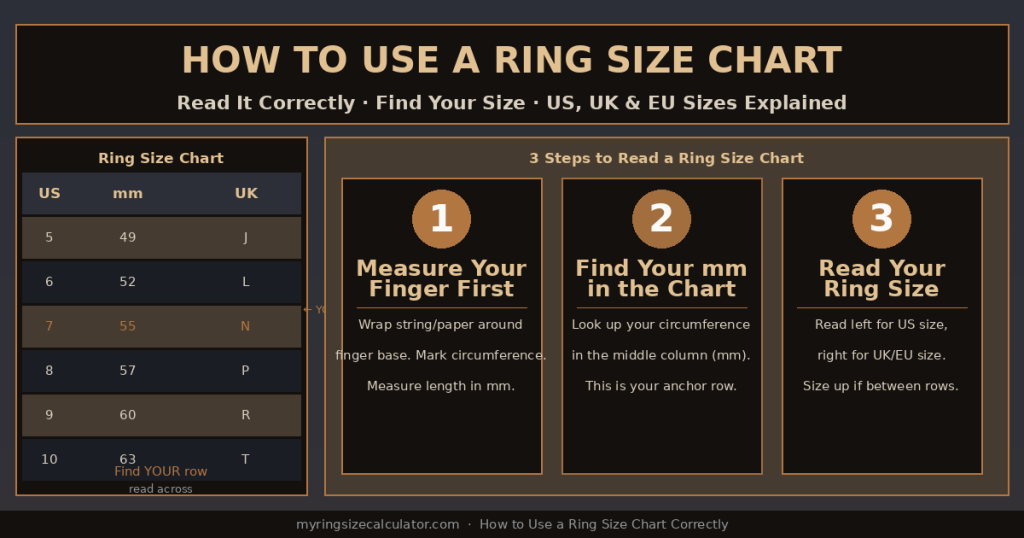
Three steps to correctly use a ring size chart: measure in mm, find your row, read your size across the columns.
| ⚡ Quick Answer: How to Use a Ring Size Chart Step 1: Measure your finger circumference in millimetres using a paper strip or string.Step 2: Find that number in the circumference column of the ring size chart (the mm column).Step 3: Read left to find your US size, read right for UK or EU sizes.Always use circumference in mm as your starting point — it is the universal measurement that eliminates conversion errors between sizing systems. If your measurement falls between two rows, move to the larger size. |
1. What Is a Ring Size Chart and How Does It Work?
A ring size chart is a reference table that translates a finger’s physical circumference (measured in millimetres) into the standardised ring size number used by jewellers. Different countries use different size numbering systems — the United States uses whole and half numbers (size 4 through 13), the United Kingdom uses letters (H through Z), and continental Europe uses numbers based on circumference minus 40 (size 47 through 76). A ring size guide by finger and gender gives you all of these simultaneously so you can order from any country’s sizing system.
The key to using a ring size chart correctly is understanding that the circumference in millimetres is the anchor column. Every other column — US size, UK size, EU size, Japanese size — is derived from this physical measurement. Starting from the circumference column and reading across eliminates common mistakes people make when measuring ring size
The Two Measurement Inputs
- Circumference: the distance around the inside of the finger or ring, measured in millimetres. This is the primary input for any ring size chart.
- Diameter: the distance across the inside of a ring from one inner wall to the other, measured in millimetres. To convert diameter to circumference, multiply by 3.14159 (pi).
Related: How to Measure Ring Size at Home | How to Know Your Finger Ring Size | Wikipedia: Ring Size
2. How to Use a Ring Size Chart: Step-by-Step
Follow these three steps to use a ring size chart correctly every time, regardless of which sizing system you need.
Step 1: Measure Your Finger Circumference in Millimetres
Before you can use a ring size chart, you need a circumference measurement. Here is the fastest accurate home method:
- Tear a thin strip of paper approximately 1 cm wide and 15 cm long.
- Wrap it snugly (not tight) around the base of the finger you plan to wear the ring on.
- Mark where the paper first overlaps itself with a pen.
- Lay the strip flat and measure the length from the end to your mark in millimetres.
- This length is your how to check ring size at home without tape measure — the number you will look up in the chart.
Step 2: Find Your Circumference in the Chart
Open the ring size chart below. Look down the circumference column (the first column, showing mm values). Find the row where the circumference matches your measurement. If your measurement falls between two rows, go to the row with the finding the perfect fit in between ring sizes.
Step 3: Read Across for Your Ring Size
Once you have found your row in the circumference column, read horizontally across the same row to find your size in the system you need:
- Read left (second column) for diameter in mm.
- Read to the ‘US Size’ column for your American ring size number.
- Read to the ‘UK Size’ column for the British letter system (H through Z).
- Read to the ‘EU Size’ column for European sizing (47 through 76).
- Read to the ‘Japan Size’ column if ordering from Japanese retailers.
| 💡 The Golden Rule: Always Start with Circumference in mm The most common mistake when using a ring size chart is starting from the wrong column. US, UK, EU and Japanese sizes are NOT directly comparable to each other — each system uses different numbering conventions. But the circumference in millimetres is a universal physical measurement that is the same regardless of which country’s sizing system you end up using. Always measure in mm first, then read across. |
3. The Full Ring Size Chart: US, UK, EU, Japan & mm
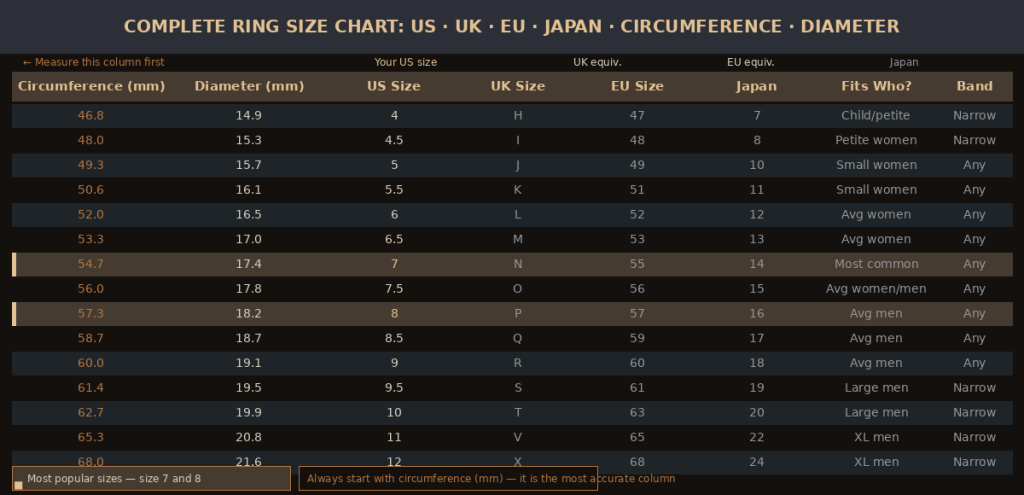
Complete ring size chart covering US, UK, EU, and Japanese sizes with circumference in mm as the anchor column. Highlighted rows = most popular sizes.
This is the complete ring size chart covering all major sizing systems. Use the circumference (mm) column as your starting point.
| Circumference (mm) | Diameter (mm) | US Size | UK Size | EU Size | Japan | Common For |
| 46.8 | 14.9 | 4 | H | 47 | 7 | Child / very petite women |
| 48.0 | 15.3 | 4.5 | I | 48 | 8 | Small women’s pinky |
| 49.3 | 15.7 | 5 | J | 49 | 10 | Small women |
| 50.6 | 16.1 | 5.5 | K | 51 | 11 | Small to average women |
| 52.0 | 16.5 | 6 | L | 52 | 12 | Average women |
| 53.3 | 17.0 | 6.5 | M | 53 | 13 | Average women |
| 54.7 | 17.4 | 7 | N | 55 | 14 | Most common women’s — popular |
| 56.0 | 17.8 | 7.5 | O | 56 | 15 | Women / small men |
| 57.3 | 18.2 | 8 | P | 57 | 16 | Average men — most popular men’s |
| 58.7 | 18.7 | 8.5 | Q | 59 | 17 | Average men |
| 60.0 | 19.1 | 9 | R | 60 | 18 | Average to large men |
| 61.4 | 19.5 | 9.5 | S | 61 | 19 | Large men |
| 62.7 | 19.9 | 10 | T | 63 | 20 | Large men |
| 64.0 | 20.4 | 10.5 | U | 64 | 21 | Large men |
| 65.3 | 20.8 | 11 | V | 65 | 22 | Large men / thumbs |
| 66.7 | 21.2 | 11.5 | W | 67 | 23 | XL men |
| 68.0 | 21.6 | 12 | X | 68 | 24 | XL men / thumbs |
| 70.7 | 22.5 | 13 | Z | 71 | 26 | XL men / thumbs |
External reference: GIA: Official Ring Size Chart | Wikipedia: Ring Size (All International Systems)
4. How to Read a Ring Size Chart Correctly
Understanding the structure of a ring size chart prevents the most common ordering errors. Here is what each column means and how to use it.
Column 1: Circumference (mm) — Your Starting Point
This column shows the inner circumference of the ring — the distance around the inside of the ring band — in millimetres. When you measure your finger circumference using string or paper, this is the column you match your measurement to. It is the most direct and accurate way to find your size because it requires no conversion between national systems.
Column 2: Diameter (mm)
The diameter column shows the distance across the inside of the ring from one inner wall to the other. If you measure an existing ring’s inner diameter with a ruler, look this column up. Multiply the diameter by 3.14159 to convert to circumference if needed.
Column 3: US Size
US ring sizes use whole and half numbers from 4 through 13 for adults. The US system does not directly correspond to any physical measurement — it is an arbitrary standardised scale, which is why you cannot calculate your US size from a ruler reading without the chart.
Column 4: UK Size
The UK system uses letters from H (smallest adult) through Z (largest). Each letter corresponds to a specific circumference. Half sizes are shown with + (e.g. ‘M+’ = between M and N). The UK system is used in the United Kingdom, Australia, Ireland, and New Zealand.
Column 5: EU Size
The European/ISO system uses numbers from approximately 47 to 76. The EU size number is derived directly from circumference: EU size ≈ circumference in mm − a small offset. The EU system is used across most of continental Europe.
Column 6: Japan Size
Japan uses its own number scale (1 through 27 for most rings). Japanese ring sizes do not directly correspond to any other national system. When ordering from Japanese retailers or brands, always look up the Japanese column specifically.
5. Ring Size Chart: US to UK Conversion
When ordering from a UK retailer or converting a UK size to US for comparison, use this direct conversion reference.
| US Size | UK Size | Circumference (mm) | Notes |
| 5 | J | 49.3 | Small women’s |
| 5.5 | K | 50.6 | Small women’s |
| 6 | L | 52.0 | Average women’s |
| 6.5 | M | 53.3 | Average women’s |
| 7 | N | 54.7 | Most popular women’s |
| 7.5 | O | 56.0 | Women’s / small men |
| 8 | P | 57.3 | Most popular men’s |
| 8.5 | Q | 58.7 | Average men’s |
| 9 | R | 60.0 | Average men’s |
| 10 | T | 62.7 | Large men’s |
| 11 | V | 65.3 | Large men’s |
| 12 | X | 68.0 | XL men’s |
6. Ring Size Chart: US to EU Conversion
When ordering from European jewellers or converting EU/ISO sizes to US, use this conversion.
| US Size | EU Size | Circumference (mm) | Notes |
| 5 | 49 | 49.3 | Small women’s |
| 5.5 | 51 | 50.6 | Small women’s |
| 6 | 52 | 52.0 | Average women’s |
| 6.5 | 53 | 53.3 | Average women’s |
| 7 | 55 | 54.7 | Most popular women’s |
| 7.5 | 56 | 56.0 | Women’s / small men |
| 8 | 57 | 57.3 | Most popular men’s |
| 8.5 | 59 | 58.7 | Average men’s |
| 9 | 60 | 60.0 | Average men’s |
| 9.5 | 61 | 61.4 | Large men’s |
| 10 | 63 | 62.7 | Large men’s |
| 11 | 65 | 65.3 | Large men’s |
7. How to Use a Ring Size Chart with an Existing Ring

If you have a ring that already fits the target finger, you can find its size using the ring size chart without measuring your finger at all.
From Inner Diameter
- Place the ring on a flat surface and measure the inner diameter (across the inside opening) in millimetres using a ruler.
- Multiply the diameter by 3.14159 to calculate the inner circumference.
- Look up this circumference in the chart’s mm column to find the US, UK, or EU size.
From Inner Circumference
- Thread a thin strip of paper through the ring’s inside, fold it to fit snugly around the inner wall, mark and measure the length in millimetres.
- Look this number up directly in the circumference column of the chart.
| ⚠️ Same Finger, Same Hand Rule The existing ring must have been worn on the same finger and the same hand as the ring you are buying. Fingers on the same hand differ by 1–2 full ring sizes. Your ring finger is not the same size as your index finger. Always verify which finger the reference ring came from. |
Full guide: How to Check Ring Size Without a Tape Measure | How to Read a Ring Sizer
| ▶ Video: How to Read a Ring Size Chart Correctly (YouTube) Watch a visual walkthrough of how to use a ring size chart — finding your mm measurement, locating your row, and reading across US, UK, and EU columns.Recommended searches: ‘how to use a ring size chart’ · ‘how to read a ring size chart’ · ‘ring size chart explained’ |
8. Band Width Adjustment: When to Go Up a Size on the Chart
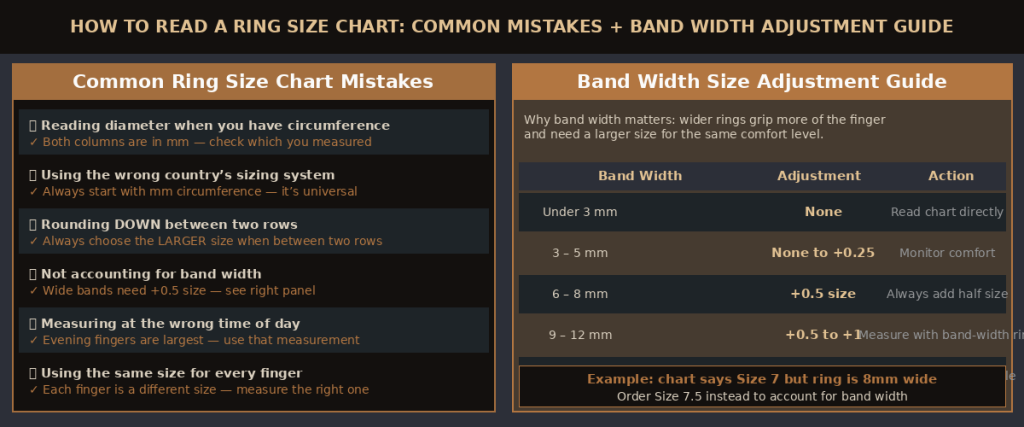
Common ring size chart reading mistakes and the band width size adjustment guide.
A ring size chart gives you the correct size for a standard-width ring (under 3mm). However, wider bands require a larger ring size for equivalent comfort, because they cover more of the finger and need more clearance at the knuckle. This adjustment is not shown in any standard ring size chart — you must apply it manually.
| Ring Band Width | Size Chart Adjustment | Practical Action |
| Under 3 mm | No adjustment | Use chart size directly — no change needed |
| 3 – 5 mm | None to +0.25 size | Monitor comfort; borderline cases add 0.25 |
| 6 – 8 mm | +0.5 size | Order half size larger than chart shows |
| 9 – 12 mm | +0.5 to +1.0 size | Order 0.5 to 1 full size larger |
| Over 12 mm | +1.0 size minimum | Order 1 full size larger; size in-store if possible |
Example: your circumference measurement is 54.7mm, which the chart shows as US Size 7. The ring you want is 8mm wide. You should order Size 7.5 instead of 7, adding 0.5 for the wide band.
9. Ring Size Chart for Different Fingers
A ring size chart applies to all fingers, but each finger on your hand has a different ring size. Using the chart correctly requires knowing which finger you are sizing. Here are typical size differences between fingers on the same hand.
| Finger | Typical Size vs. Ring Finger | Women’s Average | Men’s Average |
| Thumb | +3 to +5 sizes larger | Size 7–9 | Size 10–12 |
| Index / Pointer | +0.5 to +1 size larger | Size 6–7 | Size 7–8 |
| Middle | Similar to ring finger | Size 6–7 | Size 8–9 |
| Ring (traditional) | Baseline reference | Size 5–7 | Size 8–10 |
| Pinky / Little | −1 to −3 sizes smaller | Size 3–5 | Size 5–7 |
Always use the understanding the size six ring finger with the measurement taken from the specific finger you plan to wear the ring on. Do not use a ring from a different finger as the reference.
10. Common Ring Size Chart Mistakes
These are the errors that most commonly lead to ordering the wrong ring size using a ring size chart.
| Mistake | What Goes Wrong | How to Fix It |
| Starting from US size, not mm | Errors compound when converting between systems | Always start with circumference in mm |
| Reading diameter as circumference | Gives a size 3–4 numbers too small | Circ = diameter × 3.14. They are different numbers |
| Choosing the smaller row when between | Ring too small to pass knuckle | Always round UP to the larger circumference row |
| Ignoring band width adjustment | Wide band sits high and feels tight | Add 0.5 size for bands 6mm+, +1 for 12mm+ |
| Using a chart from a different country | UK L ≠ US L (UK uses letters, US uses numbers) | Match your measurement to the mm column only |
| Measuring the wrong finger | Off by 1–2 full ring sizes | Measure the specific finger for the ring |
| Morning measurements only | 0.5 size too small | Use evening measurement when fingers are largest |
| Not verifying chart print scale | Printable chart gives wrong result | Verify printed ruler against physical ruler |
11. Frequently Asked Questions
Q: How do you use a ring size chart?
A: Three steps: (1) measure your finger circumference in millimetres using a paper strip; (2) find that number in the circumference column of the ring size chart; (3) read across the same row to find your US, UK, or EU size. Always start from the mm circumference column — it is the universal measurement that eliminates conversion errors.
Q: How do you read a ring size chart?
A: Read a ring size chart by starting from the circumference column (the mm values in the first column). Each row represents one ring size. Moving left to right across a row: you will find circumference in mm, diameter in mm, then US size, UK size, EU size, and Japanese size. Your size across all systems is determined by which circumference row your measurement falls in.
Q: What does the mm column in a ring size chart mean?
A: The mm column shows finger circumference — the distance around the finger — in millimetres. This is the physical measurement that ring sizing is based on. When you measure your finger with a paper strip or string, you get a length in mm. You look this number up in the mm column to find your ring size in any system.
Q: How do I convert ring sizes using a chart?
A: Find the row in the chart that corresponds to your known size (e.g. US 7 = 54.7mm = UK N = EU 55). All sizes on the same row are equivalent. To convert US to UK: US 7 = UK N. To convert US to EU: US 7 = EU 55. To convert UK to US: UK N = US 7. Always verify by cross-checking the mm column rather than doing direct conversions between systems.
Q: What ring size should I order if I’m between sizes on the chart?
A: Always order the larger size when your measurement falls between two rows on the ring size chart. A ring that is half a size too large can be worn with a how to use a ring size adjuster. A ring that is half a size too small may not pass the knuckle, and if it does, can restrict circulation when fingers swell. Between sizes = go up.Mathematics
Q: How accurate are online ring size charts?
A: Legitimate ring size charts from established jewellery organisations (GIA, national standardisation bodies) are highly accurate — the measurements do not change. The limitation is not chart accuracy but measurement accuracy: how precisely you measure your finger in mm affects your result. A home measurement typically has ±0.5 ring size accuracy. For expensive rings, verify your size in-store before ordering.
Q: Why does my ring size seem different on different charts?
A: Different charts may show slightly different circumference values for the same size number. This is because US ring sizing does not have a legally mandated standard — different jewellers may use slightly different mm values for the same size number, typically varying by ±0.3mm. The GIA chart is the most widely used US reference. Always verify against the mm value rather than trusting the size number alone.
Q: What is the most common ring size?
A: In the United States, the most common ring size is Size 7 for women (circumference 54.7mm) and Size 10 for men (circumference 62.7mm). However, individual finger sizes vary significantly — the average is only a starting point. Always measure your specific finger on your specific hand before ordering.
More Ring Sizing Resources
On this site: How to Measure Ring Size at Home | How to Know Your Finger Ring Size | How to Read a Ring Sizer | How to Check Ring Size Without a Tape Measure | Oura Ring Sizing Hub
External: GIA: Official Ring Size Chart | Wikipedia: Ring Size (International Systems) | Reddit: r/jewelers — Ring Size Chart Advice | BBC: Buying Jewellery Online
| 💰 Accuracy Note Ring size charts are reference tools, not guarantees. Individual ring measurements may vary by ±0.3mm due to manufacturing tolerances. For expensive rings, always verify your size at a jeweller before ordering. |