
The quick answer: Wrap a strip of string or paper snugly around the base of your finger, mark where it overlaps, then measure that length in millimeters against the circumference chart below that single number converts directly to a US ring size. If you already own a ring that fits the intended finger, measuring its inside diameter is more reliable than measuring the finger itself, since fingers compress under a tape measure and rings don’t lie.
- Fastest: string or paper method, ~2 minutes, ±0.5 size accuracy
- Most accurate: measure an existing ring’s inside diameter, ±0.25 size accuracy
- Most reusable: our free printable ring sizer print it, keep it, measure anyone’s finger in seconds
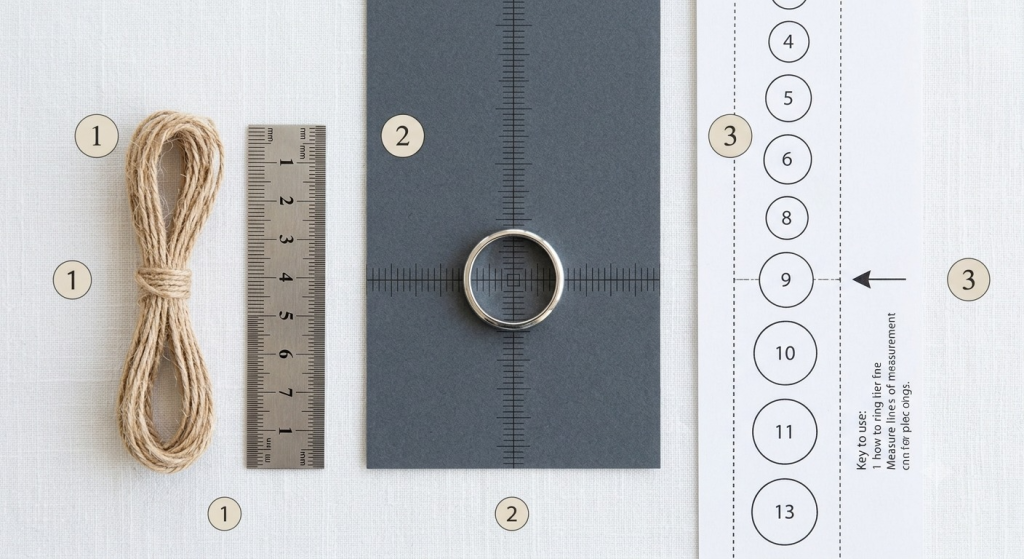
3 Simple Ways To Measure Your Ring Size At Home
Every method below gets you to the same place a circumference or diameter measurement in millimeters but they differ in how forgiving they are of user error. Start with whichever one you can do right now with what’s in your junk drawer.

Method 1: The string or paper test (best for quick estimation)
This is the one people default to because it needs nothing but string, a ruler, and a pen. It’s also the method most likely to give you a false reading if you rush it, so slow down on step 3.
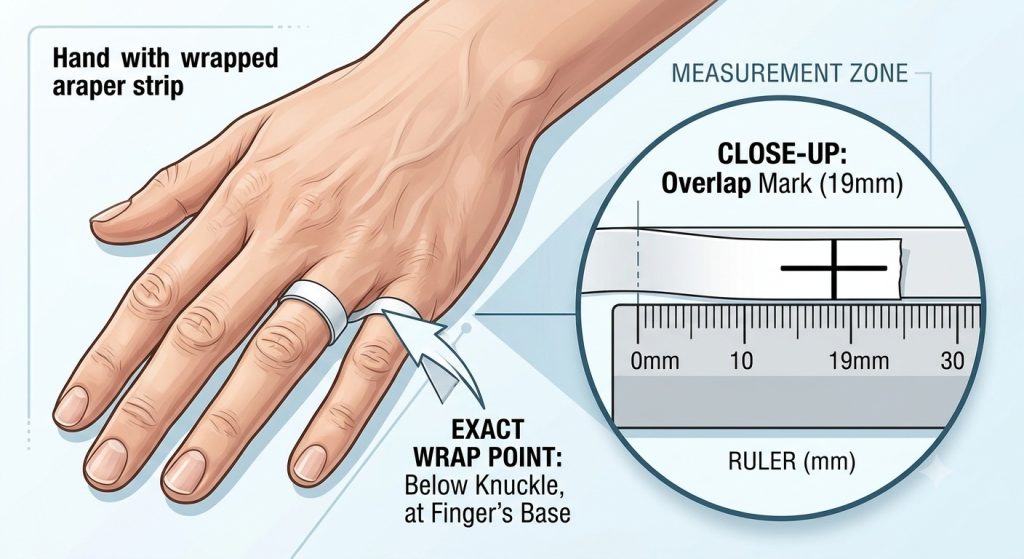
- Cut a strip of string, dental floss, or a thin strip of paper about 6 inches (15 cm) long. Paper is actually slightly more reliable than string, because string stretches under tension and paper doesn’t.
- Wrap it around the base of the finger you’re sizing not over the knuckle, the base joint where the ring will actually sit day to day.
- Mark the overlap point with a pen, right where the strip meets itself after one full wrap. Don’t pull it tight enough to indent the skin; you want snug, not compressed.
- Lay the strip flat against a ruler and measure the distance from the end to your mark, in millimeters.
- Match that number to the “Inside Circumference” column in the conversion chart further down this page.
The stretch-factor warning: if you use string instead of paper, measure twice. String has just enough give that a firm wrap can read 1–2mm smaller than your true size which doesn’t sound like much, but it’s the difference between a size 6 and a size 6.5. If your two measurements disagree, round up, not down. A ring that’s slightly loose is an easy fix at the jeweler; a ring that doesn’t clear your knuckle is a returned order.
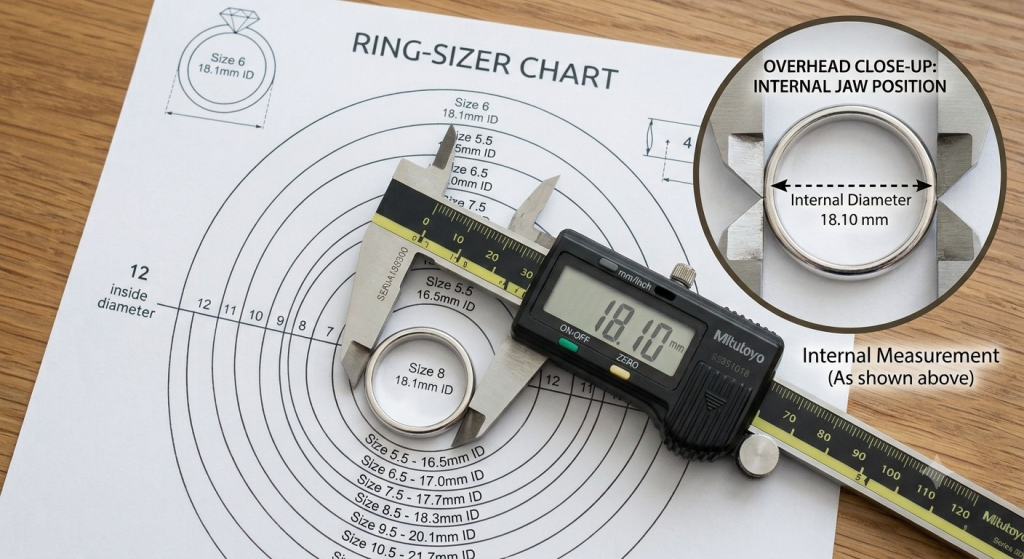
Method 2: The ring comparison test (most accurate with an existing ring)
If you can get your hands on a ring the person already wears comfortably on the correct finger, this beats the string method every time you’re measuring a rigid object instead of compressible skin.
- Find a ring that already fits the intended finger not a ring from a different finger, since sizes aren’t interchangeable finger-to-finger on the same hand.
- Place it on a flat surface and press it down gently so it isn’t tilted.
- Measure the inside diameter the straight-line distance across the inner circle, not the outer edge of the band using a ruler or digital calipers if you have them. Calipers are worth the $8; a ruler alone introduces easy half-millimeter errors on a curved edge.
- Cross-reference the diameter against the chart below.
If you’re sizing secretly for a proposal, this is usually the method that works without tipping anyone off see the FAQ below for the discreet version of this technique.
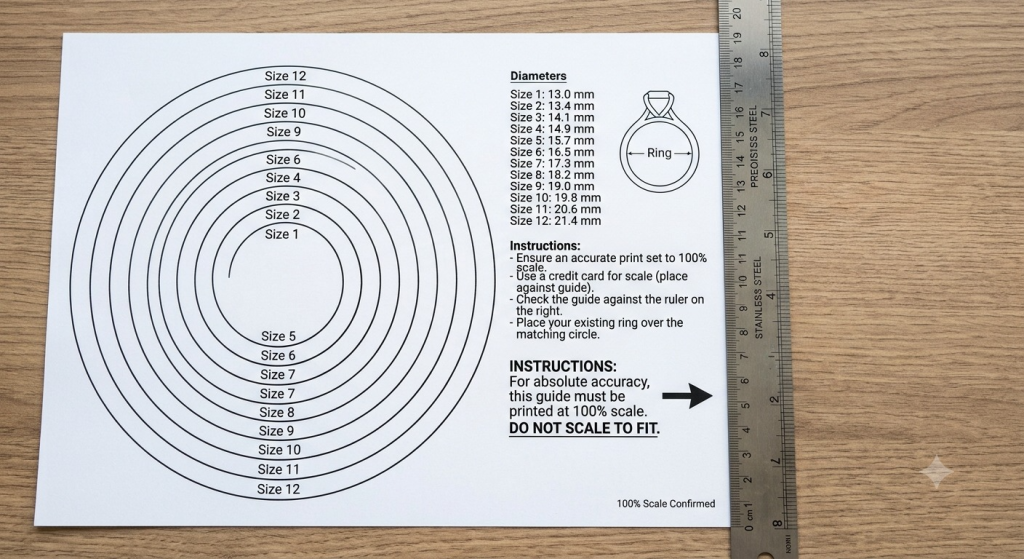
Method 3: The printable ring sizer tool
Paper and string work, but they ask you to also be your own measuring instrument, which is where most at-home errors creep in. A printable sizer removes that variable you’re matching a physical ring against pre-sized circles instead of eyeballing a ruler.
Download our printable ring sizer PDF, print it, and follow the one instruction that determines whether it works at all: print at 100% scale, never “fit to page.” Nearly every complaint about printable sizers being inaccurate traces back to a printer auto-scaling the page down a few percent enough to shift every size on the sheet. Once it’s printed correctly, either place an existing ring over the circles until one fits snugly inside the band, or wrap the attached paper strip around your finger and read the number where it meets the guide.
For a live, no-printing option, our ring size calculator does the same matching digitally place a well-photographed ring or your finger against an on-screen guide sized to your device.
International Ring Size Conversion Chart
Once you have a circumference or diameter measurement in millimeters, use the table below to find your US size. If you’re shopping a UK, EU, or Japanese site, the diameter column is your universal translator every country’s sizing system maps to the same physical circle; they just label it differently.
| US Size | Inside Diameter (mm) | Inside Circumference (mm) |
|---|---|---|
| 3 | 14.1 | 44.2 |
| 3.5 | 14.5 | 45.5 |
| 4 | 14.9 | 46.8 |
| 4.5 | 15.3 | 48.0 |
| 5 | 15.7 | 49.3 |
| 5.5 | 16.1 | 50.6 |
| 6 | 16.5 | 51.9 |
| 6.5 | 16.9 | 53.1 |
| 7 | 17.3 | 54.4 |
| 7.5 | 17.7 | 55.7 |
| 8 | 18.1 | 57.0 |
| 8.5 | 18.5 | 58.3 |
| 9 | 18.9 | 59.5 |
| 9.5 | 19.3 | 60.8 |
| 10 | 19.8 | 62.1 |
| 10.5 | 20.2 | 63.4 |
| 11 | 20.6 | 64.6 |
| 11.5 | 21.0 | 65.9 |
| 12 | 21.4 | 67.2 |
| 12.5 | 21.8 | 68.5 |
| 13 | 22.2 | 69.7 |
A quarter US size equals roughly 0.4mm of diameter, or about 1.3mm of circumference small enough that a confident measurement to the nearest millimeter is genuinely all the precision you need. Chasing tenths of a millimeter past that point doesn’t buy you accuracy; your finger’s actual size moves more than that between morning and evening anyway (more on that next). See the full US ring size chart for average women’s and men’s ring sizes, plus every size in between.
Critical Sizing Factors: Why your Measurement Changes
A ring size isn’t a fixed number the way a shoe size roughly is fingers are living tissue, and several everyday factors shift the reading by half a size or more. Knowing these ahead of time prevents the most common complaint we hear: “I measured carefully and it still doesn’t fit.”
1. Temperature
Cold hands shrink; warm hands swell. Measuring right after you’ve been outside in winter, or right after washing dishes in hot water, can throw off a reading by close to a full size. Measure at room temperature, after your hands have had a few minutes to settle.
2. Time of day
Fingers are typically smallest in the morning and largest in the evening, as fluid naturally redistributes through the day. Jewelers commonly recommend measuring in the late afternoon or evening for this reason it captures your finger closer to its “worst case” size, so the ring stays comfortable even on your largest-fingered hours.
3. Knuckle width
If your knuckle is noticeably wider than the base of your finger, sizing purely to the base gives you a ring that won’t pass the knuckle at all. Measure both the knuckle and the base, and size roughly halfway between them snug enough at the base, forgiving enough over the knuckle.
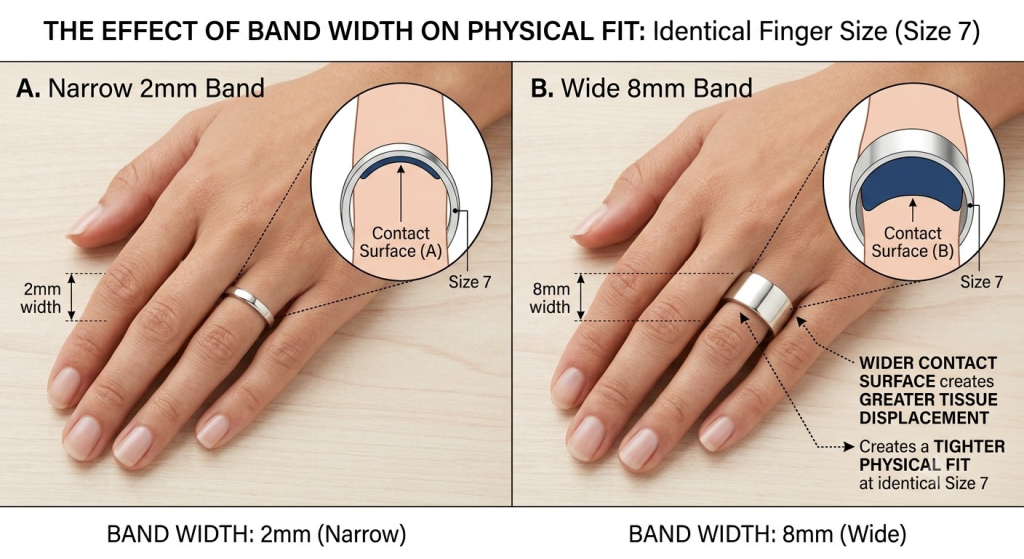
4. Ring Band Thickness
This one surprises people: a wider band fits tighter than a thin band at the identical labeled size, because more metal surface contacts the finger. If you’re moving from a thin stacking band to a chunky 8mm statement ring, go up half a size from your usual measurement.
How should a ring actually fit?
The test jewelers actually use is simpler than most sizing guides make it sound: the ring should slide over your knuckle with a bit of resistance not a fight, but a deliberate push and then move slightly looser once it’s past the knuckle and settled at the base. At rest, you should be able to rotate it around your finger and pull it about halfway to the knuckle without it sliding straight off, but pulling it that far should require a light tug, not happen on its own from gravity.
Too loose shows up as a ring that spins constantly and can be pulled off with a shake of the hand that’s a genuine loss risk, not just an annoyance. Too tight shows up as a red pressure ring on your skin after a few hours, or difficulty getting it off at all by evening when your fingers are at their largest. If you’re between the two, comfort-fit bands (which curve slightly on the inside rather than sitting flat) run about a quarter size larger than a standard flat-inside band at the same labeled number, which is worth knowing before you order.
Frequently asked questions
What if I’m between sizes?
Size up, not down, and lean toward a comfort-fit band if the ring style offers one. A slightly loose ring can be sized down cheaply and quickly by a jeweler; a ring that won’t clear your knuckle is a returned or exchanged order. The one exception is rings with a wide, chunky band — for those, round up regardless, since band width already tightens the fit at any given size.
How do I measure secretly for a surprise proposal?
The ring comparison method (Method 2) is the discreet option. Borrow a ring your partner already wears on the correct hand — ask a close friend or family member to help “borrow” one for a few hours, or simply take an existing ring while they’re asleep or in the shower and return it before they notice. Trace the inside circle onto paper or measure the inside diameter directly, then return the ring exactly where you found it. Avoid guessing from a ring worn on a different finger; sizes commonly differ by 1–2 sizes finger to finger on the same hand.
Do men’s and women’s ring sizes use the same scale?
Yes — US ring sizing is one continuous numeric scale regardless of gender; a size 9 is the same physical circumference whether it’s marketed as a men’s or women’s ring. What differs is the typical range: women’s rings are commonly sized 5–7, men’s commonly 8–11, but that’s a distribution of common finger sizes, not a separate measurement system. Anyone can order any size on the scale.
Can I trust an online ring size calculator without printing anything?
For a rough estimate, yes — a well-calibrated on-screen tool like our ring size calculator accounts for your device’s screen size to display an accurately scaled guide. For a final purchase, especially on an expensive piece, we’d still recommend confirming with a physical method (string, existing ring, or printed sizer) since screen calibration varies slightly across devices.
Does this apply to smart rings like the Oura Ring?
No — smart rings use their own sizing kits because sensor placement and all-day comfort requirements are different from standard jewelry sizing. See our Oura Ring sizing guide for that process specifically; don’t size an Oura Ring using a standard jewelry chart, as the two commonly land a size apart.
How do I know what size ring to buy without going to a store?
Use any of the three methods above and cross-check your result against the millimeter chart — that’s genuinely as accurate as an in-store sizing for the vast majority of orders. The one case worth an in-person check is a first-time engagement ring purchase on a tight budget, where a half-size error is costlier to fix; everywhere else, a careful at-home measurement is reliable enough to order with confidence.