
By myringsizecalculator.com · Updated 2026 · 9 min read
Six proven ways to measure your ring size at home — no jeweller, no specialist tools required.
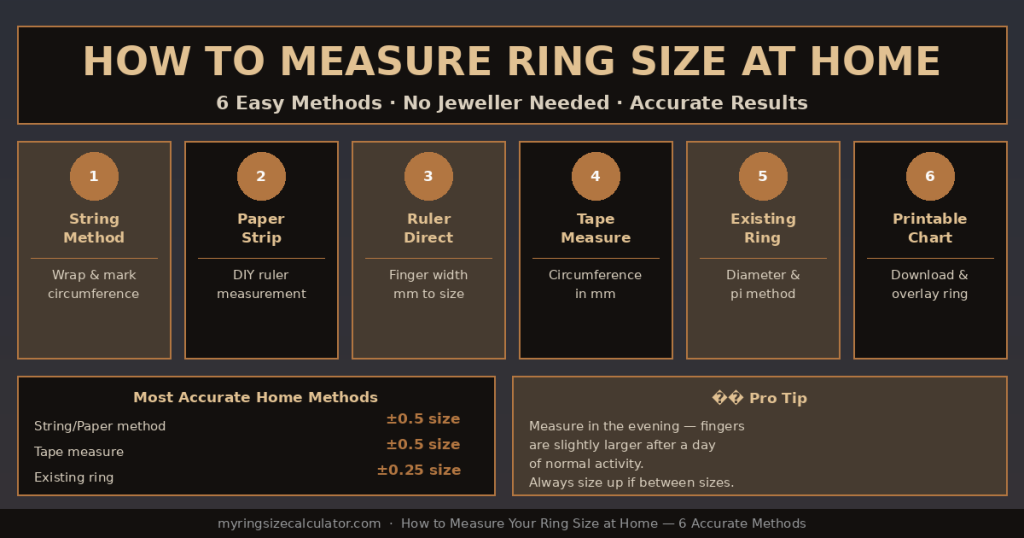
| ⚡ Quick Answer: How to Measure Ring Size at Home The fastest home method: wrap a thin strip of string or paper around the base of your finger, mark where it overlaps, measure the length in millimetres, and match to the size chart below.54.7 mm → US Size 7 · 57.3 mm → US Size 8 · 60.0 mm → US Size 9For best accuracy: measure in the evening, on your dominant hand, at room temperature. Measure 2–3 times. If between sizes, always size up. |
1. Before You Measure: What You Need to Know
Measuring your ring size at home is straightforward when you understand a few key principles. Ring sizes in the United States are expressed as numbers (typically 4 through 13 for adults), and each corresponds to a specific finger circumference — the distance around your finger — measured in millimetres.
Every home measurement method either measures circumference directly (string, tape measure) or measures diameter and converts it to circumference using the formula: circumference = diameter × π (3.14159).
Best Conditions for Measuring Ring Size at Home
- Time of day: measure in the evening. Fingers swell slightly throughout the day and are at their largest in the evening after normal daily activity. Morning measurements can be up to half a size smaller than evening measurements.
- Temperature: measure at room temperature. Cold constricts blood vessels and makes fingers smaller. Warm hands before measuring if you have been outside.
- Which hand: measure the finger on the hand you will wear the ring on. Your dominant hand is typically 0.5 ring sizes larger than your non-dominant hand due to increased muscle development and blood flow.
- Consistency: take 2–3 measurements across different times of day and use the largest reading. This accounts for natural daily size variation.
Related: How to Read a Ring Sizer (Mandrel & Gauge Guide) | Wikipedia: Ring Size
2. Method 1: String or Paper Strip (Most Popular At-Home Method)
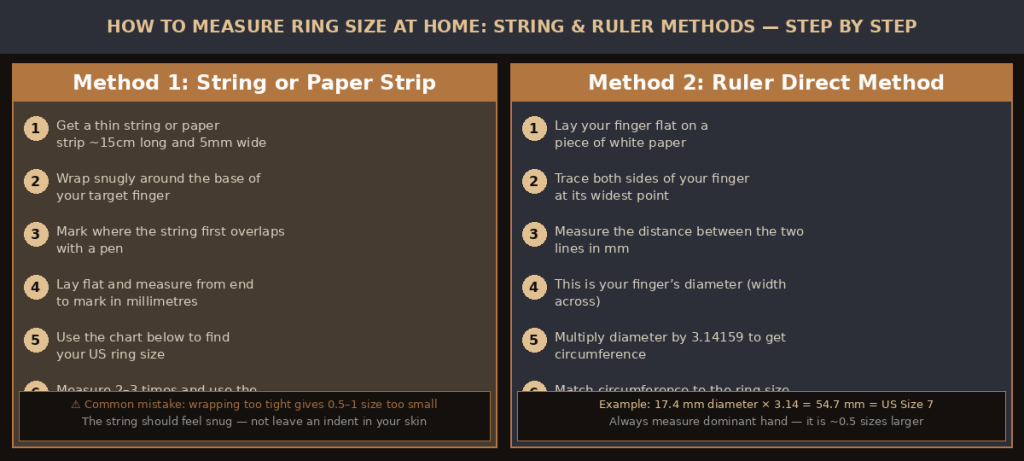
The string method and ruler direct method: the two most reliable ways to measure ring size at home without specialist tools.
The string method is the most widely used home ring sizing technique and requires nothing more than a thin piece of string, dental floss, or a narrow strip of paper, plus a ruler.
How to Measure Ring Size at Home with String
- Cut a piece of string, dental floss, or thin paper approximately 15 cm long and no more than 5 mm wide. A thinner strip gives a more accurate reading.
- Wrap the string snugly around the base of the finger you plan to wear the ring on. ‘Base’ means right at the finger’s lowest point, not across the knuckle.
- Mark the exact point where the string first crosses itself with a pen or by pinching it between your fingernails.
- Carefully remove the string and lay it flat on a ruler. Measure from the end to your mark in millimetres. This measurement is your finger circumference.
- Find your circumference in the ring size chart below to identify your US ring size.
- Repeat the measurement 2–3 times to confirm accuracy. Use the largest reading.
| ⚠️ The Most Common Mistake: Pulling the String Too Tight When measuring ring size at home with string, the single biggest source of error is wrapping too tightly. A string pulled taut enough to indent the skin gives a reading 0.5 to 1 full size smaller than your actual ring size. The string should feel snug — similar to a well-fitted ring — not tight. You should be able to slide the string off with mild resistance. |
How to Measure Ring Size at Home with Paper
The paper strip method works identically to the string method but uses a thin strip of paper (cut from a sheet of paper with scissors). Paper strips have one advantage over string: they do not stretch, which eliminates the stretch error that can affect loosely-woven string. Lay the paper strip around your finger, mark the overlap point, and measure.
3. Method 2: How to Measure Ring Size with a Ruler
If you do not have string handy, you can measure ring size at home with a ruler alone by measuring your finger’s diameter directly. This method is slightly less accurate than the circumference method but is fast and requires only a ruler.
Steps: Ruler Direct Method
- Hold your hand flat, fingers together and relaxed. Look at the widest point of the finger you want to size — usually at the knuckle or just below it.
- Place a ruler flat against the widest point of the finger and read the distance across the finger in millimetres. This is your finger diameter.
- Multiply the diameter by 3.14159 (pi) to get the circumference in millimetres.
- Example: if your finger diameter is 17.4 mm × 3.14159 = 54.7 mm circumference = US Size 7.
- Alternatively, trace around the finger on paper, measure the widest part of the tracing in mm, and multiply by π.
| Finger Diameter (mm) | Circumference (mm) | US Ring Size |
| 14.9 | 46.8 | 4 |
| 15.7 | 49.3 | 5 |
| 16.5 | 51.8–52.0 | 5.5–6 |
| 17.1 | 53.8 | 6.5 |
| 17.4 | 54.7 | 7 |
| 18.0 | 56.4 | 7.5 |
| 18.2 | 57.3 | 8 |
| 18.8 | 59.1 | 8.5 |
| 19.1 | 60.0 | 9 |
| 19.9 | 62.7 | 10 |
| 20.8 | 65.3 | 11 |
4. Method 3: Measure Ring Size at Home with a Tape Measure
If you have a flexible tape measure (the type used in sewing or crafts), measuring ring size at home becomes even easier. A tape measure directly shows the circumference reading without the need to transfer a mark to a separate ruler.
How to Use a Tape Measure for Ring Sizing
- Use the flexible cloth or plastic tape — not a metal builder’s tape, which is too rigid to wrap around your finger accurately.
- Wrap the tape measure around the base of your target finger, millimetre side facing inward.
- Read the millimetre measurement at the point where the tape completes a full loop. Do not pull tight — snug contact only.
- Match this circumference reading to the ring size chart below.
| 💡 Tape Measure Tip If your tape measure only shows inches, measure in inches and multiply by 25.4 to convert to millimetres. For example: 2.1 inches × 25.4 = 53.3 mm ≈ US Ring Size 6.5. |
5. Method 4: Measure Ring Size at Home with an Existing Ring

If you have a ring that already fits perfectly on the target finger, you can use it to determine your ring size without measuring your finger directly. This is one of the most accurate at-home methods because it uses the actual ring as a size template.
Method A: Measure the Diameter
- Place the ring face-down on a flat surface.
- Measure the inner diameter of the ring in millimetres — the distance across the inside opening at its widest point.
- Multiply the diameter by 3.14159 to get the inner circumference.
- Match to the size chart to find your US ring size.
Method B: Measure the Inner Circumference
- Thread a thin strip of paper through the inside of the ring.
- Fold the paper to trace the inner circle of the ring, then lay it flat and measure the length.
- This length is the inner circumference — match directly to the size chart.
| ⚠️ Critical: Use a Ring from the Same Finger For this method to be accurate, the reference ring must be from the same finger on the same hand as where you plan to wear the new ring. Different fingers on the same hand can differ by 1–2 full sizes. A ring from your right ring finger will not accurately size your left index finger. |
Sizing guide: Oura Ring Sizing Hub — All Sizing Methods Explained
6. Method 5: Printable Ring Size Chart
A printable ring size chart is one of the easiest ways to check your ring size at home with an existing ring. You download and print the chart at 100% scale (critical — do not scale to fit page), then lay your existing ring over the printed circles until you find the one that matches perfectly.
How to Use a Printable Ring Chart Correctly
- Download and print the ring size chart. Before printing, set your printer to ‘actual size’ or 100% — do NOT select ‘fit to page’ as this will scale the circles and give inaccurate results.
- After printing, verify scale accuracy: the chart should include a verification ruler. Use a physical ruler to confirm the printed ruler matches the actual measurement.
- Lay your existing ring over the printed circles. The circle that perfectly matches the inner diameter of your ring indicates your size.
- The ring should sit just inside the circle border — if the ring overlaps the circle, go to the next larger size.
7. Method 6: Measuring Ring Size at Home Without a Ruler
If you do not have a ruler or tape measure, you can still get a reasonable ring size estimate at home using these alternative approaches.
Using a Credit Card as a Scale Reference
A standard credit card is exactly 85.6 mm × 54 mm. You can use it as a rough scale reference to estimate millimetre measurements when wrapping string around your finger — mark the string position and compare against the card’s known dimensions.
Using a US Coin as Reference
A US quarter coin has a diameter of 24.26 mm, a penny is 19.05 mm. These can serve as rough diameter comparisons for fingers, though this method has low accuracy and should only be used as a rough starting estimate.
How to Measure Ring Size Without a Ruler: The Phone Screen Method
Several smartphone apps use your phone’s camera and known screen size to measure small objects. Search your app store for ‘ring sizer’ or ‘ruler app’. These typically achieve 85–90% accuracy when calibrated correctly.
Of all no-ruler methods, the paper strip approach combined with a US quarter coin comparison is the most reliable. It remains significantly less accurate than a proper ruler measurement, so always verify with a ruler before ordering an expensive ring.
| ▶ Video: How to Measure Your Ring Size at Home — 3 Methods Demonstrated (YouTube) Watch a step-by-step video showing the string method, ruler method, and existing ring method demonstrated on a real hand.Recommended YouTube searches: ‘how to measure ring size at home’ · ‘how to check ring size at home without tools’ · ‘at home ring sizing tutorial’ |
8. Ring Size Conversion Chart: Circumference (mm) to US Size
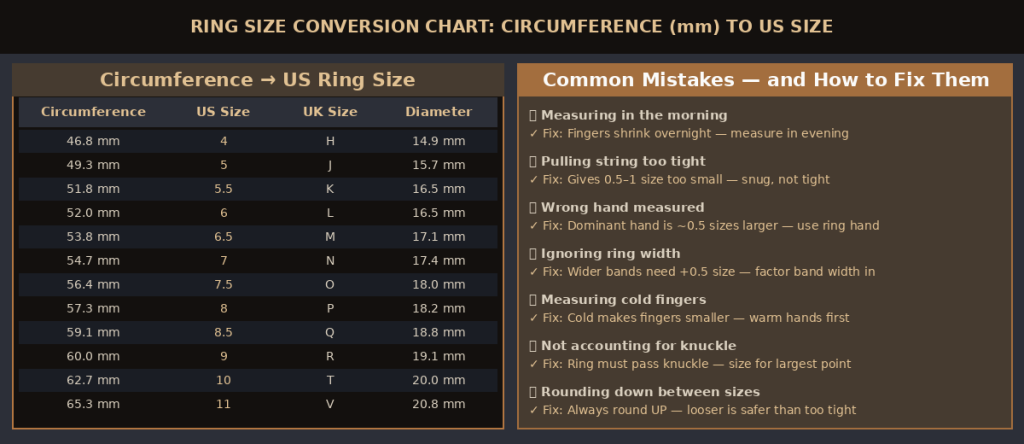
Circumference-to-US-ring-size conversion chart, plus the 7 most common measuring mistakes and how to fix each one.
Use this chart to convert your home measurement directly to a US ring size. Measurements are finger circumference in millimetres.
| Circumference (mm) | US Ring Size | UK Size | EU Size | Diameter (mm) |
| 46.8 | 4 | H | 47 | 14.9 |
| 48.0 | 4.5 | I | 48 | 15.3 |
| 49.3 | 5 | J | 49 | 15.7 |
| 50.6 | 5.5 | K | 51 | 16.1 |
| 52.0 | 6 | L | 52 | 16.5 |
| 53.3 | 6.5 | M | 53 | 17.0 |
| 54.7 | 7 | N | 55 | 17.4 |
| 56.0 | 7.5 | O | 56 | 17.8 |
| 57.3 | 8 | P | 57 | 18.2 |
| 58.7 | 8.5 | Q | 59 | 18.7 |
| 60.0 | 9 | R | 60 | 19.1 |
| 61.4 | 9.5 | S | 61 | 19.5 |
| 62.7 | 10 | T | 63 | 19.9 |
| 64.0 | 10.5 | U | 64 | 20.4 |
| 65.3 | 11 | V | 65 | 20.8 |
| 66.7 | 11.5 | W | 67 | 21.2 |
| 68.0 | 12 | X | 68 | 21.6 |
| 70.7 | 13 | Z | 71 | 22.5 |
Full international chart: GIA: Ring Size Chart | Wikipedia: Ring Size International Standards
9. Common Mistakes When Measuring Ring Size at Home
These are the errors that cause the most ring sizing problems. Identifying and avoiding them significantly improves your at-home measurement accuracy.
| Mistake | Why It Causes Errors | How to Fix It |
| Measuring in the morning | Fingers are at their smallest after overnight rest | Measure in the evening for largest daily size |
| Pulling string or paper too tight | Creates 0.5–1 size under-measurement | Snug contact only — no indentation in skin |
| Measuring the wrong hand | Dominant hand is ~0.5 sizes larger | Always measure the ring-wearing hand |
| Measuring cold fingers | Cold shrinks blood vessels = smaller reading | Warm hands to room temperature before measuring |
| Not accounting for knuckle size | Ring must pass the knuckle to be wearable | Measure at the knuckle if it’s wider than the base |
| Ignoring band width | Wider bands need +0.5 size for same comfort | Add 0.5 size for bands wider than 6mm |
| Rounding down between sizes | Too-small rings can’t be removed safely | Always round UP to the next half or whole size |
| Measuring once only | Single readings can be off due to swelling | Measure 2–3 times; use the largest reading |
| Paper stretch error | Thin paper strips can stretch slightly when wrapped | Use non-stretch string or rigid paper strip |
10. When to Size Up or Down
After measuring your ring size at home, you may find your circumference falls between two standard sizes. Here is the clear decision framework:
Always Size Up When:
- Your measurement falls between two sizes — this is the universal recommendation for any home measurement method.
- The ring you are ordering is wide (6mm or more) — wider bands sit higher on the finger and need more clearance.
- You have large or prominent knuckles relative to your finger base.
- You measured in the morning or in cold conditions — your finger will be larger in normal conditions.
- You plan to wear the ring during exercise or in warm climates where fingers swell.
- You are ordering online without a return or resize option.
Consider Sizing Down When:
- The ring is very narrow (2mm or less) and you want it to sit securely without spinning.
- You measured in the evening after unusual physical activity, which may have caused temporary swelling beyond your normal evening size.
The Non-Negotiable Rule
A ring that is slightly too loose is dramatically safer than a ring that is slightly too tight. A too-tight ring during finger swelling (injury, heat, pregnancy, illness) can cut off circulation and may require cutting the ring off. A too-loose ring can be made to fit with a ring size adjuster, or resized by a jeweller. When in any doubt — size up.
11. Frequently Asked Questions
Q: How do you measure ring size at home?
A: The most reliable home method: wrap a thin string or paper strip around the base of your target finger, mark where it overlaps, lay it flat and measure the length in millimetres. Match that measurement to a ring size chart. The circumference in mm converts directly to US ring sizes: 52mm = Size 6, 54.7mm = Size 7, 57.3mm = Size 8, 60mm = Size 9.
Q: How do you check your ring size at home without a sizer?
A: Four no-sizer methods: (1) wrap string or paper around your finger, mark and measure in mm; (2) measure your finger’s diameter with a ruler and multiply by pi (3.14); (3) lay an existing ring over a printed ring size chart; or (4) use a tape measure for direct circumference reading. All four give acceptable accuracy when performed correctly at room temperature in the evening.
Q: How do you measure ring size at home with a tape measure?
A: Wrap the flexible tape measure around the base of your finger with the millimetre scale facing inward. Pull to a snug but non-compressing tension. Read the mm marking where the tape completes the loop. If your tape measure shows inches, multiply the inch reading by 25.4 to get millimetres. Match to the size chart above.
Q: How do you measure ring size at home with string?
A: Cut a thin piece of string or dental floss about 15 cm long. Wrap it snugly (not tight) around the base of your finger. Mark where it overlaps. Lay it flat and measure the length from the end to your mark in millimetres. This is your finger circumference — match it to the chart above to find your US size.
Q: How do you measure ring size with a ruler?
A: Hold your finger flat and measure its width across the widest point in millimetres using a ruler. Multiply this diameter measurement by 3.14159 to get circumference. Example: 18.2mm × 3.14 = 57.2mm ≈ US Size 8. Alternatively, wrap a paper strip around your finger, mark the overlap, measure the strip length with a ruler.
Q: How do you determine your ring size at home?
A: The gold-standard home method is to: measure your finger circumference using the string/paper method in the evening at room temperature on your dominant hand, convert the mm reading using a ring size chart, and size up if between sizes. Take 3 measurements across the day and use the largest for maximum reliability.
Q: How can I tell my ring size at home without tools?
A: If you truly have no measuring tools: use a US quarter (24.26mm diameter) as a size reference by comparing finger width to coin width; or use a credit card (85.6mm long) as a length reference when using the string method. These estimates are rough — a printing app or ruler is strongly preferred before any purchase. Most people can also visit any jewellery store for a free professional sizing that takes under 60 seconds.
Q: How do I find out my ring size from home without a ring?
A: Use the string or paper method directly on your finger — no existing ring required. Alternatively, download a ring sizer app on your smartphone, which uses screen calibration to measure your finger. For the most accurate result, use the paper strip method with a ruler: wrap, mark, measure in mm, convert using the chart above.
Q: Are home ring size measurements accurate?
A: Home measurements with the string or paper method achieve approximately 85–90% accuracy when done correctly. The most common sources of error are measuring at the wrong time of day (morning vs. evening), pulling too tight, measuring the wrong hand, and not accounting for ring band width. Professional in-store sizing with a steel ring mandrel is the most accurate (approximately 98%) and takes under a minute at any jeweller — worth doing before ordering an expensive ring.
Further Reading
On this site: How to Read a Ring Sizer | Oura Ring Sizing Hub | Best Oura Ring
External: GIA: Ring Size Chart | Wikipedia: Ring Size | Reddit: r/jewelers — Ring Sizing Tips | BBC: How to Buy Rings Online
| 💰 Accuracy Note Home ring size measurements are estimates with a typical accuracy of ±0.5 ring sizes. For expensive or sentimental rings, verify your size at a local jeweller using a professional steel mandrel before purchasing. Resizing may not be possible on all ring styles and materials. |