
The quick answer
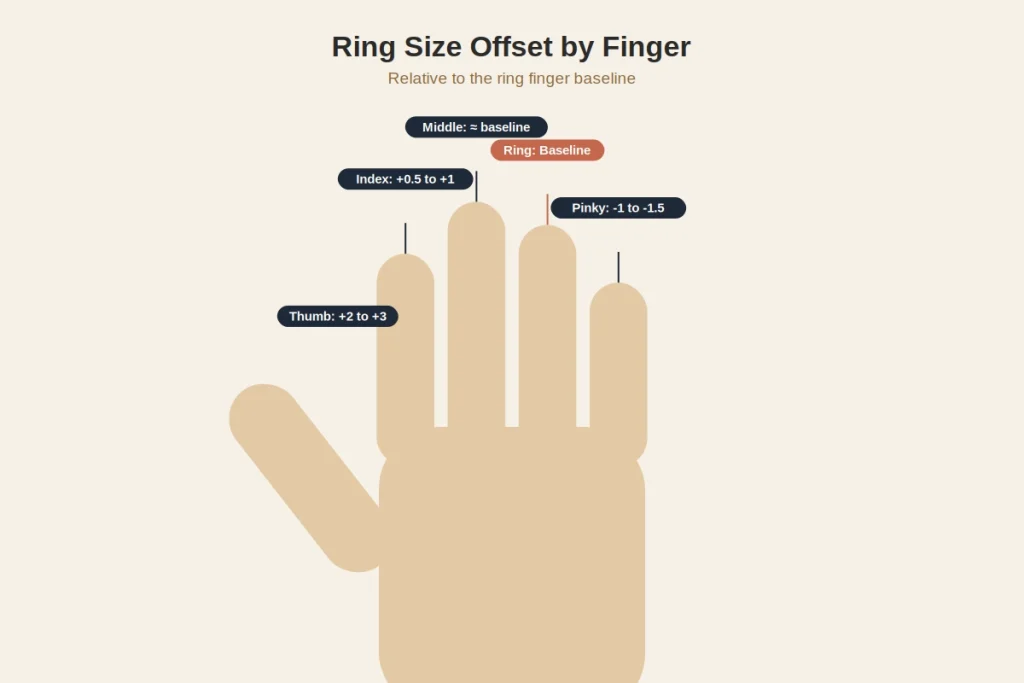
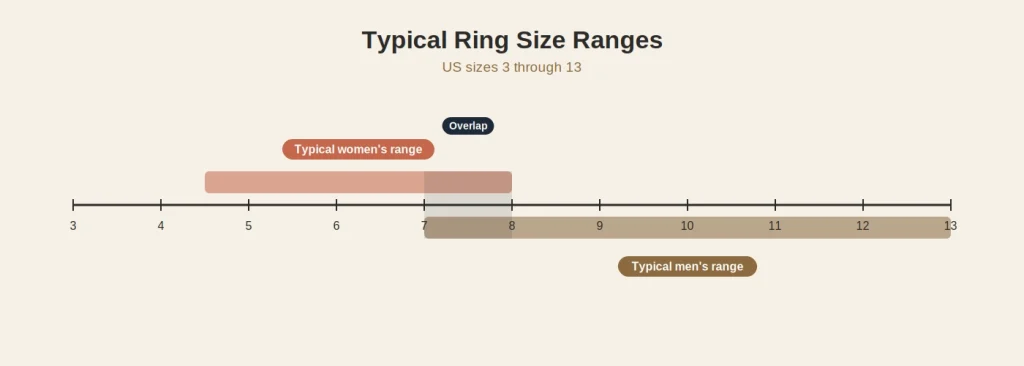
There’s no single “normal” ring size; it depends entirely on which finger and whose hand. In the US, the average women’s ring size sits around 6 to 6.5, and the average men’s ring size sits around 9 to 10, but individual sizes commonly range from 4 to 13 across both. If you’re comparing sizes across fingers on the same hand, expect the ring finger and middle finger to run close together, with the index typically half a size larger and the pinky one to one-and-a-half sizes smaller.
- Average US women’s ring size: 6–6.5
- Average US men’s ring size: 9–10
- Typical full range, either gender: 4–13
- Need the exact mm/cm conversion for a specific size? Full breakdown in our ring size conversion chart
- Need to measure your own size first? Start with our how to measure ring size guide
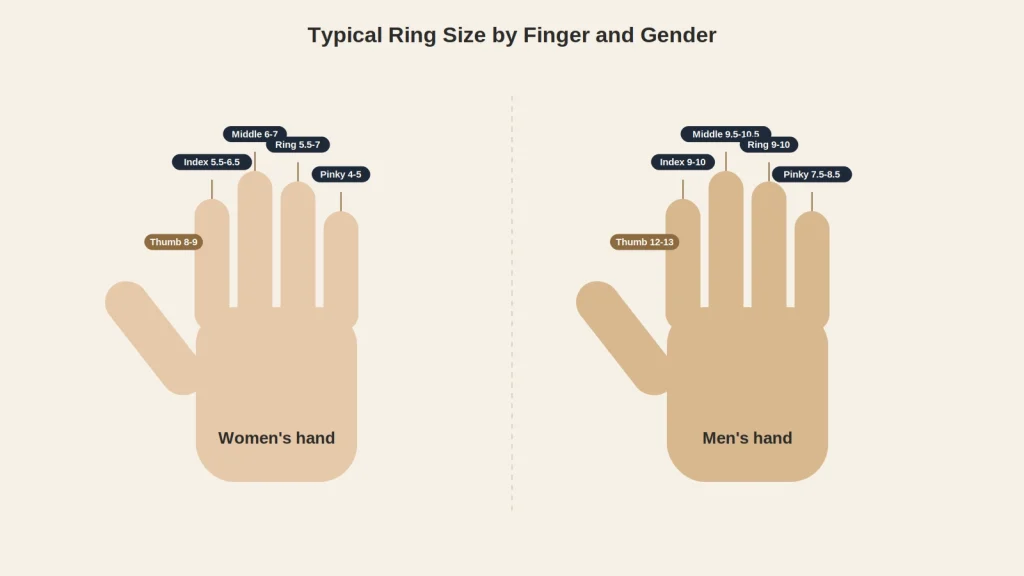
Average ring sizes by gender
Averages are a starting point, not a rule — genetics, height, and even climate (people in warmer regions trend slightly larger due to circulation patterns) shift the distribution. But they’re useful for a first guess when you don’t have a measurement yet, or when you’re sanity-checking a number someone gave you.
Women’s ring sizes cluster most heavily between 5 and 7, with 6 being the most commonly ordered size across US jewelers. Petite frames often run 4.5–5.5; larger or taller frames more commonly land 7–8.
Men’s ring sizes cluster between 8 and 11, with 9 and 10 being the two most common orders. Because men’s hands vary more in absolute size than women’s on average, the spread here is wider — anywhere from 7 to 13 is unremarkable.
These aren’t separate measurement systems, to be clear — a size 8 ring is physically identical whether it’s sold in the men’s or women’s section of a catalog. Gender labeling on a ring size chart just reflects which sizes get ordered more often for each category, not a different scale. If you want the full mechanics of why that’s true, we cover it in the FAQ on our measuring guide.
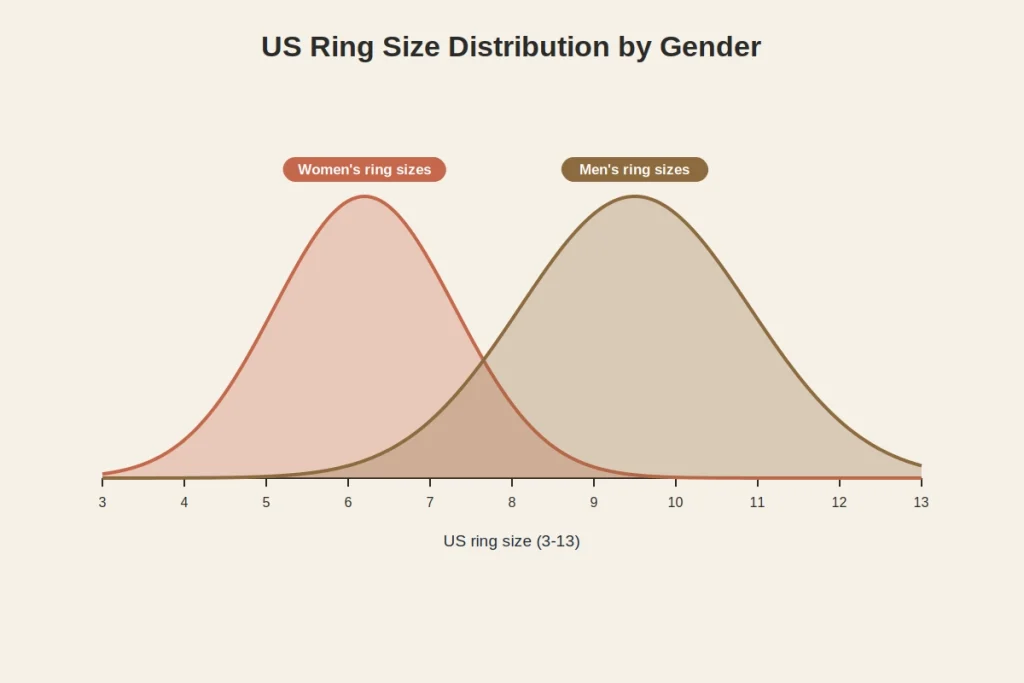
Ring sizes by finger: why the same hand needs different sizes
This is the question that trips up more first-time buyers than almost anything else: a ring that fits perfectly on one finger will not fit the same on another finger of the same hand. Each finger has its own base circumference, and the differences are consistent enough to plan around.
| Finger | Typical size relative to ring finger |
|---|---|
| Thumb | 2–3 sizes larger |
| Index | 0.5–1 size larger |
| Middle | Roughly the same, occasionally 0.5 size larger |
| Ring finger | Baseline |
| Pinky | 1–1.5 sizes smaller |
This matters most in two situations. First, if you’re borrowing a ring from a different finger to estimate someone’s size (a common move ahead of a proposal), correct for the offset above rather than using the raw number — a size 7 pulled from an index finger is probably closer to a 6 to 6.5 on the ring finger. Second, if you’re buying a right-hand ring or a pinky ring separately from an existing set, don’t assume it matches your ring-finger size; measure that specific finger.
Left and right hands also aren’t always identical — most people’s dominant hand runs slightly larger due to marginally greater muscle and bone development, though the difference is usually a quarter size at most and often not measurable at all.
Common specific-size questions, answered directly
A lot of ring size searches aren’t “what’s average” — they’re “is this specific number big or small.” Here’s direct context for the sizes people ask about most.
Is a size 7 ring big for a woman? It’s on the larger side of typical but well within normal range — roughly the 75th percentile for US women. It’s a common size for taller or larger-framed women and isn’t unusual enough to second-guess an order over.
How big is a size 9 ring? A US size 9 measures 18.9mm inside diameter, about 59.5mm circumference. For women, that’s a notably large size (above the typical range); for men, it’s close to average and unremarkable.
What’s a normal engagement ring size? For the recipient (typically sized to the left ring finger), 5 to 7 covers the large majority of US orders, with 6 being the single most common. If you don’t have a confirmed measurement, 6 is the statistically safest guess — but see the discreet-measuring method in our measuring guide before you rely on a guess for an expensive purchase.
Is a size 4 normal for a wedding band? Yes, for a petite frame — size 4 sits toward the small end of the typical women’s range but is common enough that every major jeweler stocks it as standard, not special order.
How big is a size 10 ring, and is it common? 19.8mm inside diameter, about 62.1mm circumference. It’s within the average range for men and on the larger end for women — not unusual for either, but worth double-checking if you’re ordering for a woman without a confirmed measurement.
Choosing between sizes for an engagement or wedding ring
Engagement and wedding rings carry a specific wrinkle standard rings don’t: they’re worn daily, often for decades, through the swelling and shrinking that comes with weather, activity, and age. A couple of things to weigh specifically for these purchases:
- Wedding bands are frequently worn alongside an engagement ring, stacked on the same finger. If you’re buying them separately or at different times, size the band to fit comfortably with the engagement ring already on, not on a bare finger — the combined width changes the fit.
- If sizing is uncertain, err toward the larger of two plausible sizes. Engagement rings are sized up cheaply; sizing down is also usually possible but has firmer limits for rings with certain settings (eternity bands and rings with stones set all the way around the band often cannot be sized down significantly, sometimes not at all).
- Knuckle-to-base gap matters more here than on a casual ring, since these rings are rarely removed. If the intended wearer has a noticeably wider knuckle than base, mention that to the jeweler — many offer a “knuckle sizing” adjustment on the inside of the band specifically for this.
Frequently asked questions
What does “ring size sizes” or a full ring sizes chart actually cover?
A complete ring sizes chart cross-references every standard US size against its physical measurement (diameter and circumference in millimeters) and, often, its international equivalent in UK, EU, or Japanese sizing. We keep the exhaustive version — every US size 3 through 13, half sizes included, with full mm conversions — on our dedicated ring size conversion chart, so you’re not scrolling past finger- and gender-specific context to find a single number.
Are men’s and women’s ring sizes really the same scale?
Yes. There’s one continuous US numeric scale; a size 8 is the identical physical circle regardless of which section of a catalog it’s listed under. “Men’s” and “women’s” sizing labels describe typical order distributions, not different measurement systems.
Why does my ring size feel different on different days?
Temperature, hydration, and time of day all shift finger size by up to half a size in either direction — this isn’t specific to any one finger or gender, it’s true across the board. We go into the full mechanics, including why evening measurements tend to be most reliable, in the measuring guide.
I don’t know my size and need to guess for a gift — what’s the safest number?
For a woman, 6 is the statistically safest single guess; for a man, 9 or 10. Neither is a substitute for an actual measurement if you can get one discreetly — see the borrowed-ring method in our measuring guide — but if a guess is genuinely your only option, those are the numbers with the best odds.